Tasco Spotting Scope 20-60×80 Review 2026: Still Worth It?
Big glass on a small budget sounds too good to be true. The Tasco 20-60×80 promises an 80mm objective, a wide 20x to 60x zoom range, and a price tag that usually sits far below the premium brands. That combination gets a lot of attention from range shooters and weekend birders.
So does it actually deliver in 2026? I spent time with this scope at the 100 yard line, on a lake shoreline, and on a backyard tripod at dusk.
This review covers what the Tasco does well, where it clearly falls short, and who should skip it entirely. No hype, just honest observations you can use before you spend your money.
In A Nutshell:
- Price beats performance expectations. The Tasco 20-60×80 usually costs a fraction of a Swarovski or Vortex. For casual use, that value is hard to argue with.
- Image quality peaks around 30x to 40x. Below 40x the view stays bright and usable. Push it to 60x and you get noticeable softness, color fringing, and a dimmer picture.
- The 80mm objective gathers real light. It outperforms the 60mm Tasco models in low light, especially during early morning and late evening sessions.
- The included tripod is the weakest part. It works on a stable bench. It shakes badly in wind or on soft ground. Budget for a better tripod immediately.
- Great for paper targets at 100 to 200 yards. You can see .22 caliber holes at 100 yards in good light. Beyond 300 yards, results drop off sharply.
- Not a birding scope for serious birders. Color accuracy and edge sharpness cannot match ED glass models. Casual wildlife viewing is fine.
Tasco Spotting Scope 20-60×80 Overview

Last update on 2026-09-28 / Affiliate links / Images from Amazon Product Advertising API Some of the links on this website are affiliate links, which means that at no additional cost to you, I earn a commission if you click through and make a purchase. I only recommend products and services that I believe will add value to my readers. Thank you for your support!
The Tasco 20-60×80 sits in the World Class family, a lineup Tasco has sold for decades. The model number TS20608045 refers to the 45 degree angled eyepiece version, which is the most common configuration on the market right now.
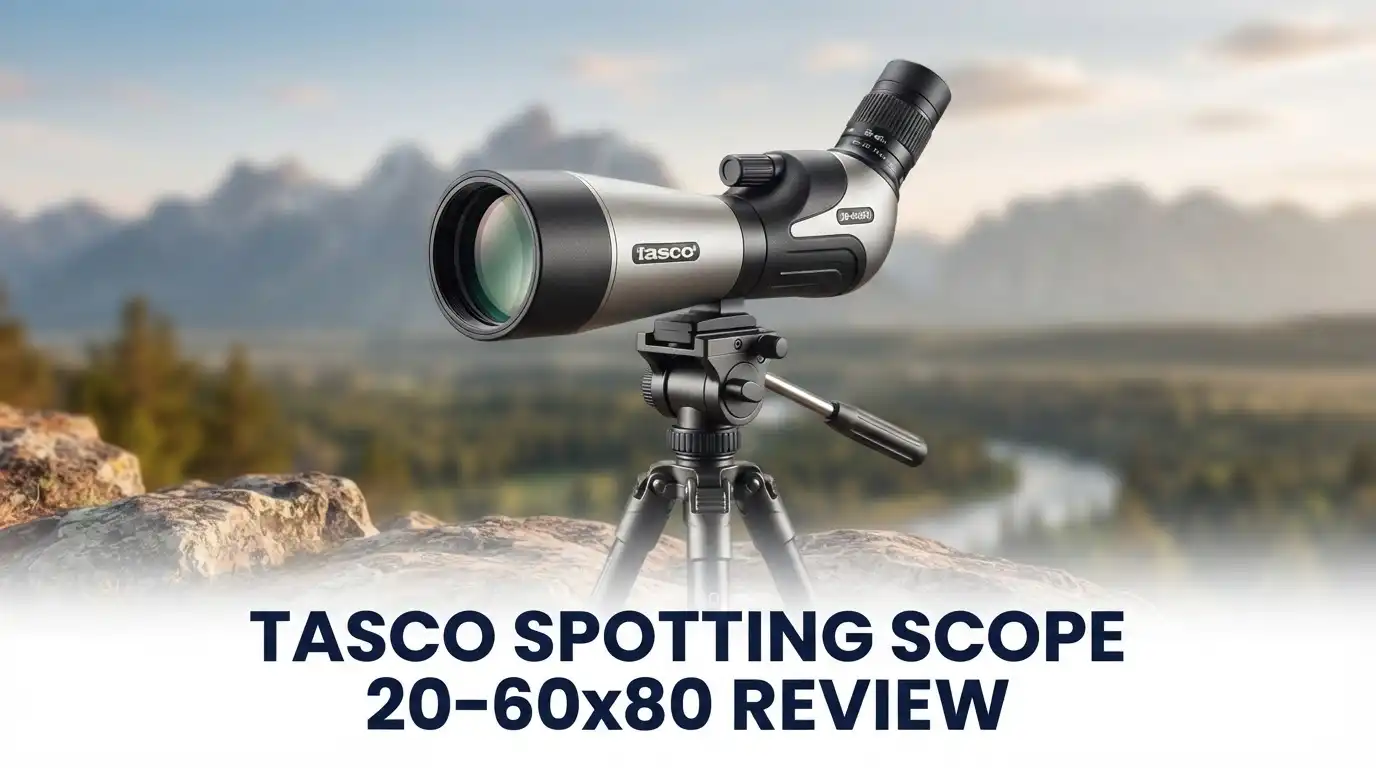
Core specs are straightforward. You get an 80mm objective lens, a 20x to 60x zoom eyepiece, fully coated optics, and a porro prism design. The body measures roughly 17 inches long and weighs close to 3 pounds without the tripod. Tasco rates it as waterproof and fogproof, though real world results vary.
What makes it interesting is the aperture. An 80mm front lens at this price point is unusual. Most scopes under this budget use 60mm or 65mm glass. The extra aperture pulls in noticeably more light, and that matters during the two hours that hunters and birders care about most.
Unboxing Experience: What Actually Comes In The Box
The box arrives plain and functional. Tasco does not chase a premium unboxing moment, and that is fine at this price. Inside you find the scope body wrapped in a thin foam sleeve, a soft nylon carry case, a compact tabletop tripod, lens caps, and a short instruction leaflet.
My first impression was surprise at the size. The scope looks and feels bigger than the photos suggest. The rubber armor covers most of the barrel and gives it a grippy, slightly tacky texture that resists sweaty hands.
The soft case is basic. It has a zipper, a shoulder strap, and minimal padding. It protects against dust and scratches, not drops. Some sellers include a hard case instead, so check your listing carefully before ordering.
The tripod comes folded in a separate compartment. It is small, light, and clearly an accessory rather than a feature.
Build Quality And Design Impressions
The chassis feels solid for the money. Tasco uses a polymer body shell with rubber armor over the high contact zones. Nothing rattles when you shake it. The zoom collar and focus wheel both stay put once set, which is not always true of cheap optics.
The 45 degree angled eyepiece is the right choice for most users. It reduces neck strain during long sessions and makes tripod height less critical. The rotating tripod collar is a genuinely useful touch. You can loosen it, roll the scope, and reposition the eyepiece for prone shooting or steep uphill viewing.
Weak points show up in the details. The lens caps fit loosely and pop off inside a pack. The sliding sunshade moves with a gritty feel. The eyecup twists, but it does not lock firmly at each position. These are small annoyances, not deal breakers.
Top 3 Alternative For Tasco Spotting Scope 20-60×80


Last update on 2026-07-01 / Affiliate links / Images from Amazon Product Advertising API Some of the links on this website are affiliate links, which means that at no additional cost to you, I earn a commission if you click through and make a purchase. I only recommend products and services that I believe will add value to my readers. Thank you for your support!
Celestron Ultima 20-60×80 Angled Spotting Scope

Last update on 2026-09-13 / Affiliate links / Images from Amazon Product Advertising API Some of the links on this website are affiliate links, which means that at no additional cost to you, I earn a commission if you click through and make a purchase. I only recommend products and services that I believe will add value to my readers. Thank you for your support!
Athlon Optics Talos 20-60×80 Spotting Scope with Tripod

Last update on 2026-09-13 / Affiliate links / Images from Amazon Product Advertising API Some of the links on this website are affiliate links, which means that at no additional cost to you, I earn a commission if you click through and make a purchase. I only recommend products and services that I believe will add value to my readers. Thank you for your support!
Gosky Updated 20-60×80 Spotting Scope with Tripod and Phone Adapter
Optical Performance And Image Clarity
Here is where honesty matters. The Tasco uses fully coated optics, not fully multi coated or ED glass. That single fact explains most of its behavior.
At 20x the image looks bright, wide, and pleasing. Contrast holds up well in daylight. The center 70 percent of the field stays sharp, and colors look natural enough for general use.
Push the zoom higher and the picture changes. Around 45x the image softens noticeably. At 60x you see reduced brightness, visible chromatic aberration on high contrast edges, and a narrower field that makes tracking moving subjects harder.
My practical advice: treat this as a 20x to 40x scope with a 60x emergency setting. Used that way, it performs well above its price. Used at maximum power all the time, it will disappoint you.
Edge softness is present at all magnifications. Center the subject and it mostly disappears.
Magnification Range Tested At Real Distances
I tested the Tasco on paper targets and natural subjects at measured distances.
At 100 yards, .22 caliber holes in white paper were visible at 30x in good light. That single capability justifies the purchase for many range shooters. At 200 yards, .30 caliber holes were readable at 40x to 50x with steady light. Mirage became the limiting factor before optics did.
At 300 yards, spotting bullet holes became guesswork. You can see impact splash on steel and dirt, but paper holes disappeared. At 500 yards the scope shows target frames and silhouettes clearly, though hole spotting is off the table.
For wildlife, a deer at 400 yards showed clear body shape and antler outline at 40x. Judging fine antler detail or reading ear tags was not realistic. Heat shimmer affects this scope the same way it affects expensive glass.
Focusing System And How It Handles
The Tasco uses a single knob focus wheel positioned on top of the body, near the eyepiece end. It is a coarse focuser without a fine focus second stage.
The wheel turns smoothly with light resistance. Travel from close focus to infinity takes roughly one and a half turns, which is quick. Quick focus helps when tracking moving animals. It hurts when you want precision at 60x.
At high magnification the depth of field shrinks dramatically. A tiny nudge of the wheel swings you from sharp to blurry. Getting critical focus at 60x takes patience and a genuinely steady tripod.
Close focus lands around 30 feet, which is typical for this class. Butterfly and insect watchers should look elsewhere. The focus wheel also sits close to the body, so gloved hands feel cramped in cold weather.
Eye Relief, Eyepiece And Eyeglass Users
The zoom eyepiece is built into the scope and cannot be swapped. That keeps cost down and limits future upgrades.
Eye relief measures roughly 18mm at low power and shrinks as you zoom in. Eyeglass wearers will see some field loss above 40x. The rubber eyecup folds down, which helps, but it does not solve the problem completely.
The eyepiece opening feels a bit small compared with modern scopes that use 50mm or 55mm wide eyepieces. Finding the sweet spot behind the glass takes a moment. Once you settle in, blackouts are uncommon.
Eye strain builds over long sessions, especially at maximum zoom. I found 20 to 30 minute viewing blocks comfortable, with breaks in between. The 45 degree angle genuinely reduces fatigue compared with straight body designs.
Weatherproofing And Durability Reality Check
Tasco markets this scope as waterproof and fogproof. Real world feedback tells a more careful story.
The scope handles rain, snow, and heavy humidity without trouble in most cases. Owners report years of use in wet hunting conditions with no internal fogging. Occasional reports of fogging do exist, usually after rapid temperature swings or submersion.
My recommendation is simple. Treat it as weather resistant rather than dive proof. Do not dunk it in a creek and expect dry optics afterward.
Rubber armor resists scuffs well. The paint and lettering on the barrel wear faster than the body itself, so a well used unit looks older than it performs. Nitrogen purging quality varies between production runs, which is a common trait of budget optics built to a price point.
The Included Tripod: The Honest Truth
The bundled tabletop tripod is the weakest component in the package, and it is not close.
It stands about 8 to 10 inches tall with aluminum legs and a small pan head. On a solid shooting bench it works. Set it on grass, gravel, or a truck tailgate in wind and the image vibrates constantly at high power.
Plan on buying a real tripod. A basic fluid head tripod rated for 6 to 8 pounds transforms this scope. Suddenly 50x becomes usable and focusing feels precise instead of frustrating.
The scope uses a standard quarter inch mounting thread, so almost any camera tripod works. This one upgrade delivers more improvement than any other change you can make. Skipping it is the most common mistake new owners make with this package.
Performance For Target Shooting At The Range
Range use is where the Tasco earns its keep. Most owners buy it for exactly this job.
The 80mm objective handles harsh midday glare well. The sunshade helps cut washout when shooting toward bright backgrounds. Holes in paper at 100 yards show clearly at 30x to 40x. That covers the majority of rifle and pistol practice.
Steel target users get instant feedback on splash and paint chips. The wide 20x field makes finding your target fast, which matters when you have a limited range window.
Limitations appear with small calibers at distance. Pellet and .17 caliber holes at 200 yards are hard to resolve. Black targets and shaded backstops also reduce contrast noticeably. For a bench rest shooter working inside 200 yards, though, this scope does the job without complaint.
Performance For Birding And Wildlife Viewing
Casual wildlife watchers will enjoy this scope. Dedicated birders will feel the compromises.
Waterfowl on a pond at 200 yards look great at 30x. Raptors on a distant perch show body shape, posture, and general markings. Deer, elk, and antelope are easy to find and follow across open country.
The problem is fine detail. Subtle plumage colors and feather edge patterns lose definition because of chromatic aberration and limited coating quality. Identifying similar sparrow species by small field marks is asking too much.
Low light performance is better than expected thanks to the aperture. The last thirty minutes of legal light stay usable, which many cheaper 60mm scopes cannot claim.
Bring realistic expectations and you will use this scope happily for years of casual observation.
Digiscoping And Phone Photography
The Tasco 20-60×80 does not include a phone adapter, and that is a real omission in 2026. Competitors at similar prices bundle one.
Third party universal adapters do fit the eyepiece with some fiddling. Once mounted, you can capture recognizable photos and video of distant subjects. Expect vignetting at low power and softness at high power. The images work fine for social sharing and hunt documentation.
Results improve if you zoom the scope to roughly 30x and let the phone do minimal digital zooming. Keeping the optical center aligned takes practice.
Serious digiscoping demands ED glass and a stable tripod head. This scope produces snapshots, not portfolio images. If phone photography is your main goal, one of the alternatives listed above will frustrate you less.
What The Tasco 20-60×80 Does Not Do Well
An honest review needs a clear list of weaknesses. Here they are.
The 60x setting is mostly marketing. Image quality at maximum zoom drops enough that most users stop at 40x. Chromatic aberration shows on any high contrast edge, including branches against sky and black bullseyes on white paper.
The included tripod is inadequate for anything above 30x outdoors. The lens caps fall off too easily. The soft case offers little impact protection.
Quality control varies between units. Some owners receive scopes with perfect collimation and smooth focus. Others report stiff zoom collars or slight image doubling.
There is no fine focus knob, which limits precision work. The eyepiece is fixed, so you cannot upgrade later. Long eye relief is not sufficient for comfortable full field viewing with glasses at high power.
Pros And Cons Of The Tasco 20-60×80
Pros
- Large 80mm objective delivers real low light advantages over 60mm budget scopes
- Excellent price for the aperture size, often well under comparable models
- Bright and sharp view from 20x through roughly 40x
- Rotating tripod collar allows flexible eyepiece positioning for prone or elevated viewing
- Comfortable 45 degree angled eyepiece reduces neck fatigue during long sessions
- Rubber armor and weather resistant construction handle field abuse
- Resolves .22 caliber holes at 100 yards in good light
- Lightweight enough at roughly 3 pounds for short hikes
- Simple controls with nothing to learn or configure
Cons
- Image softness and color fringing at 50x to 60x
- Included tabletop tripod vibrates and limits high power use
- Fully coated optics only, no ED or fully multi coated glass
- No phone adapter included in most packages
- Single speed focus wheel with no fine adjustment
- Loose fitting lens caps that detach in packs
- Fixed eyepiece prevents future optical upgrades
- Inconsistent quality control between individual units
- Limited eye relief for eyeglass wearers at high magnification
Who Should Buy This Scope In 2026
The Tasco 20-60×80 fits specific buyers very well.
Buy it if you shoot at a range inside 200 yards and want to stop walking downrange. Buy it if you need a first spotting scope and cannot justify spending three hundred dollars or more. Buy it if you want maximum aperture for the least money.
Skip it if you identify birds by subtle field marks. Skip it if you plan serious phone photography. Skip it if you need reliable hole spotting past 300 yards.
Value depends heavily on what you pair it with. Add a sturdy tripod and this becomes a genuinely capable setup. Use the bundled tripod only and you will wonder why the image never looks sharp.
For hunters who need a lightweight glassing option for open country scouting, it earns a place in the truck.
Final Verdict: Is The Tasco 20-60×80 Worth It?
Last update on 2026-09-28 / Affiliate links / Images from Amazon Product Advertising API Some of the links on this website are affiliate links, which means that at no additional cost to you, I earn a commission if you click through and make a purchase. I only recommend products and services that I believe will add value to my readers. Thank you for your support!
My overall rating is 3.8 out of 5 for the price bracket it occupies.
The Tasco 20-60×80 is an honest budget scope with one standout feature and one obvious flaw. The 80mm aperture is the standout. It gives you brightness that similarly priced 60mm scopes simply cannot match. The flaw is optical quality at high magnification, driven by basic lens coatings.
Judged against premium glass, it loses badly. Judged against its actual price, it performs well. That distinction matters.
If your budget is fixed and your distances are moderate, this scope solves your problem. If you can stretch further, the Celestron Ultima or Athlon Talos give you better coatings and better resolution at 60x.
Buy it with clear expectations, add a real tripod, and you will get years of useful service.
Frequently Asked Questions
Is the Tasco 20-60×80 good for 1000 yards?
No. At 1000 yards you can see target frames and large silhouettes, but you cannot spot bullet holes in paper. Atmospheric distortion and the scope’s resolution limits both work against you. For 1000 yard use, a high end scope with ED glass is necessary, and even then hole spotting depends on conditions.
Can you see bullet holes at 100 yards?
Yes. Most owners report clearly seeing .22 caliber holes in white paper at 100 yards using 30x to 40x magnification in good light. Contrast matters. Black targets and shaded backstops make holes harder to see. A stable tripod improves results significantly.
Is the Tasco 20-60×80 waterproof?
Tasco rates it as waterproof and fogproof. In practice it handles rain and humidity well. A small number of owners report internal fogging after extreme temperature changes. Treat it as weather resistant and avoid submerging it.
Does it come with a tripod?
Most packages include a small tabletop tripod. It works on a solid bench but vibrates outdoors at high magnification. Upgrading to a full size tripod with a fluid head is strongly recommended and costs less than you might expect.
What is the best magnification to use?
The 30x to 40x range gives the best balance of brightness, sharpness, and field of view. Use 20x to locate your subject quickly. Reserve 60x for brief looks under ideal light and very stable support.
How does it compare to the Tasco 20-60×60?
The 80mm version gathers roughly 78 percent more light than the 60mm version. That translates to a brighter image, especially at dawn and dusk. The tradeoff is more weight and bulk. Optical coatings are similar between the two models.
Can I attach my phone to it?
Yes, with a third party universal phone adapter. No adapter is included in most packages. Photo quality is adequate for sharing but shows vignetting and softness. Keep magnification near 30x for the best results.

Hello, I’m Emily Price, the founder of Birds Affection. As a passionate bird enthusiast and spiritual seeker, I’ve always been fascinated by the symbolic meanings and mystical connections between birds and our lives. On this website, I share my knowledge and insights on the spiritual significance of various bird species, exploring their roles as messengers, guides, and teachers. Through my writing, I aim to inspire and educate others on the profound wisdom and beauty that birds bring to our world. Join me on this journey as we delve into the enchanting realm of bird symbolism and discover the hidden meanings behind these magnificent creatures.