
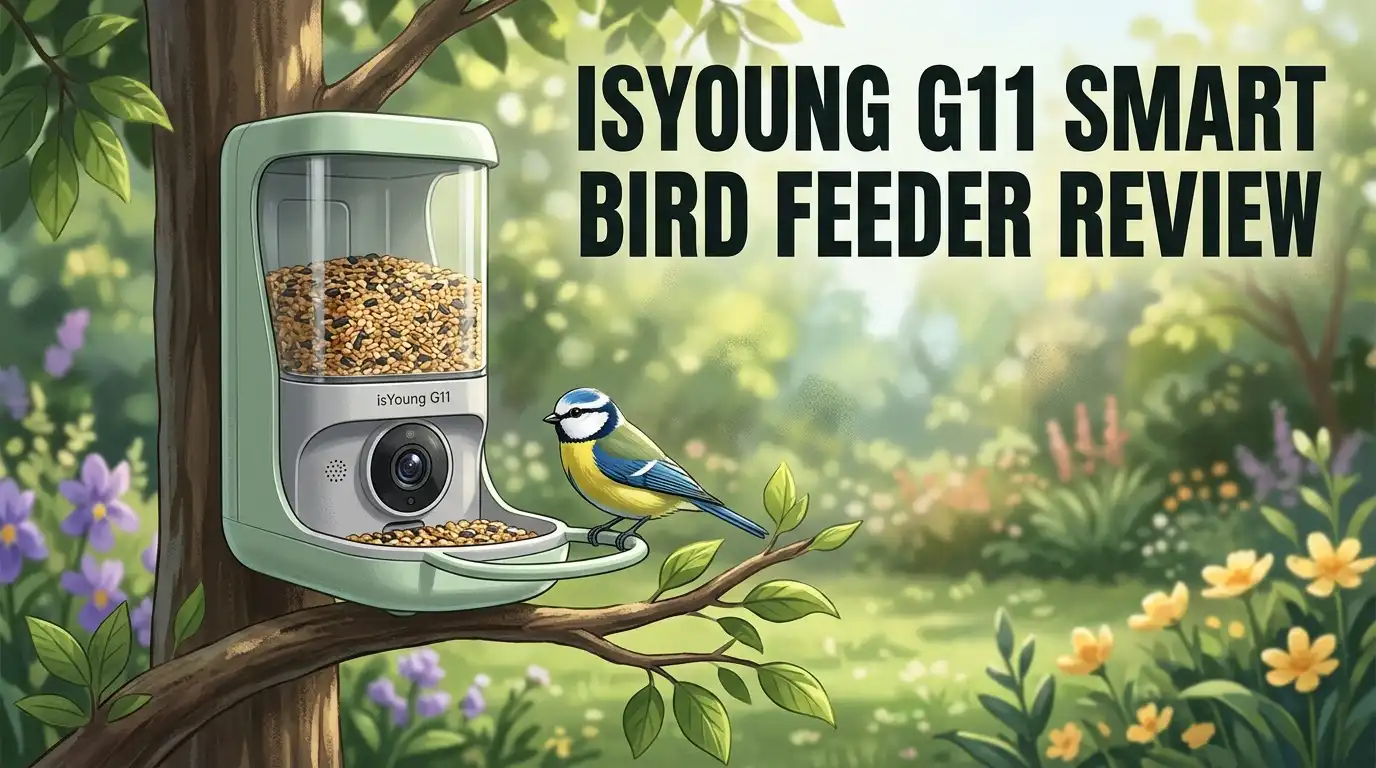
isYoung G11 Smart Bird Feeder Review 2026: Worth Buying?
Backyard birdwatching changed the moment cameras got small enough to sit inside a feeder. The isYoung G11 Smart Bird Feeder is one of the newer attempts at that idea, and it arrives with bold claims: 2.5K video, AI that recognizes more than 16,000 species, a 5W solar panel, and dual night vision.
That sounds impressive on a product page. The real question is whether it holds up after a few weeks of rain, squirrels, and 3 a.m. motion alerts.
This review covers the unboxing, the setup, the picture quality, the subscription costs, and the parts that genuinely annoyed me. If you want a smart feeder that works without constant fiddling, keep reading.
In a Nutshell:
- Picture quality punches above its price. The 2.5K sensor with a 170 degree field of view captures sharp feather detail on cardinals, finches, and chickadees. Daylight footage looks genuinely lovely, and the wide angle means birds rarely wander out of frame.
- AI identification works well, but not perfectly. The app claims 16,000 plus species. In practice it nails common backyard visitors quickly. It gets confused by sparrows, juvenile birds, and anything photographed from behind. Expect roughly 80 to 85 percent accuracy in real conditions.
- Solar charging reduces the hassle, it does not remove it. The 5W panel plus 5000mAh battery keeps the feeder alive through sunny stretches. Shady yards and short winter days still require manual charging every few weeks.
- The subscription is the sting. You get a free trial month. After that, full AI recognition and cloud storage move behind a paid plan. Budget for this before you buy.
- Squirrels remain undefeated. The G11 is not marketed as a squirrel proof feeder, and it is not one. A dedicated baffle on your pole is close to mandatory.
- Best for: curious beginners, families with kids, and gift buyers who want a fun, affordable entry into camera feeders rather than professional grade birding gear.
isYoung G11 Smart Bird Feeder: Full Overview

Last update on 2026-08-27 / Affiliate links / Images from Amazon Product Advertising API Some of the links on this website are affiliate links, which means that at no additional cost to you, I earn a commission if you click through and make a purchase. I only recommend products and services that I believe will add value to my readers. Thank you for your support!
The G11 sits in the midrange of the smart feeder market. It pairs a weather sealed camera module with a feeding tray, a sloped roof, and a removable solar panel on top.
The headline specs include a 2.5K QHD camera, a 170 degree viewing angle, a 5000mAh rechargeable battery, IP65 water resistance, and 2.4GHz WiFi connectivity. The feeder uses a dual granary design, meaning you can load two different seed types and serve them separately.
isYoung positions this as an all in one birdwatching station. Motion detection triggers recording, the app sends an alert, and the AI attempts to name the visitor. You get a tiny nature documentary filmed in your own yard. The design choices feel practical rather than flashy, and the feeder clearly targets buyers who want results without a steep learning curve.
Unboxing the G11: First Impressions
The box arrives compact and surprisingly heavy for its size. Inside, isYoung packs everything in molded foam, which is reassuring given the camera inside.
You get the feeder body, the detachable camera unit, the solar panel roof, a mounting strap for trees, a pole mount bracket, screws, a USB C charging cable, and a short printed guide with a QR code for the app.
The first thing I noticed was the plastic. It is ABS, and it feels sturdy rather than premium. There is no wobble in the roof, the seams line up, and the seed chamber lid clicks shut with a satisfying snap. The camera module slides out with a simple release, which makes indoor charging easy.
My one gripe at unboxing: the printed manual is thin and the diagrams are small. Most people will end up watching a setup video instead.
Setup and App Pairing: How Long Does It Take?
Setup took me about twenty minutes including mounting. You download the companion app, create an account, charge the camera to full, then scan a QR code that the app generates on your phone screen. Hold the phone in front of the camera lens, wait for the chime, and the pairing completes.
One important detail trips up a lot of buyers: the G11 only connects to 2.4GHz WiFi. It will not see a 5GHz network. If your router broadcasts both bands under one name, you may need to temporarily split them or disable 5GHz during pairing.
Mounting is straightforward. The strap handles tree trunks, and the bracket fits standard poles. Pick your spot carefully. Facing the camera north or east avoids harsh backlight and keeps midday footage from blowing out.
Top 3 Alternatives for isYoung G11 Smart Bird Feeder

Last update on 2026-08-27 / Affiliate links / Images from Amazon Product Advertising API Some of the links on this website are affiliate links, which means that at no additional cost to you, I earn a commission if you click through and make a purchase. I only recommend products and services that I believe will add value to my readers. Thank you for your support!
Birdbuddy Pro Solar Smart Bird Feeder with Camera


Last update on 2026-07-01 / Affiliate links / Images from Amazon Product Advertising API Some of the links on this website are affiliate links, which means that at no additional cost to you, I earn a commission if you click through and make a purchase. I only recommend products and services that I believe will add value to my readers. Thank you for your support!
Birdfy 2 Pro Solar Smart Bird Feeder Camera with Dual Lens

Last update on 2026-07-01 / Affiliate links / Images from Amazon Product Advertising API Some of the links on this website are affiliate links, which means that at no additional cost to you, I earn a commission if you click through and make a purchase. I only recommend products and services that I believe will add value to my readers. Thank you for your support!
HARYMOR Bird Feeder with Camera, 2K Live Video, Solar Powered
Camera Quality: Is 2.5K Actually Sharp?
Yes, in good light it genuinely is. The 2.5K sensor resolves individual feather barbs on a house finch sitting on the perch. Colors lean slightly warm, which flatters cardinals and goldfinches.
The 170 degree field of view is the real advantage here. Birds land anywhere on the tray and still appear fully in frame, which smaller angle cameras often fail to do.
Detail softens once the sun drops. Evening clips show visible noise, and fast wing movement produces motion blur. This is normal for a sensor this size and this price.
A practical tip: clean the lens weekly. Pollen, seed dust, and rain spots accumulate fast on an outdoor feeder, and a hazy lens ruins otherwise excellent footage. Thirty seconds with a microfiber cloth makes a visible difference.
AI Bird Identification: Does It Recognize 16,000 Species?
The marketing number is 16,000 plus species. That figure reflects the size of the reference database, not the accuracy you will see in your yard. Common North American visitors get identified reliably. Blue jays, cardinals, mourning doves, tufted titmice, and downy woodpeckers all registered correctly and fast.
Accuracy drops with difficult subjects. Sparrow species blur together. Juvenile birds in transitional plumage confuse the system. Any bird photographed from behind, or partially hidden behind the seed tray, often returns a wrong guess or no guess at all.
My honest estimate sits around 80 to 85 percent correct on everyday backyard traffic. That is useful and fun, but it is not a replacement for a field guide. Treat the AI as a helpful assistant rather than an authority.
Solar Power and Battery Life in Real Conditions
The 5000mAh battery and 5W solar panel form a decent partnership. In a sunny yard with moderate bird traffic, the G11 held its charge indefinitely through spring and summer. The panel topped up faster than the camera drained.
Winter tells a different story. Short days, low sun angles, and snow on the panel all cut charging dramatically. Place the feeder under a dense tree canopy and the solar contribution becomes close to decorative. In those conditions, expect to pull the camera module and charge it every two to four weeks.
Heavy motion activity also drains the battery faster. A busy feeder recording fifty clips a day uses far more power than a quiet one. Adjusting motion sensitivity down one notch extends runtime noticeably without missing real visitors.
Night Vision and Low Light Performance
The G11 offers two night modes. Infrared produces black and white footage up to roughly seven meters without disturbing wildlife. White light mode produces color footage but illuminates the area, which can startle nocturnal visitors.
Birds rarely feed at night, so this feature matters mostly for other guests. Raccoons, opossums, flying squirrels, and the occasional deer all showed up in my night clips. Infrared is the mode to use if you want honest observation rather than scared animals.
Image quality at night is serviceable, not spectacular. You can identify a raccoon easily. You could not identify a specific bird species from infrared footage alone. The white light mode produces better detail but attracts insects, which then trigger more motion alerts. Pick your trade off.
Food Capacity and the Dual Granary Design
The split seed chamber is one of the smarter features on this feeder. You load two seed types, and each dispenses to its own side of the tray. Fill one side with black oil sunflower seed and the other with safflower or nyjer, and you attract a wider mix of species.
Total capacity sits around 1.5 to 2 liters depending on seed density. That lasts roughly three to five days in an active yard during peak season. Refilling takes seconds thanks to the hinged lid.
The sloped roof keeps rain off reasonably well. I still found damp seed near the bottom after prolonged storms. Fill the chamber only halfway during wet weeks so seed moves through faster and does not sit long enough to clump or mold.
App Experience, Storage, and Subscription Costs
The app handles live viewing, clip playback, species logging, and notification settings. It is functional and clean, though not as polished as the apps from Bird Buddy or Birdfy. Occasional loading delays occur when scrolling through a long clip library.
Storage works two ways. A microSD card slot gives you local recording with no ongoing fee. Cloud storage and the full AI recognition features sit behind a subscription, with a free trial month included at purchase.
This is the part buyers complain about most, and the complaint is fair. The feeder still works without a subscription, recording and streaming normally. You lose the automatic species naming and cloud backup, which are the features most people bought the thing for in the first place.
Weather Resistance and Build Quality
The IP65 rating means dust tight construction and protection against water jets from any direction. In practice the G11 survived thunderstorms, a week of humidity, and a light snow without issue. Seals around the camera module held up.
IP65 does not mean submersible. Do not mount this feeder where sprinklers hit it directly at close range, and do not leave it sitting in standing water.
The ABS plastic resists UV fading better than cheaper feeders, though I would expect some color dulling after two or three seasons in full sun. Screws and brackets are coated steel. One weak point: the plastic perch flexes slightly under heavier birds like grackles. It has not broken, but it is the part I would watch.
What the G11 Does Not Do Well
Honest reviews name the flaws, so here they are. The G11 is not squirrel proof. Nothing about the design stops a determined squirrel from emptying the tray. You need a pole baffle.
Connectivity is fragile at distance. The 2.4GHz radio struggles past roughly sixty feet with walls in between. Live streams stutter or fail to load entirely at the edge of range.
Notification spam is real out of the box. Wind moving branches, falling leaves, and insects all trigger alerts until you tune the sensitivity settings.
The AI misidentifies sparrows and juveniles regularly. Night footage is grainy. The app lags occasionally. And the subscription model irritates buyers who expected full functionality for the purchase price. None of these are deal breakers, but all of them are real.
Pros and Cons of the isYoung G11
Pros
- Sharp 2.5K daytime video with excellent color and detail
- Wide 170 degree angle keeps birds in frame reliably
- Dual seed chambers attract a broader mix of species
- Solar panel plus 5000mAh battery handles sunny months without intervention
- IP65 build survived real storms without water intrusion
- MicroSD slot allows local storage with no recurring fee
- Simple twenty minute setup with removable camera for easy charging
- Strong value compared to premium competitors
Cons
- Subscription required for full AI recognition and cloud storage
- No squirrel protection built into the design
- 2.4GHz only, with limited range and no 5GHz support
- AI struggles with sparrows, juveniles, and rear angle shots
- Night vision footage is grainy and low in detail
- App performance lags during long clip library scrolling
- Winter solar charging is weak in shaded locations
- Perch flexes under larger birds
Who Should Buy the isYoung G11?
This feeder suits beginners and casual birdwatchers more than serious birders. If you want to see what visits your yard, share clips with family, and learn a dozen new species names, the G11 delivers that experience at a friendly price.
It also makes a strong gift. Kids love the notification alerts, and the setup is simple enough that a nontechnical recipient will not need help.
Skip it if you need professional image quality, if your WiFi barely reaches the yard, or if you refuse subscription software on principle. Serious birders tracking rare species will want the dual lens precision of a Birdfy 2 Pro or the refined ecosystem around Bird Buddy instead. The G11 is the sensible middle choice, not the maximum one.
Final Verdict: Is the G11 Worth It in 2026?
The isYoung G11 earns a recommendation with clear conditions attached. The hardware delivers more than the price suggests. Video quality, field of view, build durability, and the dual chamber design all perform well. Setup is painless. Solar charging genuinely reduces maintenance during most of the year.
The software is where it stumbles. AI accuracy is good rather than great, the app needs polish, and the subscription gate frustrates buyers who expected everything included.
My overall rating sits at 4 out of 5. Buy it if you want an affordable, enjoyable window into your backyard and you accept a modest ongoing cost. Buy a baffle at the same time. Place it in sunlight, within solid WiFi range, and you will get months of genuine delight from it.
Frequently Asked Questions
Does the isYoung G11 require a subscription to work?
No. The feeder records, streams live video, and sends motion alerts without any subscription. A microSD card stores footage locally at no cost. The subscription unlocks automatic AI species identification and cloud storage. A free trial month comes included, so you can test the full experience before deciding.
Will the G11 connect to a 5GHz WiFi network?
No. The camera supports 2.4GHz networks only. If your router combines both bands under a single network name, temporarily disable the 5GHz band during pairing or create a separate 2.4GHz network. This is the single most common setup problem owners report.
How often do I need to refill the seed?
Expect three to five days in an active yard with the chambers filled. Quiet periods stretch that longer. During wet weather, fill only halfway so seed does not sit long enough to absorb moisture and clump.
Is the isYoung G11 squirrel proof?
No. The design includes no squirrel deterrent mechanism. Mount the feeder on a pole with a baffle, position it at least ten feet from trees and fences, and consider safflower seed, which squirrels generally dislike.
How long does the battery last between charges?
In full sun with moderate traffic, the solar panel keeps it charged indefinitely. In shade or during winter, plan on removing the camera module and charging it every two to four weeks. Lowering motion sensitivity extends runtime meaningfully.
Can multiple people view the camera feed?
Yes. The app supports sharing access with family members, so several people can view live footage and receive alerts from the same feeder.

Hello, I’m Emily Price, the founder of Birds Affection. As a passionate bird enthusiast and spiritual seeker, I’ve always been fascinated by the symbolic meanings and mystical connections between birds and our lives. On this website, I share my knowledge and insights on the spiritual significance of various bird species, exploring their roles as messengers, guides, and teachers. Through my writing, I aim to inspire and educate others on the profound wisdom and beauty that birds bring to our world. Join me on this journey as we delve into the enchanting realm of bird symbolism and discover the hidden meanings behind these magnificent creatures.


