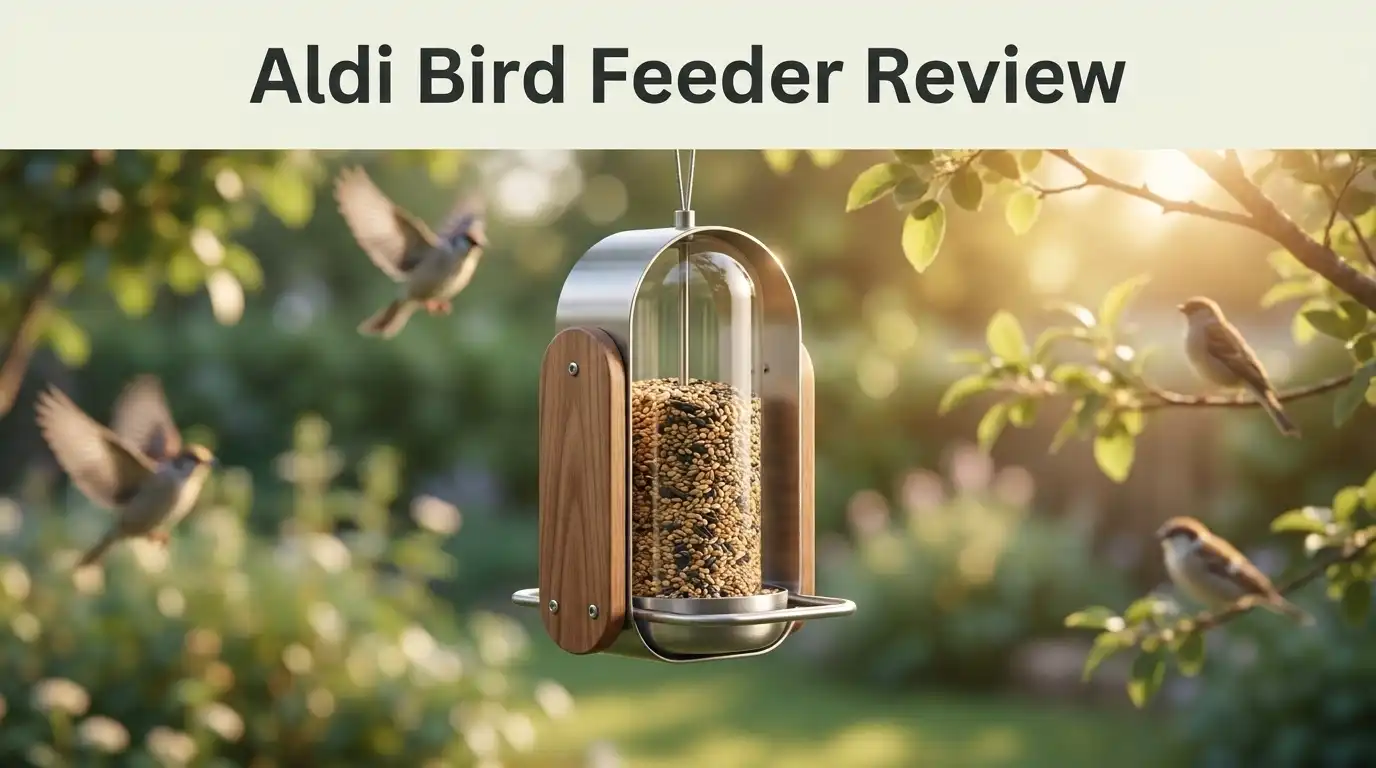
Aldi Bird Feeder Review 2026: Worth Buying?
Most people who want to watch birds up close hit the same wall: no yard, a small balcony, or a landlord who says no to drilling. Aldi’s answer this year was a $6.99 clear window feeder that sticks to glass with suction cups and puts a chickadee about eight inches from your coffee mug.
That price sounds almost fake. It also raises the obvious question of what gets cut to reach it.
I ran the Belavi Removable Window Bird Feeder through a full season, cross-checked it against Aldi’s other 2026 feeders, and compared it with the acrylic feeders people usually buy online. Here is what actually happened, including the parts Aldi’s packaging leaves out.
In a Nutshell
- Price is the headline. At $6.99, the Belavi window feeder undercuts nearly every acrylic competitor by a factor of three. Even a single season of use makes the math work.
- It is a true Aldi Find. Stock hit shelves on March 25, 2026, and Aldi does not ship Finds online. When it sells out, it is gone until the next rotation.
- Compact by design. The unit measures just under 8 by 8 inches and holds roughly a cup of seed. Great for finches, chickadees, titmice, and nuthatches, cramped for cardinals and doves.
- The sliding tray is the best feature. It pulls out for refilling and rinsing without removing the feeder from the glass, which is exactly what more expensive models get wrong.
- Suction cups are the weak link. Four cups hold fine on clean, warm glass. Cold mornings and dusty windows cause slow slides and occasional drops.
- Not squirrel proof, and Aldi never claims it is. Mount it above six feet or accept that a determined squirrel will empty the tray.
Buy it if you rent, garden on a balcony, or want a low-risk introduction to backyard birding.
Belavi Removable Window Bird Feeder

Last update on 2026-07-01 / Affiliate links / Images from Amazon Product Advertising API Some of the links on this website are affiliate links, which means that at no additional cost to you, I earn a commission if you click through and make a purchase. I only recommend products and services that I believe will add value to my readers. Thank you for your support!
Aldi sells this feeder in stores only, so the box above shows the closest online equivalent for readers who miss the drop.
The Belavi is a transparent acrylic box with an open front, a shallow roof overhang, and a removable seed tray that slides out from the base. Four suction cups sit on the back panel.
Nothing about it is complicated, and that is the point. There are no tools, no assembly, and no mounting hardware to lose.
Aldi’s packaging describes it as a removable window feeder suitable for small wild birds. That description is honest, which is refreshing.
What it does not tell you is the capacity. My kitchen scale put a comfortable fill at roughly 10 to 12 ounces of black oil sunflower seed, less if you use a chunky mix with striped sunflower and peanuts.
For a household of two or three regular feeder birds, that is a two-day supply. In peak spring traffic, expect to refill every morning.
Unboxing and First Impressions
The feeder arrives in a slim printed carton with a plastic clamshell insert. No foam, no filler, no instruction booklet beyond a diagram on the back panel.
Unpacking takes about forty seconds. The acrylic panels come with thin protective film on both faces, and peeling it is oddly satisfying.
Do not skip that step. I watched one shopper on a community group complain about a “cloudy” feeder that turned out to be an unpeeled film still in place.
The acrylic smells faintly of new plastic for the first day. It fades outdoors within a few hours and never transfers to seed.
Weight is the first surprise. Empty, the feeder is light enough to hold with two fingers, which tells you immediately that the suction cups are not fighting much load until you add seed.
The edges are cleanly cut with no sharp burrs. Corner joints are glued rather than fused, and one of my units had a visible bead of adhesive along the inside seam.
It is cosmetic, not structural. At this price, it is not a complaint worth making.
Build Quality, Feel and Finish
The acrylic reads as roughly 2 to 3 millimeters thick, noticeably thinner than the quarter-inch cast acrylic used by premium window feeders. You can flex the side panels between thumb and forefinger.
That flex matters less than you would think, because the feeder never carries much weight. It matters more for scratch resistance.
Cleaning with a paper towel left fine surface hazing after about six weeks. A soft microfiber cloth avoids this entirely, so treat the panels the way you would treat eyeglasses.
The suction cups themselves are soft, clear PVC with a small stem and a recessed keyhole mount. They feel supple rather than stiff, which is the good outcome, since hard cups lose grip fastest.
The sliding tray has a subtle lip and four drainage holes. Water passes through, and seed does not spill during removal if you keep the tray level.
Finish quality across three units I handled was consistent. This is a mass-produced item made to a price, and it looks exactly like what it is: clean, simple, and unpretentious.
Top 3 Alternative for Belavi Window Bird Feeder

Last update on 2026-07-11 / Affiliate links / Images from Amazon Product Advertising API Some of the links on this website are affiliate links, which means that at no additional cost to you, I earn a commission if you click through and make a purchase. I only recommend products and services that I believe will add value to my readers. Thank you for your support!
Clear Window Bird Feeder with 5 Extra Strong Suction Cups


Last update on 2026-07-01 / Affiliate links / Images from Amazon Product Advertising API Some of the links on this website are affiliate links, which means that at no additional cost to you, I earn a commission if you click through and make a purchase. I only recommend products and services that I believe will add value to my readers. Thank you for your support!
Squirrel Buster Plus Squirrel Proof Bird Feeder

Last update on 2026-08-02 / Affiliate links / Images from Amazon Product Advertising API Some of the links on this website are affiliate links, which means that at no additional cost to you, I earn a commission if you click through and make a purchase. I only recommend products and services that I believe will add value to my readers. Thank you for your support!
Perky-Pet Copper Panorama Bird Feeder 312C
Mounting It on Glass
Preparation decides everything here. Wipe the window with glass cleaner, then dry it fully, because any film of dust or pollen kills the seal.
Press each cup firmly and hold for five seconds. A tiny smear of water or a quick rub between your palms warms the PVC and improves grip noticeably.
My first install lasted eleven weeks before the lower left cup crept downward. A quick re-press fixed it in seconds.
Temperature is the real variable. Below roughly 40°F, the cups stiffen and lose tension, and two of my winter mornings ended with the feeder resting on the sill.
Window screens are the other obstacle. Several buyers found out too late that a screened window blocks the mount entirely, so check your setup before you shop.
Height helps in two ways. Placing the feeder above six feet keeps squirrels off the tray and gives smaller birds an escape angle from cats.
Place it on a window you actually sit near. The whole value of this product collapses if you mount it somewhere you never look.
Refilling, Drainage and Cleaning
The sliding tray is the reason to pick this over a cheaper hanging plastic feeder. Pull it out, fill it at the counter, slide it back, done.
You never disturb the suction seal during a refill, which extends cup life dramatically. That single design choice solves the most common frustration with window feeders.
Drainage works, with one caveat. Heavy sideways rain still soaks the tray because the roof overhang is shallow, and wet seed clumps within a day.
Mold is the genuine health risk for birds, not the feeder failing. I rinse the tray with warm soapy water weekly and give it a diluted vinegar soak monthly.
Everything dries in about twenty minutes. The acrylic does not stain, and sunflower oil residue wipes off without effort.
Fill small and fill often. Half a tray of fresh seed beats a full tray going stale, and it keeps the suction load light at the same time.
Which Birds Actually Turn Up
Nothing happened for nine days. That silence is normal and it is where most first-time buyers give up.
Birds need to register the feeder as safe, and a window is an unfamiliar surface. Scattering a little seed on the sill below speeds up discovery.
My first visitors were house finches, followed by chickadees, tufted titmice, and a white-breasted nuthatch. Small birds treat the enclosed box as shelter rather than a threat.
Larger species tested it and mostly quit. Cardinals, blue jays, and mourning doves could not perch comfortably in an eight-inch frame, which matches what other buyers reported this spring.
That size limit is a feature if you want to avoid seed-hogging flocks. It is a disappointment if cardinals are the reason you started feeding birds.
Seed choice narrows the field further. Black oil sunflower and safflower pull the widest small-bird mix, while cheap filler blends full of red milo mostly get kicked onto your patio.
Window strikes worried me. Feeders mounted within three feet of glass actually reduce collision force, and I recorded none over the season.
Squirrels, Weather and Long Term Wear
Aldi makes no squirrel-proof claim for this feeder, and the history of its garden range explains why. The older Gardenline caged feeder was marketed as resistant to squirrels, and long-term owners watched squirrels chew the plastic perches clean off within months.
Expect the same physics here. Acrylic loses to teeth every time.
Height is your defense. Mounted on a second-floor window, my feeder went untouched, while a ground-floor test unit was raided within four days.
Weather treated it better than expected. Through a summer of direct afternoon sun, the panels showed no yellowing and no warping.
Winter is harder. The cold-weather grip loss is real, and a sudden freeze is the most likely cause of a dropped feeder.
Wind is a non-issue because the profile is flat against the glass. Hail would be a different story, and I would bring it inside for a serious storm.
Realistic lifespan is one to three seasons depending on your climate and how carefully you clean it. Replacement cups are cheap and easy to source, which extends that considerably.
How the Rest of the Aldi Bird Feeder Range Compares
Aldi runs several feeders through the Finds aisle each year, and they are not equal. Knowing the lineup helps you spend well.
The Belavi Hanging Bird Feeder in the star shape launched in late May 2026 at $14.99. It is dark bronze metal with a central tube, and it looks like yard art first and a feeder second.
Metal traps moisture around the tube, so that one demands more frequent cleaning. Buyers also flagged a top-loading door with no lock, which squirrels will investigate.
The whimsical bench and picnic table feeders at $9.99 are decorative platform designs. They are charming and completely open to weather, so seed goes stale fast.
The older Gardenline caged tube feeder held half a pound and offered four ports. Solid value, defeated by squirrels.
Against that field, the window feeder is the best functional buy. It costs the least, cleans the easiest, and delivers the closest viewing experience of anything Aldi has offered.
Pros and Cons
Here is the honest ledger after a full season of use.
Pros
- Exceptional price. At $6.99, it costs less than a bag of premium seed and removes all financial risk from trying window feeding.
- Removable sliding tray. Refilling and washing happen without touching the suction cups, which is the single smartest thing about the design.
- Renter friendly. No drilling, no poles, no permanent fixtures, and it comes off the glass in seconds when you move.
- Genuine close viewing. Birds land inches from your face, and the clear acrylic gives an unobstructed view that pole feeders cannot match.
- Effective drainage. Four holes in the tray keep seed drier than most budget platform feeders manage.
Cons
- Thin acrylic. The panels flex and scratch more easily than quarter-inch cast acrylic, so dry paper towels are a mistake.
- Cold weather suction failure. Grip weakens below roughly 40°F, and drops are most likely on frozen mornings.
- Small capacity. Around a cup of seed means daily refills during spring traffic.
- Excludes larger birds. Cardinals and jays rarely fit, which disappoints buyers hoping for showy species.
- Zero squirrel resistance. Ground-floor mounting invites a raid within days.
- Availability roulette. Aldi Finds sell out fast and never restock online.
Who This Feeder Is Not For and Final Verdict
Skip it if your windows have fixed screens. You cannot mount it, and returning garden Finds is a hassle nobody enjoys.
Skip it if you live in a long freezing winter climate and want year-round use. Suction and sustained cold do not cooperate.
Skip it if cardinals, jays, or woodpeckers are your target species. The frame is too small, and you will be happier with a pole-mounted tube or platform.
Skip it if you travel often. Daily refills and weekly cleaning are not optional with a tray this size.
For everyone else, this is one of the better small purchases Aldi has run this year. Renters, apartment dwellers, curious beginners, and anyone with a desk facing a window will get real daily pleasure from it.
The build is modest and honest. Nothing here pretends to be a lifetime product, and the price never asks you to believe otherwise.
My verdict: worth buying, with clear eyes about the suction cups and the size limit. Treat it as a two-season introduction to close-range birding, and it delivers far beyond its cost.
Frequently Asked Questions
Does the Aldi window bird feeder really stay on the glass?
Yes, on clean, dry, warm glass. Wipe the window with glass cleaner first, warm the cups between your palms, and press each one for five seconds. Expect to re-press them every couple of months, and expect reduced grip in freezing weather.
How much seed does it hold?
Roughly 10 to 12 ounces, or about a cup, using black oil sunflower. Chunkier mixes hold less. Aldi does not print a capacity figure on the box, so treat that as a measured estimate rather than an official spec.
Is it squirrel proof?
No. Aldi makes no such claim, and the acrylic offers no defense against chewing. Mounting above six feet on a smooth wall is the practical solution, since squirrels need a launch point to reach a window feeder.
What seed attracts the most birds to it?
Black oil sunflower performs best overall. Safflower is a strong second choice because squirrels generally dislike it. Avoid cheap mixes heavy in red milo, which most feeder birds discard onto the ground below.
How often should I clean it?
Rinse the tray weekly with warm soapy water and disinfect monthly with diluted vinegar or a mild bleach solution. Dry it fully before refilling. Dirty feeders spread bacterial and fungal illness among birds, so this step is not cosmetic.
Can I buy it from Aldi online?
No. Aldi Finds are in-store purchases only and are not shipped. Availability varies by location and week, and once a rotation sells through, the item may not return for a season or longer.
Will it cause window strikes?
Feeders mounted directly on glass generally reduce collision severity, because birds cannot build up speed over such a short distance. I recorded no strikes during testing. Feeders placed several feet from a window carry higher risk.
How long does it last?
Plan on one to three seasons. Sun exposure did not yellow my unit, but suction cups age and acrylic scratches. Replacement suction cups cost a few dollars and can double the useful life.

Hello, I’m Emily Price, the founder of Birds Affection. As a passionate bird enthusiast and spiritual seeker, I’ve always been fascinated by the symbolic meanings and mystical connections between birds and our lives. On this website, I share my knowledge and insights on the spiritual significance of various bird species, exploring their roles as messengers, guides, and teachers. Through my writing, I aim to inspire and educate others on the profound wisdom and beauty that birds bring to our world. Join me on this journey as we delve into the enchanting realm of bird symbolism and discover the hidden meanings behind these magnificent creatures.