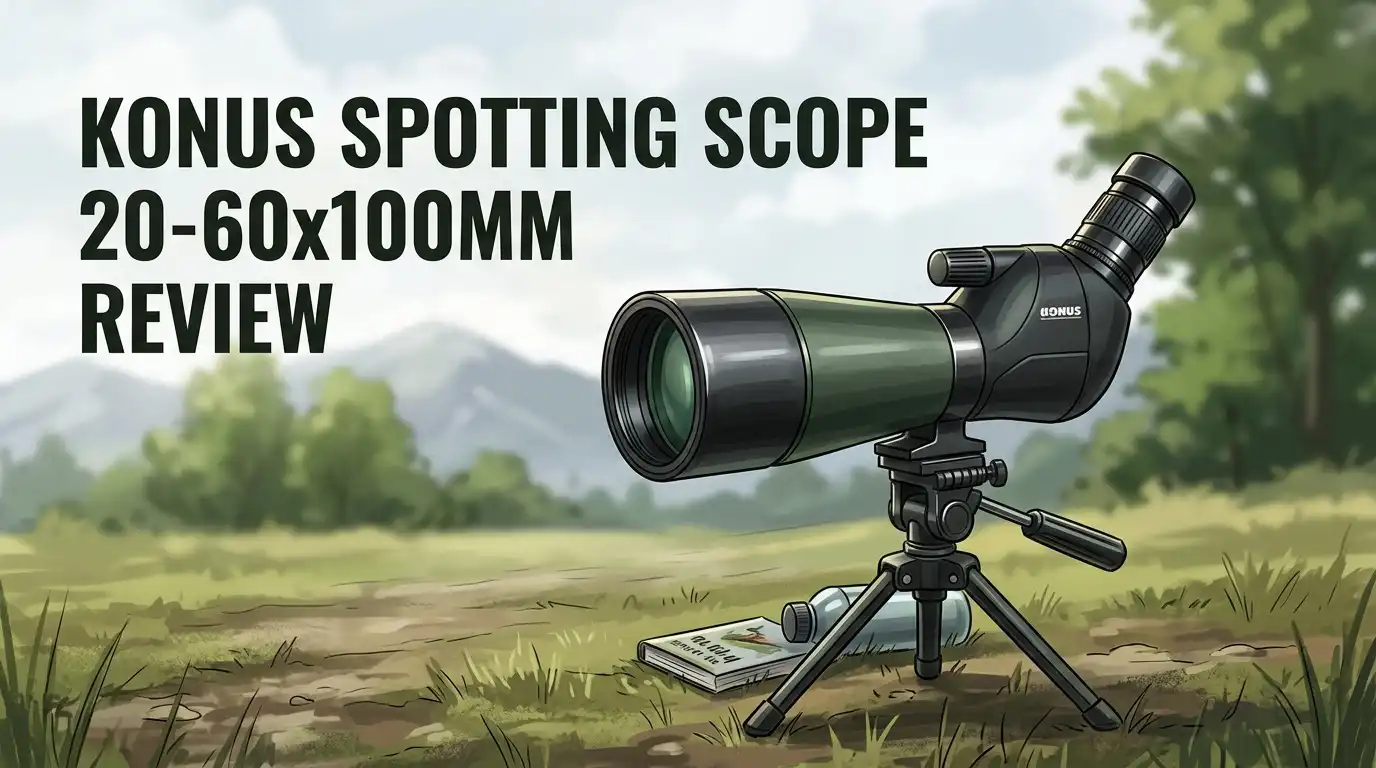
Konus Spotting Scope 20-60x100mm Review 2026: Worth Buying?
Big glass changes what you see. The Konus KonuSpot 100 carries a 100mm objective lens, and that single number explains most of its appeal. Shooters use it to read bullet holes at 400 yards. Birders use it to watch shorebirds across a mudflat. Amateur astronomers point it at the moon and count craters.
But this scope is not for everyone. It weighs over five pounds. It demands a serious tripod. It ships without one. Some owners love the brightness. Others complain about softness at maximum zoom.
This review covers the real experience: the unboxing, the glass, the handling flaws, and the honest weak spots. You will learn who should buy this scope in 2026 and who should walk away. No marketing fluff. Just what the scope does and where it falls short.
In a Nutshell:
- Huge light gathering power. The 100mm objective pulls in far more light than a typical 60mm or 80mm scope. Dawn and dusk viewing is where this scope earns its price. Low light performance is the single strongest reason to choose it.
- Heavy and bulky by design. The body weighs roughly 85 ounces and measures about 19 inches long. This is a truck to bench scope, not a backpacking scope. Carrying it into the woods with a rifle is unrealistic.
- Tripod is not included and matters enormously. A cheap tripod ruins the image at high magnification. Budget an extra $100 to $250 for stable legs. The scope also tips easily when the eyepiece is removed.
- Optics are good, not elite. Contrast holds well up to about 40x. Above that, some users report graininess and a slight color fringe on bright edges. It is not ED glass and does not pretend to be.
- Strong accessory package. Smartphone adapter, DSLR adapter, soft case, and lens covers come in the box. Digiscoping works well once you steady the setup.
- Priced around $400 in 2026. That puts it against the Celestron Ultima 100 and below ED class scopes. Value is solid if you want aperture over refinement.
What Is the Konus KonuSpot 100 20-60x100mm Spotting Scope?

Last update on 2026-09-25 / Affiliate links / Images from Amazon Product Advertising API Some of the links on this website are affiliate links, which means that at no additional cost to you, I earn a commission if you click through and make a purchase. I only recommend products and services that I believe will add value to my readers. Thank you for your support!
The KonuSpot 100 is Konus Italy’s largest standard spotting scope. Konus builds optics in Italy and sells binoculars, riflescopes, and telescopes worldwide. The model number is 7127 for the current version and 7122 for the earlier run.
The scope uses a 100mm multicoated objective lens and a permanently attached 20x to 60x zoom eyepiece. The eyepiece sits at a 45 degree angle. That angle helps when you view from a seated position or share the scope with other people.
Field of view runs about 99 feet at 1000 yards at 20x and drops to roughly 51 feet at 60x. Exit pupil measures 5mm at 20x and 1.75mm at 60x. The body carries rubber armor over a metal chassis. Konus lists the scope as waterproof and fogproof.
Unboxing Experience: What Actually Arrives
The box arrives heavier than most buyers expect. Lift it once and you understand the scope’s character immediately.
Inside, the scope sits in molded foam. A soft padded carrying case with a shoulder strap comes underneath. The case has cutouts so you can view through the scope while it stays partly covered.
You also get a smartphone adapter bracket, a DSLR T adapter, objective and eyepiece caps, a lens cloth, and a printed manual. The DSLR adapter needs a camera specific T ring, which Konus does not include. Plan that purchase separately.
The first real surprise is the missing tripod. Nothing in the box holds the scope up. The second surprise is weight. Pulling the scope out with one hand feels awkward. Use two.
Build Quality and Body Design
The body feels solid. Rubber armor covers the barrel and resists knocks and fingerprints. A damp cloth wipes it clean in seconds.
The sliding sunshade extends from the front of the tube. It cuts glare on bright range days and keeps light rain off the objective glass. This feature works better than expected and costs you nothing in bulk.
Controls feel precise. The zoom collar turns with steady resistance. The focus knob sits where your palm naturally rests against the barrel. Konus also fits a rotating tripod collar, so you can swing the eyepiece sideways without unmounting the scope.
One design flaw stands out. The tripod foot sits too far forward for true balance. Remove or loosen the eyepiece and the scope tips backward, even with a tightened friction lock. Handle it carefully during setup.
Top 3 Alternative for Konus KonuSpot 100 20-60x100mm


Last update on 2026-09-24 / Affiliate links / Images from Amazon Product Advertising API Some of the links on this website are affiliate links, which means that at no additional cost to you, I earn a commission if you click through and make a purchase. I only recommend products and services that I believe will add value to my readers. Thank you for your support!
Celestron Ultima 22-66×100 Spotting Scope

Last update on 2026-09-24 / Affiliate links / Images from Amazon Product Advertising API Some of the links on this website are affiliate links, which means that at no additional cost to you, I earn a commission if you click through and make a purchase. I only recommend products and services that I believe will add value to my readers. Thank you for your support!
Celestron Regal M2 100ED Spotting Scope

Last update on 2026-09-13 / Affiliate links / Images from Amazon Product Advertising API Some of the links on this website are affiliate links, which means that at no additional cost to you, I earn a commission if you click through and make a purchase. I only recommend products and services that I believe will add value to my readers. Thank you for your support!
Gosky Updated 20-60×80 Spotting Scope
Optical Performance in Daylight
Daylight viewing is where most owners spend their time. The KonuSpot 100 performs well through the practical part of its zoom range.
At 20x to 30x, images look bright, sharp, and wide. Colors stay natural. Edge softness exists but stays mild. This is the sweet spot for scanning a field or a shoreline.
Push to 40x and detail still holds. You can read .30 caliber holes on paper at 200 yards in good light. Mirage becomes the limiting factor more often than the glass does.
At 60x, quality drops. Some users describe a faint graininess and slightly reduced contrast. A few report a light purple fringe on high contrast edges like white targets against dark backing. That is chromatic aberration, and it appears because this scope uses standard glass rather than ED glass.
Low Light Performance at Dawn and Dusk
This is the scope’s headline strength. A 100mm objective collects roughly 56 percent more light than an 80mm objective and nearly three times more than a 60mm.
The practical result shows up in the last 20 minutes of legal shooting light. Deer that vanish into gray shapes through a small scope still show antler detail through this one. Owls at dusk stay identifiable.
At 20x the exit pupil measures a full 5mm, which matches a relaxed human pupil in dim conditions. That pairing delivers a genuinely bright image when the sun is gone.
Keep magnification low in dim light. At 60x the exit pupil shrinks to 1.75mm and the view darkens quickly. Owners who stay near 20x to 30x after sunset report the best results.
Zoom Range and Eye Relief in Real Use
The 20x to 60x zoom covers most spotting tasks. The collar moves smoothly and holds its position without drifting.
Eye relief measures 18mm at 20x and drops to 12mm at 60x. That range is workable for most viewers. Eyeglass wearers will find 12mm tight at full zoom. You may see vignetting around the edges with glasses on.
The twist up eyecup helps. Extend it for bare eye viewing. Collapse it when wearing glasses.
Focus shifts slightly as you zoom, which is normal for scopes in this class. Refocus after any large magnification change. Plan to use 20x for finding your subject and 40x for studying it. Treat 60x as a bonus rather than a working setting.
Focus System and Ease of Use
Konus uses a single large focus knob on the top of the body. There is no dual speed fine focus wheel like premium scopes offer.
The knob turns with moderate resistance and rarely slips. Most testers find the placement comfortable because your palm can rest on the barrel while your fingers turn the wheel. That contact point reduces shake at high magnification.
The downside is precision. Fine focus at 60x requires small, careful movements. A coarse and fine system would make the job easier. You will occasionally overshoot and come back.
Close focus sits around 100 feet, which is long. Butterfly watchers and anyone studying nearby subjects should look elsewhere. This scope is built for distance work, and its focus range reflects that purpose.
Digiscoping With a Phone or DSLR
Konus includes both adapters, which adds real value. The smartphone bracket clamps around the eyepiece and holds the phone camera over the lens.
Alignment takes patience the first few times. Once centered, phone photos of the moon, distant birds, and target boards come out surprisingly clear. Use 20x to 30x for phone shots. Higher magnification amplifies every vibration.
The DSLR T adapter replaces the eyepiece path and turns the scope into a long telephoto lens. You must buy a T ring matched to your camera mount separately.
Two warnings apply. First, any tripod flex shows up instantly in photos. Second, removing the eyepiece for DSLR use creates the tipping problem mentioned earlier. Support the scope with one hand during every swap.
Tripod Requirements: The Hidden Cost
Ignore this section and you will be disappointed with the scope. A 100mm optic amplifies every vibration in your support system.
A lightweight aluminum tripod will not work. At 400 yards and 40x, flex from cheap legs makes the image swim. The wobble takes several seconds to settle after every touch.
Look for a tripod rated for at least 15 pounds with a fluid video head. Sturdy aluminum models start around $120. Carbon fiber options cost more and save weight you probably do not need for bench use.
Some owners mount the scope on a shooting bench pod or a window mount instead. Both work well. Add the tripod cost to the scope price before you compare it against competitors that include legs. That comparison changes the value picture significantly.
Weather Resistance and Durability Over Time
Konus lists the KonuSpot 100 as waterproof and fogproof with nitrogen purging. Owners who use it in rain and heavy dew report no internal fogging.
The rubber armor handles bench knocks and truck bed transport well. Reported failures are uncommon, and most complaints focus on handling rather than reliability.
One maintenance issue deserves attention. The included soft case is slightly too small for the scope with the eyepiece installed on older units. Owners who force the fit or repeatedly remove parts risk introducing dust inside the optical path. Check the fit on arrival.
Konus offers a limited warranty, historically one year on this model with longer coverage on some regional versions. Register the product after purchase and keep your receipt.
What the Konus 20-60x100mm Does Not Do Well
Honest reviews list the failures. Here are this scope’s real weaknesses.
Portability is poor. At 85 ounces and 19 inches, this scope stays at the truck. Backcountry hunters should not consider it.
High magnification quality softens. Above 40x, contrast drops and some units show color fringing. If you need tack sharp 60x views, you need ED glass.
Balance is wrong. The tripod foot placement causes tipping when the eyepiece comes off. This is a design oversight, not user error.
No tripod included. A 100mm scope without legs is an incomplete purchase.
Focus is single speed. Fine adjustment at high power takes more fiddling than it should.
Close focus is long. Nearby subjects stay out of reach.
Pros and Cons of the Konus KonuSpot 100 20-60x100mm
Last update on 2026-09-25 / Affiliate links / Images from Amazon Product Advertising API Some of the links on this website are affiliate links, which means that at no additional cost to you, I earn a commission if you click through and make a purchase. I only recommend products and services that I believe will add value to my readers. Thank you for your support!
Pros
- Excellent low light brightness from the 100mm objective, easily the best reason to buy this scope
- Sharp, bright, high contrast images through the 20x to 40x range where most spotting happens
- Complete accessory kit with smartphone adapter, DSLR adapter, soft case, and lens cloth included
- Built in sliding sunshade cuts glare and shields the objective from light rain
- Rotating tripod collar lets you reposition the eyepiece without unmounting
- Solid rubber armored metal body that survives range and field use
- Waterproof and fogproof construction with nitrogen purging
- Strong price per millimeter of aperture compared with ED class 100mm scopes
Cons
- Very heavy at roughly 85 ounces, which rules out any walking use
- No tripod included, and cheap tripods fail badly under this weight
- Image quality softens noticeably above 40x magnification
- Some units show mild purple fringing on high contrast edges
- Tripod mount placement causes tipping when the eyepiece is removed
- Single speed focus knob lacks fine adjustment
- Soft case fit is tight and can require eyepiece removal
- Short warranty period compared with lifetime warranty competitors
Who Should Buy It and Who Should Skip It
Buy it if you shoot from a bench or prone position at a fixed range. The aperture helps you read impacts in poor light and through mirage.
Buy it if you watch wildlife from a vehicle, a blind, or a deck. Stationary viewing suits this scope perfectly.
Buy it if you want maximum aperture for under $450 and you already own a heavy duty tripod.
Skip it if you hike to your glassing spot. Weight will defeat you.
Skip it if you demand sharp 60x images. Save money and buy an 80mm ED scope instead.
Skip it if your budget cannot stretch to include a proper tripod. An unstable 100mm scope performs worse than a stable 60mm scope.
Price, Value, and Warranty in 2026
The KonuSpot 100 lists around $400 on Amazon in 2026, with street pricing sometimes dipping lower during sales. That sits close to the Celestron Ultima 22-66×100, its most direct competitor.
Compared with ED glass 100mm scopes, which start near $900, the Konus costs less than half. You trade optical refinement for aperture and accessories.
Compared with an 80mm scope at $250, the Konus costs more and weighs more but gathers noticeably more light.
Warranty coverage is the weak point. Konus offers a limited period rather than the lifetime transferable coverage from brands like Vortex. Buyers who value long term support may prefer a competitor even at similar optical quality.
Value verdict: fair to good, provided you understand the tripod cost and the magnification limits.
Final Verdict: Is the Konus 20-60x100mm Worth It in 2026?
The Konus KonuSpot 100 is a specialist tool. It does one thing better than almost anything at its price: it delivers a bright image when light runs out.
Everything else involves compromise. You accept weight. You accept softness at maximum zoom. You accept buying a tripod separately.
If your viewing happens from a fixed position and low light matters to you, the scope earns its place. Range shooters, deck birders, and casual moon watchers get real value here.
If you walk to your glassing spot or chase pixel level sharpness at 60x, look at an 80mm ED scope instead. Aperture without stability and without refinement only gets you halfway.
Rating: 3.9 out of 5, which matches what verified owners report.
Frequently Asked Questions
Does the Konus KonuSpot 100 come with a tripod?
No. The standard 7127 package includes the scope, a soft carrying case, a smartphone adapter, a DSLR T adapter, lens caps, and a cleaning cloth. Some regional bundles add a small table tripod, which is not strong enough for serious use. Budget separately for a tripod rated to hold at least 15 pounds.
Can I use this scope for astronomy?
Yes, within limits. The moon looks excellent. Jupiter shows its four bright moons and cloud bands. Saturn’s rings appear as a distinct shape. Deep sky objects stay faint because the zoom eyepiece caps your magnification and field options. A dedicated telescope serves astronomy better.
Is the Konus 20-60x100mm good for a 1000 yard range?
It works, but expect limits. At 1000 yards you can spot steel hits and see large impact splashes. Reading .22 caliber holes on paper at that distance is not realistic for any scope in this price class. Mirage usually interferes before optical quality does.
How does it compare to the Celestron Ultima 100?
Both use 100mm objectives and sit at similar prices. The Celestron Ultima 22-66×100 starts at slightly higher magnification and includes a similar accessory set. The Konus offers a sunshade and a phone adapter in the box. Optical quality between the two is close, and owner reviews for both hover near 4 stars.
Is it waterproof enough for rain and snow?
Yes. Konus builds the scope with sealed construction and nitrogen purging, so internal fogging does not occur under normal temperature swings. Owners report reliable performance in rain and heavy dew. Still dry the exterior before storing it in the soft case.
Do I need eyeglasses off to use this scope?
Not necessarily. Eye relief reaches 18mm at 20x, which most eyeglass wearers find comfortable with the eyecup collapsed. At 60x, relief drops to 12mm and you may see the field edges cut off. Lower magnification solves the issue for glasses wearers.

Hello, I’m Emily Price, the founder of Birds Affection. As a passionate bird enthusiast and spiritual seeker, I’ve always been fascinated by the symbolic meanings and mystical connections between birds and our lives. On this website, I share my knowledge and insights on the spiritual significance of various bird species, exploring their roles as messengers, guides, and teachers. Through my writing, I aim to inspire and educate others on the profound wisdom and beauty that birds bring to our world. Join me on this journey as we delve into the enchanting realm of bird symbolism and discover the hidden meanings behind these magnificent creatures.