Pentax PF-80ED Spotting Scope Review 2026: Worth Buying?
The Pentax PF-80ED has quietly outlasted most of its rivals. It launched years ago, yet birders, target shooters, and backyard astronomers still hunt for used and new copies in 2026. That says something. Most optics fade after a few product cycles. This one built a cult following instead.
So the real question is simple. Does an older Japanese made 80mm scope still beat the newer wave of budget ED glass?
I spent time with this scope at the range, in the field, and under a dark sky to find out. This review covers the good, the frustrating, and the parts nobody mentions in the marketing copy.
Key Takeaways:
- Optical quality punches far above the price. The 80mm ED objective delivers sharp, high contrast images with almost no color fringing. Against scopes costing twice as much, the gap is small. Against scopes costing the same, the Pentax usually wins.
- The 1.25 inch eyepiece port is the hidden superpower. This scope accepts standard astronomy eyepieces. You can mount a Baader zoom, a wide angle Pentax XW, or a cheap Plössl. Very few spotting scopes allow that freedom.
- It is lighter than most full size competitors. The straight model weighs about 49 ounces. The angled version sits near 56 ounces. Both travel well compared to chunky 85mm alternatives.
- Single speed focus is the biggest weakness. There is no fine focus wheel. At 60x you will fiddle. Newer scopes with dual focus systems feel faster and more precise.
- Availability is now the real problem. Stock comes and goes. Prices swing. You may end up buying used, and eyepieces are often sold separately.
- Best suited to patient users who value glass over gadgets. If you want modern conveniences like helical focus and arca swiss rails, look elsewhere.
Pentax PF-80ED Spotting Scope: Quick Verdict

Last update on 2026-09-20 / Affiliate links / Images from Amazon Product Advertising API Some of the links on this website are affiliate links, which means that at no additional cost to you, I earn a commission if you click through and make a purchase. I only recommend products and services that I believe will add value to my readers. Thank you for your support!
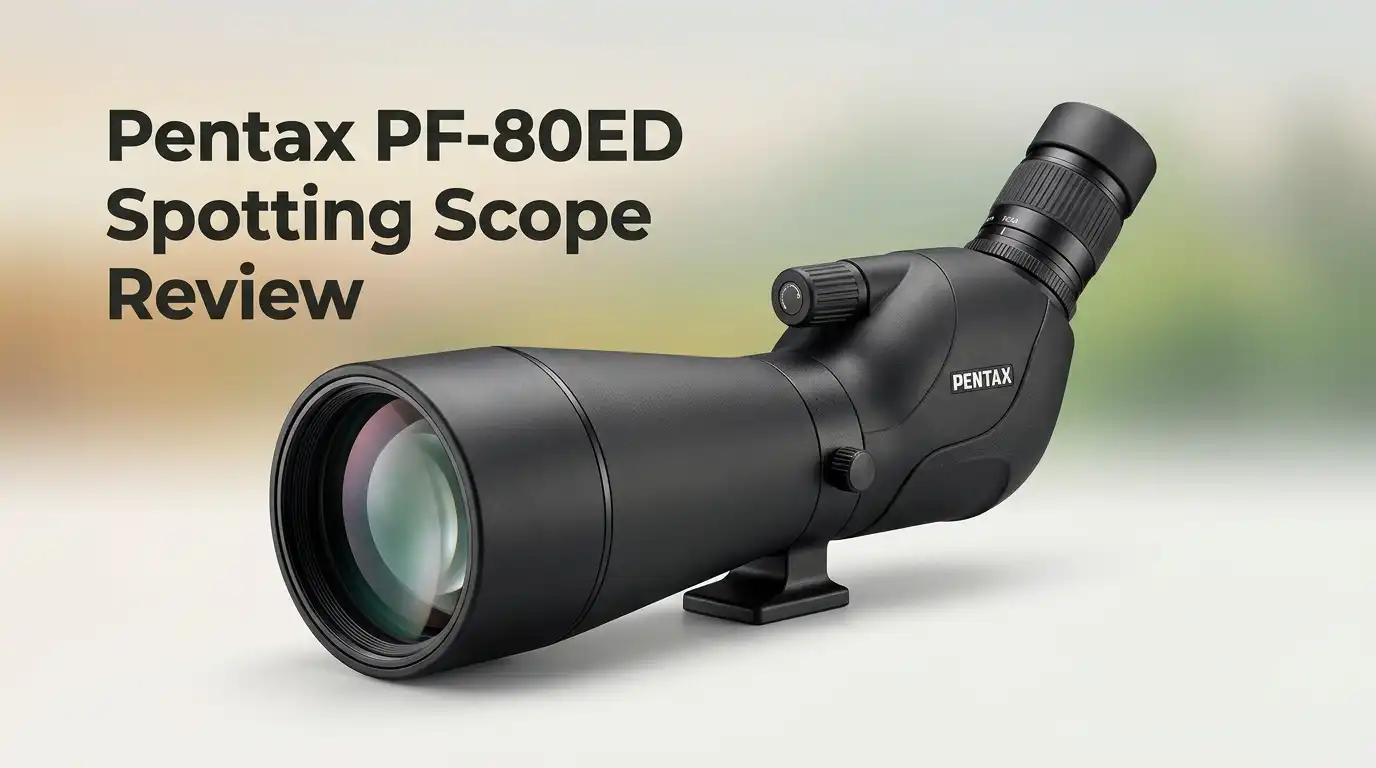
The Pentax PF-80ED is a large aperture spotting scope built around an 80mm extra low dispersion objective lens. Pentax sells it as a body only unit or bundled with a field case, and you choose your own eyepiece. That approach feels unusual today, when most brands ship a fixed zoom and call it done.
The payoff is control. You decide whether you want maximum field of view, maximum eye relief, or maximum sharpness. The scope simply supplies a clean, bright, well corrected image and steps out of the way.
My verdict after weeks of use: this is an optics purist’s scope. It rewards good eyepieces and punishes lazy technique. The image at 20x to 40x is genuinely beautiful. Contrast is snappy. Colors look natural rather than cool or yellow.
It is not the easiest scope to live with, and I will explain why later. But on pure image quality per dollar, it remains one of the strongest choices available in 2026.
Unboxing The Pentax PF-80ED
The unboxing is refreshingly plain. Pentax ships the scope in a simple cardboard box with molded foam. There are no glossy inserts, no branded stickers, and no marketing pamphlets. It feels like opening a professional tool rather than a consumer gadget.
Inside you get the scope body, objective and eyepiece caps, a short instruction sheet, and the soft field case if you bought that version. The case surprised me. It is a Cordura style nylon wrap with velcro flaps that stay on the scope while you use it. You fold the flaps back, and the scope works fully clothed.
First impression on lifting it out: the balance is excellent. The weight sits close to the tripod foot, so it does not nose dive on a light head.
The rubber armor feels grippy and slightly tacky. The retractable sunshade slides out with a smooth, damped motion. Nothing rattles. Nothing feels hollow. It is an honest, understated presentation from a company that clearly spent the budget on glass.
Build Quality And Everyday Durability
Pentax built the PF-80ED around a magnesium alloy chassis wrapped in shock absorbing rubber. That combination keeps the weight sensible while surviving real abuse. Mine rode in a truck bed, sat in drizzle, and got knocked against a fence post. It shrugged all of it off.
Waterproofing is complete, and the body is nitrogen filled to stop internal fogging. I have taken it from a cold car into humid morning air with no clouding inside.
The tripod collar rotates smoothly and locks with a single ring. That matters more than people expect. When you switch from level birding to steep angles for astronomy, rotating the eyepiece keeps your neck comfortable.
The focus knob sits on top of the barrel and turns with firm, even tension. There is no slop or backlash, which partially offsets the lack of a fine focus wheel.
One small gripe. The eyepiece cap is a loose friction fit. Mine has fallen off twice in a backpack. A tethered cap would have been smarter.
Top 3 Alternative For Pentax PF-80ED


Last update on 2026-09-17 / Affiliate links / Images from Amazon Product Advertising API Some of the links on this website are affiliate links, which means that at no additional cost to you, I earn a commission if you click through and make a purchase. I only recommend products and services that I believe will add value to my readers. Thank you for your support!
Celestron Regal M2 80ED Spotting Scope

Last update on 2026-09-13 / Affiliate links / Images from Amazon Product Advertising API Some of the links on this website are affiliate links, which means that at no additional cost to you, I earn a commission if you click through and make a purchase. I only recommend products and services that I believe will add value to my readers. Thank you for your support!
Vortex Optics Diamondback HD 20 to 60×85 Angled Spotting Scope

Last update on 2026-09-17 / Affiliate links / Images from Amazon Product Advertising API Some of the links on this website are affiliate links, which means that at no additional cost to you, I earn a commission if you click through and make a purchase. I only recommend products and services that I believe will add value to my readers. Thank you for your support!
Athlon Optics Ares G2 20 to 60×85 UHD Spotting Scope
Optical Performance In Daylight
This is where the Pentax earns its reputation. The 80mm ED objective produces an image with strong micro contrast and clean edges. At 20x, the view looks almost three dimensional. Feather barbs, bark texture, and distant lettering all resolve with ease.
Chromatic aberration is very well controlled. Point the scope at a dark bird against bright sky and you will see only a whisper of purple fringing at high power. Non ED scopes in this size class show obvious color halos in the same test.
Brightness holds up beautifully in low light. At dawn and dusk, the large aperture gathers plenty of light, so images stay usable when smaller 60mm and 65mm scopes turn muddy.
Sharpness stays high across roughly the central eighty percent of the field. The outer edge softens slightly, though your eyepiece choice affects this more than the objective does.
Push past 50x and the image dims and softens, as physics demands. Most of my viewing settled happily between 25x and 45x.
Eyepiece Choices And The 1.25 Inch Advantage
The PF-80ED uses a 1.25 inch eyepiece receptacle, the same standard used by astronomical telescopes. This single design decision transforms the scope from a good product into a long term platform.
You are not locked into one manufacturer. Pentax offers the XF 6.5 to 19.5mm zoom and the XW fixed focal length range. Beyond that, Baader, Televue, APM, and dozens of other brands all fit.
Here is the practical effect. Want a huge immersive field for scanning a marsh? Fit a wide angle fixed eyepiece. Want flexible power for reading targets? Fit a zoom. Want planets? Fit a short focal length astronomy ocular.
Zoom eyepieces give convenience. Fixed eyepieces give a wider apparent field and often sharper edges. I used both and preferred a fixed 14mm for birding and a zoom for the range.
The catch is cost. Good eyepieces are expensive, and a poor one will waste the objective’s talent entirely.
Straight Or Angled: Which Version Suits You
Pentax sells the PF-80ED in a straight body and the PF-80ED-A with a 45 degree angled eyepiece. Both share the same optics, so the choice is purely ergonomic.

Last update on 2026-09-24 / Affiliate links / Images from Amazon Product Advertising API Some of the links on this website are affiliate links, which means that at no additional cost to you, I earn a commission if you click through and make a purchase. I only recommend products and services that I believe will add value to my readers. Thank you for your support!
Choose the straight model if you scan from a vehicle window, track moving game, or share the scope rarely. Straight bodies point naturally. You simply look where the tube points, which speeds up target acquisition.
Choose the angled model if you view upward, share with people of different heights, or observe for long stretches. The angled eyepiece lets you lower the tripod, which improves stability and reduces neck strain.
Birders on shared trips almost always prefer angled. Target shooters at a bench often prefer straight. Astronomy users should pick angled without hesitation, since pointing near the zenith with a straight scope is painful.
Weight differs slightly too. The straight version comes in near 49 ounces, and the angled version near 56 ounces. Neither feels heavy for an 80mm class instrument.
Field Test: Birding And Wildlife Watching
I took the PF-80ED to a coastal mudflat, which is honest testing ground. Heat shimmer, distance, and dull light all conspire against optics there.
The scope handled it well. Shorebirds at roughly 200 yards showed leg color, bill shape, and subtle wing patterns. Identification calls that felt like guesswork through binoculars became obvious.
Close focus is the weak spot for birders. Minimum focus sits around 19 feet, or 5.8 meters. That is fine for open habitat. It is limiting for warblers in a nearby hedge or butterflies on a pond edge. Several modern scopes focus much closer.
Color rendition is neutral, which I appreciate. Some scopes warm the image and make plumage look richer than reality. The Pentax shows what is actually there, which helps with tricky identifications.
Panning felt smooth on a fluid head. The balance point sits well, so the scope does not tip when you release it mid sweep.
Field Test: Spotting Bullet Holes At The Range
Shooters ask one question about any spotter. Can it see holes in paper? The answer depends on conditions, and this scope is honest about that.
In good morning air, I could resolve .22 caliber holes at 200 yards without strain. Push to 300 yards and .30 caliber holes stayed visible at 40x to 50x.
At 500 yards, results split by conditions. With still air and even light, groups were readable most of the time. With afternoon mirage rolling across the berm, the image boiled and reading holes became guesswork. No spotting scope defeats mirage, and this one is no exception.
The lack of fine focus shows here. You often want a tiny nudge in focus to sharpen a hole edge, and the single knob can overshoot.
Bring a solid tripod. An 80mm scope at 50x reveals every vibration in a flimsy head, and shaky mounting will erase the optical advantage instantly.
Astronomy Performance After Dark
Many spotting scopes disappoint under stars. The Pentax does not, mostly because it accepts real astronomy eyepieces.
The Moon is stunning. Crater rims look crisp, and the limb shows minimal false color. Terminator shadows reveal fine detail at 60x and above with a short focal length eyepiece.
Saturn’s rings separate clearly, and Jupiter shows cloud belts plus its four bright moons. That is genuinely impressive for a porro prism spotting scope, and it is the direct result of the ED objective and the standard eyepiece port.
Deep sky targets are modest. Open clusters like the Pleiades and the Double Cluster look lovely. Faint galaxies stay dim smudges, because 80mm simply cannot gather enough light for detail.
Two limits worth knowing. The prism system makes the image right side up but reduces contrast slightly compared with a dedicated refractor. High power also runs out around 100x before the image softens noticeably.
What The Pentax PF-80ED Does Not Do Well
Every honest review needs this section, so here are the real flaws.
Single speed focus is the headline complaint. At high magnification you will hunt back and forth for the sweet spot. Competitors with dual focus or helical focus systems make this faster and less annoying.
Close focus of roughly 19 feet limits nearby subjects. Insect watchers and garden birders will feel it.
The body only purchase confuses newcomers. You can spend good money and receive a scope that cannot be used until a separate eyepiece arrives.
Availability in 2026 is inconsistent. Listings appear and vanish, prices jump, and some sellers offer only used units with unclear history.
There is no arca swiss compatible foot, so you will need an extra plate. The tripod foot is also fairly short, which slightly limits balance adjustment with heavy camera adapters.
Finally, the eyepiece cap fits loosely and falls off. Small issue, constant irritation.
Pros And Cons Of The Pentax PF-80ED
Here is the balanced summary in plain terms.
Pros
- Excellent ED glass with sharp resolution, high contrast, and very low color fringing
- Accepts any standard 1.25 inch eyepiece, including astronomy oculars from other brands
- Lighter than most rival 80mm and 85mm scopes, which helps on hikes and light tripods
- Magnesium alloy body with rubber armor, fully waterproof and fogproof construction
- Smooth rotating tripod collar that makes angle changes quick and comfortable
- Strong low light performance at dawn and dusk thanks to the large aperture
- Doubles as a capable astronomy instrument for Moon, planets, and bright clusters
- Excellent value compared to premium European alternatives with similar image quality
Cons
- Single speed focus knob with no fine adjustment wheel, which slows high power focusing
- Close focus near 19 feet is too long for nearby subjects like insects or garden birds
- Eyepiece often sold separately, which raises the true cost significantly
- Stock availability is unpredictable in 2026, with fluctuating prices
- No arca swiss foot and no modern conveniences like a built in phone adapter
- Loose fitting eyepiece cap that detaches easily in a bag
- Edge sharpness softens slightly with budget eyepieces
Who Should Buy The Pentax PF-80ED
This scope suits specific people very well and frustrates others.
Buy it if you care most about image quality per dollar. Serious birders, long range target shooters, and hybrid users who also enjoy astronomy will get enormous value here.
Buy it if you already own astronomy eyepieces. Your existing collection instantly upgrades this scope, and that flexibility saves real money over time.
Buy it if you prefer a lighter scope for hiking. The reduced weight compared with big 85mm bodies matters after three miles uphill.
Skip it if you want plug and play convenience. Beginners who simply want to open a box and start viewing should choose a bundled scope with an included zoom and dual focus.
Skip it if you frequently watch subjects inside 20 feet. The close focus limit will annoy you daily.
Skip it if you need current warranty support and guaranteed stock. Newer models from Vortex, Athlon, and Celestron are easier to buy and service today.
Frequently Asked Questions
Does the Pentax PF-80ED come with an eyepiece?
Sometimes. Pentax sells body only versions and bundled versions. Always read the listing carefully. The body only option costs less but requires a separate 1.25 inch eyepiece before you can use it.
Is the Pentax PF-80ED still worth buying in 2026?
Yes, if you find one at a fair price. The optics remain competitive with current mid tier and upper mid tier scopes. The main compromises are the single focus system and patchy availability.
Can I use astronomy eyepieces with this scope?
Yes. The 1.25 inch receptacle accepts standard astronomical eyepieces from brands like Baader, Televue, and APM. This is one of the scope’s strongest selling points.
What magnification does it reach?
That depends on your eyepiece. With the common 20 to 60x zoom you get that range. With short focal length astronomy eyepieces you can exceed 100x, though image quality softens near that limit.
Is the straight or angled model better?
Neither is better overall. Angled suits astronomy, shared viewing, and long sessions. Straight suits vehicle viewing, quick target acquisition, and bench shooting.
Can I attach a camera or phone?
Yes. Digiscoping works with the right adapter, and results are good thanks to the ED glass. You will need to buy the adapter separately, and a sturdy tripod is essential.
How does it compare to the Pentax PF-65ED II?
The 65mm model is smaller, lighter, and cheaper, and it usually includes a zoom eyepiece. The 80mm model gathers more light and resolves more detail, especially at long distance and in dim conditions.

Hello, I’m Emily Price, the founder of Birds Affection. As a passionate bird enthusiast and spiritual seeker, I’ve always been fascinated by the symbolic meanings and mystical connections between birds and our lives. On this website, I share my knowledge and insights on the spiritual significance of various bird species, exploring their roles as messengers, guides, and teachers. Through my writing, I aim to inspire and educate others on the profound wisdom and beauty that birds bring to our world. Join me on this journey as we delve into the enchanting realm of bird symbolism and discover the hidden meanings behind these magnificent creatures.