Celestron C70 Mini Mak Spotting Scope Review 2026: Still Worth It?
The Celestron C70 Mini Mak has quietly sat on shelves for over fifteen years, and people still buy it every single month. That says something.
It promises 75x magnification, a 70mm aperture, and a body small enough to toss in a backpack side pocket. On paper it looks like a bargain. In the field, the story gets more interesting, and a little more complicated.
This review covers what the C70 Mini Mak genuinely does well, where it stumbles badly, and whether it still earns a spot in your kit in 2026. No marketing fluff. Just the good, the frustrating, and the honest verdict.
In a Nutshell:
- The optics punch above the price, but not above the aperture. The Maksutov Cassegrain design delivers sharp, high contrast images with almost zero color fringing. Real world brightness, though, feels closer to a quality 55mm refractor than a true 70mm scope.
- Portability is the headline feature. At roughly 2.3 pounds and 11 inches long, this scope travels better than almost any 70mm class spotter. It fits in a daypack without a fight.
- The 25 to 75x zoom eyepiece is a mixed bag. Views look crisp at 25x and 35x. Push past 50x and the image dims noticeably and the field of view shrinks to a keyhole.
- It is not waterproof. No nitrogen purging, no sealed body. Rain and heavy humidity are genuine risks, which rules it out for serious wet weather birding.
- Astronomy is a legitimate bonus. Lunar craters and Saturn’s rings show up clearly. This scope doubles as a starter telescope better than most spotting scopes in its class.
- Best for budget buyers who value size over brightness. Anyone needing bright dusk performance or weatherproofing should spend more elsewhere.
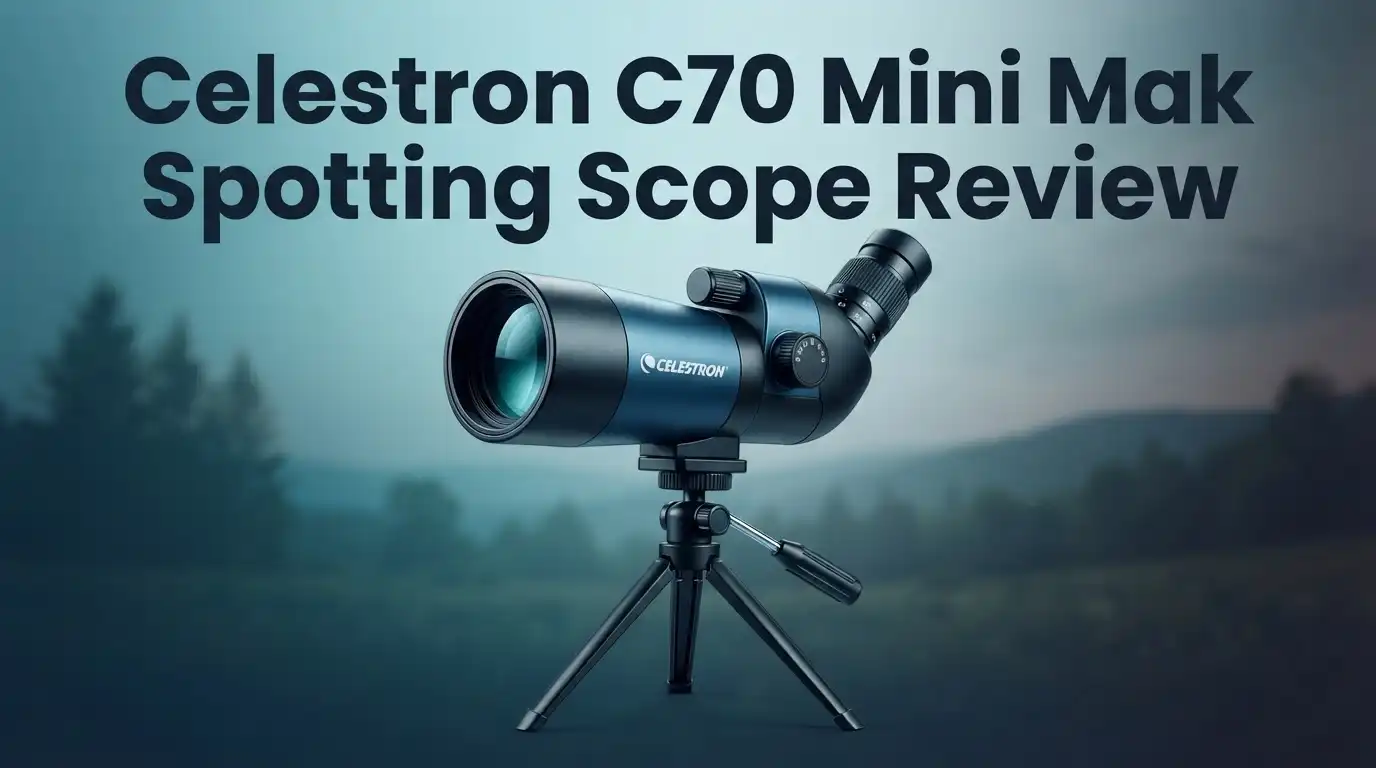
Celestron C70 Mini Mak Spotting Scope


Last update on 2026-09-28 / Affiliate links / Images from Amazon Product Advertising API Some of the links on this website are affiliate links, which means that at no additional cost to you, I earn a commission if you click through and make a purchase. I only recommend products and services that I believe will add value to my readers. Thank you for your support!
The C70 Mini Mak is a catadioptric spotting scope, which means it uses both a lens and mirrors to fold light inside a short tube. Celestron packs 750mm of focal length into an 11 inch body, and that trick is the whole point of this design.
The scope ships with a built in 25 to 75x zoom eyepiece, a 45 degree correct image prism, a tabletop tripod with slow motion controls, and a soft carrying case. Celestron markets it for birding, target shooting, nature watching, and digiscoping.
Think of it as a telescope wearing a spotting scope costume. That identity shapes everything about how it performs, and it explains both its biggest strengths and its most annoying weaknesses.
Unboxing Experience: What Actually Arrives
The box is smaller than expected. Mine arrived in a plain Celestron carton with orange accents, and the whole package weighed less than a bag of sugar. Opening it takes about thirty seconds.
Inside you find the scope wrapped in a soft nylon carry case with a shoulder strap and a zip closure. The case feels thin but functional. Underneath sits the tabletop tripod in its own plastic bag, plus a folded instruction sheet and warranty card.
First impressions are genuinely good. The rubber armor feels grippy and dense. The scope is heavier in the hand than its size suggests, which reads as quality at first touch. The zoom collar turns smoothly straight out of the box. No loose parts, no rattles, no missing accessories.
Key Specifications at a Glance
The numbers tell you a lot about this scope’s personality. The objective lens measures 70mm across, and the focal length reaches 750mm, giving a focal ratio around f/10.7. That is a slow, narrow system by spotting scope standards.
Magnification runs from 25x to 75x through the integrated zoom eyepiece. Angular field of view spans 1.3 degrees at the low end down to 0.7 degrees at maximum zoom. In practical terms that means 66 feet of view at 1000 yards at 25x, shrinking to 35 feet at 75x.
Close focus sits at 16 feet. Eye relief measures about 22mm at 25x. Total weight is 37 ounces, and length is 11 inches. The scope accepts standard 1.25 inch eyepieces once you remove the zoom.
Top 3 Alternatives for Celestron C70 Mini Mak

Last update on 2026-09-23 / Affiliate links / Images from Amazon Product Advertising API Some of the links on this website are affiliate links, which means that at no additional cost to you, I earn a commission if you click through and make a purchase. I only recommend products and services that I believe will add value to my readers. Thank you for your support!
Celestron C90 Mak Spotting Scope

Last update on 2026-09-13 / Affiliate links / Images from Amazon Product Advertising API Some of the links on this website are affiliate links, which means that at no additional cost to you, I earn a commission if you click through and make a purchase. I only recommend products and services that I believe will add value to my readers. Thank you for your support!
Celestron Ultima 18 to 55×65 Angled Spotting Scope

Last update on 2026-07-01 / Affiliate links / Images from Amazon Product Advertising API Some of the links on this website are affiliate links, which means that at no additional cost to you, I earn a commission if you click through and make a purchase. I only recommend products and services that I believe will add value to my readers. Thank you for your support!
Celestron Ultima 20 to 60×80 Angled Spotting Scope
Optical Performance in Daylight
Daylight is where the C70 Mini Mak feels most at home. At 25x the image looks clean, contrasty, and pleasantly sharp across the center of the field. Edges soften a little, but nothing offensive at this price.
The Maksutov design almost eliminates chromatic aberration. Dark tree branches against bright sky show no purple fringing, which is a real advantage over cheap refractor spotters. Colors look natural rather than washed out.
Brightness is the weak spot. The central obstruction from the secondary mirror spot eats light, and the small internal prism does not help. A good 60mm refractor scope will often look brighter than this 70mm Mak. In midday sun you will never notice. At dawn, dusk, or under heavy tree cover, the difference becomes obvious fast.
Astronomy Performance: Moon, Planets and Deep Sky
This is the C70’s secret weapon. Most spotting scopes make poor telescopes. This one genuinely works. The 750mm focal length and 75x top magnification let you do real observing.
The Moon looks excellent. Crater rims, terminator shadows, and mare boundaries all show crisp detail at 50x to 75x. Saturn reveals its rings as a clear separated shape rather than a blob. Jupiter shows two cloud belts and all four Galilean moons on a steady night.
Deep sky is a different matter. The narrow field and modest light gathering mean star clusters look sparse and nebulae look faint. The lack of any finder scope makes aiming at night genuinely frustrating. You aim by sighting along the tube and hoping.
Build Quality and Handling
The rubber armor covering feels tough and dampens knocks well. Underneath that shell, though, the construction is largely plastic. The corrector cell and eyepiece mount use aluminum. Most of the rest does not.
That plastic body keeps weight down, which is the entire point of this scope. Handling feels balanced and comfortable, and the single tripod socket sits at a sensible spot along the tube. There is no rotating collar, so you cannot spin the body to change eyepiece angle.
Some users report play in the focuser wheel out of the box. Mine had a slight wobble that tightened up with use. The scope also has no rotating sunshade and no built in dew shield, which matters more than you would think on damp mornings.
The 25 to 75x Zoom Eyepiece
The integrated zoom is smooth and well damped. Turning the collar feels satisfying, with no gritty spots or sudden jumps. Eye relief at low power is generous enough for eyeglass wearers.
Image quality holds up well from 25x to about 45x. Beyond that the picture dims steadily and the exit pupil shrinks to under 1mm, which makes eye placement fussy. At the full 75x setting, atmospheric shimmer usually ruins the view before the optics do.
The good news is that the zoom is removable. The visual back accepts standard 1.25 inch eyepieces. Swapping in a decent 15mm or 20mm eyepiece transforms this scope more than any other upgrade you can make.
Focuser Feel and Close Focus
The focuser is a rear mounted knob that shifts the primary mirror, exactly like a small Maksutov telescope. It is extremely sensitive, and that cuts both ways.
Fine focus adjustments land precisely, which helps at high magnification. The flip side is that finding focus quickly on a moving bird takes practice. A quarter turn of the knob sweeps through the entire focus range at low power. New users often overshoot repeatedly during the first few outings.
Close focus sits at 16 feet, which is acceptable but not impressive. Butterfly and dragonfly watchers will find that limiting. There is also some image shift as the mirror moves, meaning your target drifts slightly off center during focusing. Annoying at 75x. Barely noticeable at 25x.
Digiscoping With the C70 Mini Mak
Celestron promotes this scope as digiscoping ready, and that claim holds up reasonably well. The 45 degree correct image prism gives properly oriented views, so photos come out right side up.
Smartphone adapters clamp onto the eyepiece easily because the zoom barrel is a simple cylinder. Lunar photos through a phone look surprisingly good. Daytime bird shots work at 25x to 35x.
Vignetting appears fast at higher magnifications, and the dim image forces slower shutter speeds. Motion blur becomes a constant fight. The included tabletop tripod is far too light for steady photography, so you will need a proper tripod. Treat digiscoping here as a fun bonus rather than a serious feature.
The Included Tabletop Tripod
Celestron includes a small tabletop tripod with built in slow motion controls. It looks useful in product photos. In practice, opinions split sharply.
The slow motion controls are genuinely handy for tracking at high magnification, letting you nudge the scope smoothly instead of bumping it. That feature alone puts this tripod ahead of most freebie mounts.
The legs are the problem. They are short, light, and prone to vibration. Any breeze or table tap sends the image shaking for several seconds. The tripod works fine on a picnic table or a car hood in calm conditions. For anything serious, plan on buying a proper tripod. Many owners sell the included one and never miss it.
What the C70 Mini Mak Does Not Do Well
Honest reviews list failures, so here they are plainly. This scope is not waterproof or fog proof. No nitrogen purging, no sealed housing. Internal fogging in humid conditions is a documented problem.
Low light performance disappoints. The central obstruction and small internal prism together cost real brightness, and dawn or dusk sessions suffer badly.
The tiny internal prism is the true weak link. Reviewers who have opened the scope describe it as undersized and mediocre, which caps overall image quality no matter what eyepiece you use.
Thermal cool down takes time. The thick corrector plate needs fifteen to thirty minutes outdoors before images settle. There is no finder scope, no case for the tripod, and the narrow field makes target acquisition slow.
Pros and Cons
Pros
- Genuinely pocketable size at 11 inches and 2.3 pounds, easier to carry than any comparable 70mm spotter
- Almost no chromatic aberration thanks to the Maksutov Cassegrain design, giving clean high contrast views
- Doubles as a capable beginner telescope for the Moon, Saturn, and Jupiter
- Accepts standard 1.25 inch eyepieces, so upgrades are cheap and easy
- Smooth zoom collar and useful 22mm eye relief at low power
- Tabletop tripod includes slow motion controls, rare at this price
- Strong value for the money, often well under $200
Cons
- Not waterproof or fog proof, a serious limitation outdoors
- Dim images in low light compared to refractor scopes of similar size
- Undersized internal prism limits peak image quality
- Focuser is sensitive and shows noticeable image shift
- No finder scope, making night aiming difficult
- Narrow field of view complicates tracking moving subjects
- Included tripod vibrates easily and feels undersized
- Requires cool down time before sharp views appear
Who Should Buy the C70 Mini Mak
This scope suits specific people very well. Backpackers and travelers who count every ounce will love it. Nothing else offers this reach in this package size at this price.
Beginner astronomers on a tight budget get real value here. The Moon and planets look genuinely good, and the 1.25 inch eyepiece compatibility opens an upgrade path.
Target shooters using it in dry, bright conditions will find it perfectly adequate for spotting holes at 100 yards.
Skip it if you bird at dawn or dusk, hunt in wet weather, need fast target acquisition, or want the brightest possible image. Serious birders should look at a 65mm or 80mm refractor style scope instead. The brightness gap is simply too wide to ignore.
Price and Value in 2026
Last update on 2026-09-28 / Affiliate links / Images from Amazon Product Advertising API Some of the links on this website are affiliate links, which means that at no additional cost to you, I earn a commission if you click through and make a purchase. I only recommend products and services that I believe will add value to my readers. Thank you for your support!
The C70 Mini Mak typically sells for well under $200, and that price has held remarkably steady for years. At that number, the value calculation is favorable.
Nothing else in this price bracket combines 750mm of focal length, a compact body, and telescope grade optics. Competing scopes at similar prices are either much larger or much weaker optically.
The value improves further if you already own a tripod and a few eyepieces. Dropping a quality 20mm eyepiece into the visual back gives a noticeable jump in sharpness and comfort.
The value argument weakens above $200. At that point, the Celestron Ultima 65 and similar scopes offer brighter images and full weather sealing, which matter more for most outdoor users.
Final Verdict
The Celestron C70 Mini Mak is a specialist tool pretending to be a generalist. Judge it as a compact travel scope with astronomy talent and it succeeds. Judge it as an all purpose birding spotter and it falls short.
The optics are honest for the money. Contrast is good, color correction is excellent, and the size is unbeatable. The failures are equally real, especially the missing weather sealing and the dim low light performance.
Buy it if portability and price top your list. Buy something bigger if image brightness and weatherproofing matter more. For the right user, this little scope remains one of the better bargains in optics, and that is why it has survived on the market for so long.
Frequently Asked Questions
Is the Celestron C70 Mini Mak waterproof?
No. The C70 Mini Mak is not waterproof and is not nitrogen purged. The rubber armor resists light splashes, but the body is not sealed. Internal fogging can occur in humid conditions or during sudden temperature changes. Keep it dry and store it with the caps on.
Can the C70 Mini Mak be used as a telescope?
Yes, and it performs better than most spotting scopes at this task. The 750mm focal length and 75x maximum magnification show lunar craters, Saturn’s rings, and Jupiter’s cloud belts clearly. Removing the zoom lets you fit standard 1.25 inch astronomy eyepieces for better views.
What tripod works best with this scope?
Any photo tripod with a fluid pan head works well. Look for one rated above 5 pounds capacity with a smooth panning motion. The included tabletop tripod handles casual use but vibrates too much for high magnification or photography.
How does the C70 compare to the C90 Mak?
The C90 offers a 90mm aperture and 1250mm focal length, so images are brighter and higher powered. The C70 is smaller, lighter, and cheaper. Choose the C90 for image quality and the C70 for portability.
Does it come with a carrying case?
Yes. A soft nylon case with a shoulder strap is included. It protects the scope from scratches and dust during transport, though it offers little impact protection. The tabletop tripod does not have its own case.
Is the zoom eyepiece replaceable?
Yes. The visual back accepts standard 1.25 inch eyepieces once the zoom is removed. Many owners consider this the single best upgrade, since a quality fixed eyepiece improves sharpness, brightness, and field of view noticeably.

Hello, I’m Emily Price, the founder of Birds Affection. As a passionate bird enthusiast and spiritual seeker, I’ve always been fascinated by the symbolic meanings and mystical connections between birds and our lives. On this website, I share my knowledge and insights on the spiritual significance of various bird species, exploring their roles as messengers, guides, and teachers. Through my writing, I aim to inspire and educate others on the profound wisdom and beauty that birds bring to our world. Join me on this journey as we delve into the enchanting realm of bird symbolism and discover the hidden meanings behind these magnificent creatures.