Hawke Nature Trek Spotting Scope Review 2026: Still Worth It?
Spotting scopes sit in an awkward price gap. Cheap ones show mush at high power. Premium ones cost more than a used car payment. The Hawke Nature Trek family tries to land in the middle, and it has quietly built a loyal following among birders, target shooters, and backcountry hunters.
I spent time with this line across open fields, a 100 yard range, and a few soggy mornings on a lake shore.
This review covers what the glass actually delivers, how the body holds up, and the honest weak spots that marketing pages skip. If you want a clear picture before you spend money, keep reading.
Key Takeaways
- Optical value is the main selling point. Fully multi coated glass paired with BAK 4 porro prisms gives sharp, high contrast images at low and medium power. At 20x to 30x the view looks genuinely impressive for the money.
- The 80mm model costs around $409 and weighs 48.1 ounces. The 65mm version runs closer to $364 at 41.8 ounces. The tiny 9x to 27x compact weighs just 20.3 ounces and fits in a jacket pocket.
- Top magnification is the weak link. Push past 45x and brightness drops, contrast softens, and image shake becomes obvious on anything but a heavy tripod. This is normal for non ED glass, but you should know it before buying.
- No tripod is included. Budget an extra $80 to $200 for a stable head and legs, or the scope will disappoint you.
- Hawke backs it with a No Fault Lifetime Warranty, limited to two years on the eyepiece. That coverage is stronger than most rivals in this bracket.
- Best fit: birders, range shooters, and casual wildlife watchers. Poor fit: anyone judging fine antler detail at extreme distance or chasing edge to edge ED sharpness.
What Is the Hawke Nature Trek Spotting Scope?

Last update on 2026-09-23 / Affiliate links / Images from Amazon Product Advertising API Some of the links on this website are affiliate links, which means that at no additional cost to you, I earn a commission if you click through and make a purchase. I only recommend products and services that I believe will add value to my readers. Thank you for your support!
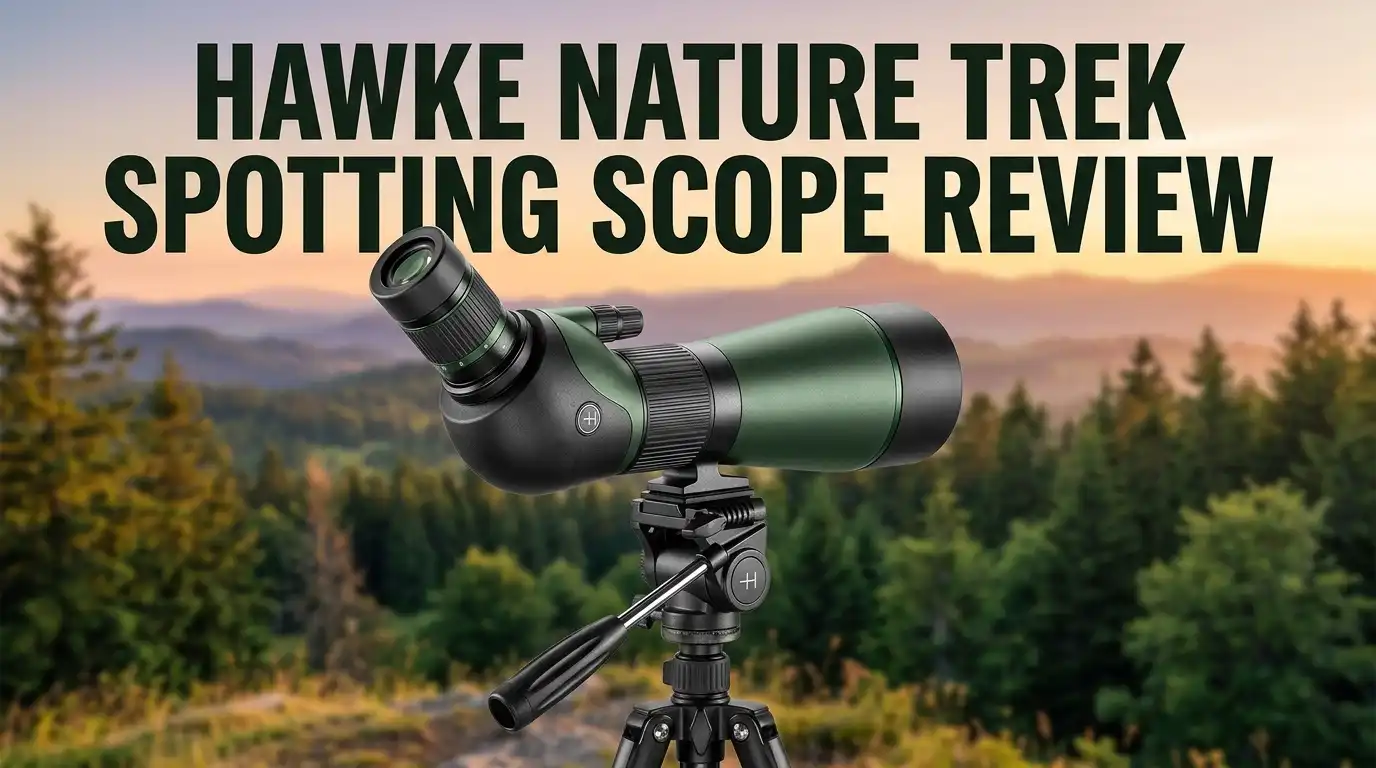
The Nature Trek is Hawke’s mid tier spotting scope range. It sits above the entry level Vantage line and below the Endurance ED and Frontier series. The family includes four main bodies: a 13x to 39x 56mm, a 9x to 27x 56mm compact, a 16x to 48x 65mm, and the flagship 20x to 60x 80mm.
Every model shares the same core recipe. You get a fully multi coated optical system, BAK 4 porro prisms, nitrogen purging, and a waterproof and fog proof housing. Hawke calls the optical layout System H2.
The 80mm model is the one most buyers land on. It measures 15.7 inches long, weighs 48.1 ounces, and delivers a field of view of 108 feet down to 60 feet at 1000 yards. Eye relief sits at a comfortable 20mm across the zoom range.
Think of it as a working scope rather than a showpiece. It targets people who want real performance without paying alpha glass prices.
Unboxing Experience and First Impressions
The packaging surprised me. Instead of a flimsy cardboard sleeve, the 80mm arrived inside a reinforced hard case with dense foam padding cut to the scope’s shape. Spare compartments hold the smaller bits. That case alone would cost $50 if you bought it separately.
Inside you find the scope, a stay on soft neoprene cover, a carry strap, a lens cloth, an objective lens cover, an ocular cover, eyepiece covers, and the instruction booklet.
The stay on cover is already fitted when you lift the scope out. You simply unzip the flaps to expose the eyepiece and objective. This is a small touch that saves you from ever handling a bare barrel in the rain.
First impression in hand: it feels denser than expected. The rubber armour has a grippy matte finish. The zoom ring turns with a firm, controlled motion. Nothing rattles, nothing feels hollow. For a scope in this price band, the presentation punches above its weight.
Build Quality and Body Design
The body uses a rubber armoured aluminium chassis. The armour covers the entire barrel, so knocks against rocks or bench edges do not chip paint. After several weeks of field use mine picked up scuffs but no real damage.
The rotating tripod collar is the standout feature. Loosen the ring, twist the body, and you can view from a seated position, a prone position, or over a car window. Birders sharing a scope with kids or shorter adults will use this constantly.
A retractable sunshade pulls out from the objective end. It cuts glare and keeps light drizzle off the front lens. The twist up eyecup has three usable positions and works well with glasses at the 20mm eye relief setting.
The mounting thread is a standard quarter inch 20 UNC female fitting, so any camera tripod attaches directly. One gripe: the collar lock screw is small and slippery with cold fingers. A larger knurled knob would help.
Optical Performance in Daylight
This is where the Nature Trek earns its reputation. In bright conditions at 20x, images snap into focus with strong contrast and neutral colour. I read a maker’s nameplate roughly five inches wide on old farm equipment at 400 yards with room to spare.
At 30x the image stays crisp. Fine detail like feather edges on a distant heron or bullet holes in paper at 100 yards resolves cleanly. The sweet spot for this scope runs from 20x to about 35x.
Edge sharpness holds up reasonably well. You get mild softness in the outer ten percent of the view, which is expected without ED glass. Chromatic aberration appears as a faint purple fringe on high contrast targets such as a dark branch against white sky.
Colour rendition leans slightly warm. Greens and browns look natural, which suits woodland and grassland viewing. Compared with cheaper 80mm scopes, the difference in contrast is immediately visible side by side.
Top 3 Alternatives for Hawke Nature Trek Spotting Scope


Last update on 2026-07-01 / Affiliate links / Images from Amazon Product Advertising API Some of the links on this website are affiliate links, which means that at no additional cost to you, I earn a commission if you click through and make a purchase. I only recommend products and services that I believe will add value to my readers. Thank you for your support!
Celestron Ultima 80 Angled Spotting Scope

Last update on 2026-09-13 / Affiliate links / Images from Amazon Product Advertising API Some of the links on this website are affiliate links, which means that at no additional cost to you, I earn a commission if you click through and make a purchase. I only recommend products and services that I believe will add value to my readers. Thank you for your support!
Athlon Optics Talos 20 to 60×80 Spotting Scope

Last update on 2026-09-13 / Affiliate links / Images from Amazon Product Advertising API Some of the links on this website are affiliate links, which means that at no additional cost to you, I earn a commission if you click through and make a purchase. I only recommend products and services that I believe will add value to my readers. Thank you for your support!
Gosky 20 to 60×80 Spotting Scope with Phone Adapter
Low Light Performance at Dawn and Dusk
Low light is where objective size and coating quality show their true value. The 80mm model gathers enough light to stay usable for roughly twenty to thirty minutes after sunset at low magnification.
Exit pupil tells the story. At 20x you get a 4mm exit pupil, which feeds your eye plenty of light. At 60x that shrinks to 1.3mm, and the image goes visibly dim. In practical terms, drop to 20x or 25x once the sun dips and you will keep a bright, usable view much longer.
The 65mm version holds a similar 4.1mm exit pupil at its 16x setting, so it performs closer to the 80mm than the size gap suggests.
Honest limitation: premium ED scopes from Swarovski, Kowa, or Vortex Razor pull ahead noticeably in the last ten minutes of shooting light. If dawn and dusk viewing is your main use, the Nature Trek will feel merely adequate rather than excellent.
Zoom Range and Image Shake at 60x
Every spotting scope advertisement pushes maximum magnification. Real world use tells a different story. At 60x the Nature Trek loses brightness, contrast softens, and the field of view narrows to just 60 feet at 1000 yards.
Image shake becomes the bigger problem. Any tripod flex, wind gust, or finger touch turns a 60x view into a wobbling blur. During my range session, a lightweight aluminium tripod produced visible shake at 40x and made 60x almost useless.
Switching to a heavier tripod with a fluid head fixed most of it. That is not a scope fault, but it is a real cost you must plan for.
Also note that you must refocus every time you change magnification. The zoom is not parfocal. This becomes muscle memory quickly, but it slows you down when tracking moving animals.
My advice: treat 60x as an occasional detail check, not a daily setting.
Focus Wheel and Handling
The 80mm and 65mm models use a single focus knob mounted on top of the barrel. Resistance feels well judged, with a smooth motion that lets you land on sharp focus without hunting back and forth.
The knob travels through its full range in roughly two turns. That is a sensible compromise between speed and precision. You can go from close focus at 18 feet to infinity quickly, then fine tune with small nudges.
The compact 9x to 27x model uses a dual focus knob instead, which gives coarse and fine control in a smaller package.
One handling note worth mentioning: the magnification numbers are printed on the eyepiece ring and are easy to read, even in poor light. Small design choices like this matter more in the field than spec sheets suggest.
The angled eyepiece design suits tripod use and group viewing. Straight body versions suit window mounts and shooting benches better.
The Compact 9x to 27x Nature Trek Model

Last update on 2026-09-23 / Affiliate links / Images from Amazon Product Advertising API Some of the links on this website are affiliate links, which means that at no additional cost to you, I earn a commission if you click through and make a purchase. I only recommend products and services that I believe will add value to my readers. Thank you for your support!
This little scope deserves its own section because it solves a different problem. It weighs 20.3 ounces and measures 7.6 inches long. It genuinely fits in the palm of your hand.
The field of view runs from 234 feet down to 108 feet at 1000 yards, which is wide and forgiving. Close focus sits at just 8.2 feet, making it useful for butterflies, dragonflies, and garden birds.
Backcountry hunters and hikers are the obvious audience. Carrying a pound of optics instead of three pounds changes how far you are willing to walk.
The tradeoff is reach and light gathering. A 56mm objective at 27x simply cannot match an 80mm at 40x for detail at long range. You are trading resolution for portability, and that trade only makes sense if weight genuinely limits you.
Priced around $219 to $249, it undercuts most compact rivals while keeping the same coatings and warranty.
Digiscoping With a Phone or Camera
All Nature Trek models are digiscope compatible. Hawke sells a dedicated adapter that clamps onto the eyepiece, and third party universal phone mounts also fit.
Results are decent at low magnification. At 20x to 25x you can capture sharp photos of perched birds and readable target groups. Video works better than stills because you can crop and stabilise afterwards.
Above 35x, vignetting appears as dark circles at the frame edges, and any vibration ruins the shot. The narrow exit pupil also forces your phone to raise ISO, which adds noise.
The scope is not sold with an adapter, so factor in another $25 to $40 if photography matters to you. Some competing budget scopes include a phone bracket in the box, which is a fair point against Hawke.
For casual sharing of what you spotted, it works fine. For serious wildlife photography, a camera lens remains the better tool.
Weather Sealing and Durability
The Nature Trek is nitrogen purged, waterproof, and fog proof. I used mine through steady drizzle and a cold morning with heavy dew. No internal fogging appeared, and the image stayed clear once I wiped the objective.
The stay on cover adds a second layer of protection. It absorbs bumps during transport and keeps the barrel dry when you set the scope on wet ground.
Hawke’s No Fault Lifetime Warranty covers the scope regardless of how the damage happened, with the eyepiece limited to two years. That policy is unusually generous at this price and reduces the risk of buying.
Realistic durability note: the armour resists scuffs well, but the objective lens sits fairly exposed even with the sunshade extended. A dropped scope landing face down would still be bad news. Use the case, and use the covers.
What the Hawke Nature Trek Does Not Do Well
Honest reviews list the failures, so here they are plainly.
It does not use ED or fluorite glass. Purple and green fringing shows on high contrast subjects, especially above 40x. Premium scopes suppress this almost entirely.
It does not perform well at maximum magnification. The top third of the zoom range exists more for spec sheets than for daily use.
It does not include a tripod, adapter, or phone mount. Your real cost is higher than the sticker price.
It is not light. At 48.1 ounces, the 80mm model is a vehicle and short walk scope, not a mountain scope.
The eyepiece is not interchangeable on these models, so you cannot upgrade to better glass later or fit a wide angle fixed eyepiece.
Finally, availability in the United States can be patchy compared with the United Kingdom, and prices fluctuate more than with bigger brands.
Who Should Buy It and Who Should Skip It
Buy the Nature Trek if you watch birds from a hide, a garden, or a car window. The wide field of view at low power and the rotating collar make shared viewing easy.
Buy it if you shoot at 100 to 300 yards and want to see bullet holes without walking downrange. At 20x to 30x, the scope handles this job perfectly.
Buy the compact model if pack weight rules your decisions and you accept reduced reach.
Skip it if you regularly glass past 800 yards in poor light. Step up to an ED model instead.
Skip it if you plan to digiscope seriously, because the fixed eyepiece and lack of ED glass limit image quality.
Skip it if your budget cannot stretch to a proper tripod. A $400 scope on a $40 tripod performs worse than a $200 scope on a solid mount. That is the single most common mistake new buyers make.
Pros and Cons
Pros
- Sharp, high contrast images at 20x to 35x that beat most scopes at similar prices
- Fully multi coated optics with BAK 4 porro prisms for strong colour and clarity
- Rotating tripod collar allows comfortable viewing from almost any body position
- Genuinely waterproof and fog proof with nitrogen purging that held up in wet conditions
- Excellent accessory package including hard case, stay on cover, strap, and lens covers
- No Fault Lifetime Warranty from Hawke reduces long term ownership risk
- Four body sizes let you match the scope to your weight and reach needs
- Smooth focus knob with well judged resistance for precise adjustment
Cons
- No ED glass, so colour fringing shows on high contrast targets
- Image quality drops noticeably above 45x magnification
- Heavy at 48.1 ounces for the 80mm model
- No tripod, phone adapter, or digiscoping kit included in the box
- Eyepiece is fixed and cannot be upgraded or swapped
- Requires refocusing every time you change magnification
- Tripod collar lock screw is small and awkward with cold or gloved hands
Final Verdict for 2026
The Hawke Nature Trek remains a smart mid range buy in 2026. It delivers optics that clearly outperform budget scopes, wrapped in a body that survives real weather and real use.
The value case rests on the accessories and the warranty as much as the glass. A hard case, stay on cover, and lifetime no fault coverage add real worth that competing scopes often leave out.
You are not buying alpha performance. Colour fringing and dim high power views are real limits. Set your expectations at the 20x to 35x range and the scope will please you every time you use it.
For birders, range shooters, and casual wildlife watchers who want honest performance around $350 to $410, it earns a recommendation. For anyone glassing at extreme distance in fading light, save longer and buy ED glass instead.
Frequently Asked Questions
Does the Hawke Nature Trek come with a tripod?
No. The box includes a hard case, stay on cover, carry strap, lens cloth, and lens covers, but no tripod. You attach it using a standard quarter inch 20 UNC thread. Budget $80 to $200 for a stable tripod with a fluid head, especially if you plan to use magnifications above 30x.
Is the Hawke Nature Trek waterproof?
Yes. Every model is nitrogen purged, waterproof, and fog proof. I used mine in drizzle and heavy dew with no internal fogging. The included stay on neoprene cover adds extra protection during transport and in wet field conditions.
What magnification should I actually use?
Stay between 20x and 35x on the 80mm model for the best balance of brightness, sharpness, and stability. Higher settings work in bright light on a heavy tripod, but image quality and steadiness both drop as you approach 60x.
Is the Nature Trek good for bird watching?
Yes, particularly the 65mm and 80mm models. The wide field of view at low power helps you find birds quickly, and the rotating collar makes shared viewing comfortable. The 65mm focuses as close as 11.5 feet, which suits garden and wetland viewing.
How does it compare to the Hawke Endurance ED?
The Endurance ED uses extra low dispersion glass, which cuts colour fringing and improves sharpness at high magnification. It costs more. The Nature Trek offers most of the everyday performance at a lower price, with the gap widening only at the top of the zoom range and in dim light.
Can I use it for digiscoping?
Yes, with a separately purchased adapter. Results are good up to about 30x. Above that you will see vignetting and noise. Video generally turns out better than still photos because you can stabilise it afterwards.
What does the warranty cover?
Hawke provides a No Fault Lifetime Warranty on the scope body, meaning accidental damage is covered. The eyepiece carries a two year limit. Registration details are on Hawke’s website, and coverage terms can vary slightly by region.

Hello, I’m Emily Price, the founder of Birds Affection. As a passionate bird enthusiast and spiritual seeker, I’ve always been fascinated by the symbolic meanings and mystical connections between birds and our lives. On this website, I share my knowledge and insights on the spiritual significance of various bird species, exploring their roles as messengers, guides, and teachers. Through my writing, I aim to inspire and educate others on the profound wisdom and beauty that birds bring to our world. Join me on this journey as we delve into the enchanting realm of bird symbolism and discover the hidden meanings behind these magnificent creatures.