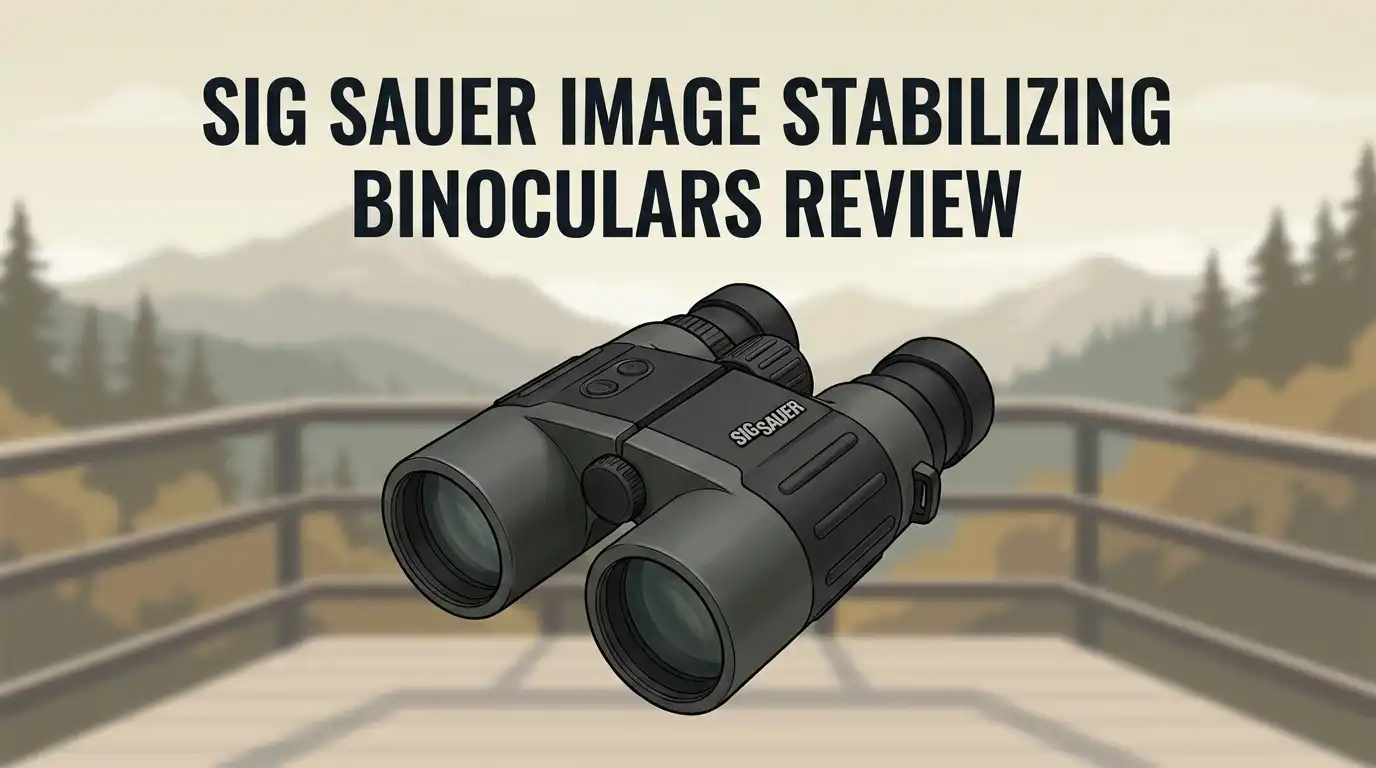
Sig Sauer Image Stabilizing Binoculars Review: Worth It?
You raise a 16x binocular to your eyes and the image jumps like a dropped phone. That shake is the reason most hunters leave high magnification at home and settle for 10x glass.
Sig Sauer built the ZULU6 HDX line to kill that problem without a tripod. It uses gyroscopic Optical Image Stabilization to cancel hand tremor at magnifications that are normally unusable freehand.
I spent time with the 16x42mm ZULU6 HDX, cross-checked it against long-term owner reports, and compared it to the newer HDX Pro and the Canon IS lineup. Here is what holds up and what does not.
In a Nutshell
- Two stabilization modes, not one. Scan Mode smooths panning across a hillside. Target Mode adds up to 50% more stability and locks the view almost tripod-still once you find your animal.
- Weight is the real headline. At 21.9 ounces and 7.08 inches long, the 16×42 is lighter than most Canon IS models and packable in a chest harness.
- Optics are good, not alpha. Center resolution impresses. Edge sharpness drops off, and several owners report a blue cast near the periphery.
- Battery life is honest. One AA battery runs roughly 30 hours. The system auto-shuts off after five minutes of idle time, which saves you from your own forgetfulness.
- Built for weather. IPX7 waterproof and fog-proof, with a thermoplastic body and rubber armor. Owners have run these through dust storms and coastal downpours without failure.
- Best for mobile glassers. Truck hunters, timber bowhunters, boaters, and anyone with unsteady hands gain the most. Tripod-based long-range glassers gain the least.
Sig Sauer ZULU6 HDX 16x42mm Image Stabilizing Binocular

Last update on 2026-07-25 / Affiliate links / Images from Amazon Product Advertising API Some of the links on this website are affiliate links, which means that at no additional cost to you, I earn a commission if you click through and make a purchase. I only recommend products and services that I believe will add value to my readers. Thank you for your support!
This is the model most buyers land on. The 16x magnification paired with 42mm objectives hits the sweet spot between reach and carry weight.
Sig pairs HDX glass with SpectraCoat anti-reflection coatings, LensArmor abrasion resistance, and a LenShield oleophobic layer that sheds water and fingerprints.
The prism system is Schmidt-Pechan, which keeps the body short. Field of view sits at 3.8 degrees, and near focus is a usable 13.1 feet.
Eye relief is 14mm, which is the first real compromise. That number is tight for eyeglass wearers and it shows in practice.
Diopter adjustment runs plus or minus 3, and interpupillary spacing covers 56mm to 70mm. Most adult faces fit without trouble.
The whole package is tripod mount capable, though a separate adapter is required. Sig includes a foam carrying case and a neck strap.
Street pricing hovers near $1,199, which places it below alpha European glass and below the Canon 10×42 L IS WP.
Unboxing and Build Feel
The box is plain. Inside sits a foam carry case, the binocular, a neck strap, eyecup covers, and a single AA battery.
First contact is strange. This is a unibody shell, not two barrels on a hinge, because the stabilization gimbal needs one housing.
Only the eyepieces swivel to set eye spacing. The objectives stay fixed, which feels wrong for about ten minutes and then stops mattering.
The rubber armor is flat dark earth and smooth. It looks premium and it is slick, especially with wet hands.
Weight distribution is the pleasant surprise. The body balances forward but stays controllable one-handed, which matters for bowhunters.
The focus wheel turns with light resistance and no grit. Diopter adjustment holds position once set.
The IS toggle sits on top near the focus wheel. You can reach it with an index finger without breaking your grip.
Fit and finish read as serious field tool rather than luxury optic. Nothing rattles, nothing flexes.
How the Two Stabilization Modes Perform
Flip the switch and the view settles within a second. The effect is not subtle.
Scan Mode is the default. It softens tremor while you grid a hillside and keeps the image fluid during panning.
Target Mode is the reason people buy these. Owners describe the view as rock solid, close to tripod steady, once you lock onto a stationary subject.
The practical gain is detail. You count points on a buck, read brands on cattle, or resolve texture in shadow that a handheld 10x simply cannot deliver.
One long-term user glassed a mile of beach in 30 mph gusts with an elbow braced on driftwood and called it easy work.
The system stays engaged without holding a button, unlike several Canon models. It runs five minutes, then powers down.
There is a learning curve. The first session feels floaty, almost like the image is swimming, until your brain accepts it.
Leave IS running while the binocular hangs at your chest and the view will wander when you raise it again. Toggle it off between looks.
Top 3 Alternative for Sig Sauer ZULU6 HDX Binoculars


Last update on 2026-07-25 / Affiliate links / Images from Amazon Product Advertising API Some of the links on this website are affiliate links, which means that at no additional cost to you, I earn a commission if you click through and make a purchase. I only recommend products and services that I believe will add value to my readers. Thank you for your support!
Canon 10×42 L IS WP

Last update on 2026-07-25 / Affiliate links / Images from Amazon Product Advertising API Some of the links on this website are affiliate links, which means that at no additional cost to you, I earn a commission if you click through and make a purchase. I only recommend products and services that I believe will add value to my readers. Thank you for your support!
Fujinon Techno-Stabi TS16x28WP

Last update on 2026-07-25 / Affiliate links / Images from Amazon Product Advertising API Some of the links on this website are affiliate links, which means that at no additional cost to you, I earn a commission if you click through and make a purchase. I only recommend products and services that I believe will add value to my readers. Thank you for your support!
Canon 12×36 IS III
Optical Quality in Daylight and Low Light
Center-field resolution is genuinely good. Bark texture, hair patterns, and antler tines separate cleanly at several hundred yards.
Color rendition runs cool. Side-by-side comparisons show a blue bias against the warmer Canon look, and colors read slightly muted next to alpha glass.
Edge performance is the weak point. Sharpness falls off before the field stop, and the effect is visible if you look for it.
Chromatic aberration is well controlled on the HDX generation. Owners upgrading from the original ZULU6 report noticeably less fringing.
Low light is limited by physics. A 16×42 produces a 2.6mm exit pupil, so dawn and dusk performance trails a 10×42.
The 20×42 version drops to a 2.1mm exit pupil and becomes fussy about eye placement, with frequent blackouts. Most experienced users step back to 16x.
Stabilization partially offsets the dimmer view. A steady image reveals detail that a brighter but shaking image hides.
Honest summary: good glass with excellent stabilization, not alpha glass with a bonus feature.
Ergonomics, Grip, and Eye Relief
The unibody shape encourages a two-hand cradle, and the battery housing sits naturally in the crook of your thumb.
One-handed use works well. That single trait makes these popular with archery hunters who need a free hand for the bow.
The twist-up eyecups click into position and hold. They do not creep under pressure.
Eyeglass wearers face a problem. 14mm of eye relief is marginal, and several users see a blue ring at the field edge with glasses on.
Contact lens users report no such issue, which points squarely at eye positioning rather than a coating defect.
The smooth armor lacks texture where you need it most. Wet hands slip, and a few owners have nearly dropped theirs while repositioning.
The longer body limits harness options. Standard bino chest packs sized for a 10×42 will feel cramped.
The included eyecup covers are loose, untethered, and easy to lose. Treat them as shipping protection, not field gear.
Battery Life and Power Management
The 16×42 runs on a single AA battery and Sig rates it near 30 hours. Real-world use tracks close to that number.
The larger HDX Pro models use two AA batteries and claim up to 40 hours of runtime.
AA power is a deliberate choice and a smart one. You can buy replacements at any gas station in any hunting town.
Lithium AAs extend runtime meaningfully in cold weather and weigh less than alkaline. Worth the upgrade for backcountry trips.
The five-minute auto shutoff is a genuine battery saver. It also prevents the drifting-image problem when you lower the binocular.
Carry one spare and you are covered for a full week hunt. Carry two if temperatures drop below freezing.
There is no rechargeable pack and no USB port. Some buyers will see that as dated, others as field-proof simplicity.
The binocular works as a normal optic with the battery dead, so a failure never leaves you blind.
Durability, Waterproofing, and Field Abuse
The IPX7 rating means full submersion survival at one meter for thirty minutes. The original pre-HDX model was only IPX4.
Nitrogen purging handles the fog-proofing. Users report no internal condensation after temperature swings.
One reviewer subjected a ZULU6 to heavy dust on two pronghorn hunts, then torrential rain across a full blacktail season. No adverse effects.
The thermoplastic frame keeps weight down. It does not feel as reassuring as magnesium, but no field failures have surfaced.
LensArmor coatings resist scratching from casual lens cleaning and brush contact. The oleophobic LenShield layer makes water bead and roll.
Electronics inside a hunting optic worry people. That concern is fair, though multi-season owner reports have been quiet on failures.
Sig backs the line with the Infinite Guarantee, an unlimited lifetime warranty that transfers between owners with no receipt required.
That warranty is arguably the strongest argument for buying new rather than used.
The Downsides Nobody Advertises
Marketing calls this a tripod replacement. It is not. It is a tripod supplement.
Extended glassing sessions still favor a tripod-mounted 15x. Arms tire, and stabilization does not fix fatigue.
Mounting the ZULU6 on a tripod does not stack benefits. The IS system needs some motion to reference and behaves oddly on a rigid platform.
The yo-yo effect is real. Stop the binocular abruptly and the image keeps drifting for a beat before settling.
Some users find Target Mode harder to focus precisely than Scan Mode. Opinions split sharply on this point.
Optical compromise is baked into the price. Sig spent budget on the stabilization system, and the glass reflects that tradeoff.
You can buy optically superior non-stabilized binoculars for the same $1,200. Several people will prefer that trade.
The slick armor, loose lens caps, and harness fit issues are small irritations that add up over a season.
Who Should Skip These Binoculars
Backcountry backpack hunters counting ounces who already carry a spotting scope will find these redundant.
Dedicated open-country glassers who spend hours behind a tripod gain little. A 15x on sticks still wins for endurance sessions.
Serious birders chasing color accuracy may dislike the cool cast and soft edges. Alpha 8×42 glass serves them better.
Eyeglass wearers with strong prescriptions should try before buying. The 14mm eye relief is a genuine barrier.
Low-light specialists hunting the last ten minutes of legal light will want a larger exit pupil.
Buyers who distrust electronics in the field should stay with conventional glass. There is no shame in that position.
Anyone expecting alpha optical performance at this price will be disappointed regardless of how well the stabilization works.
Everyone else, especially hunters who glass from vehicles, boats, ridgelines, or timber, will likely be surprised.
Price, Warranty, and Final Verdict
Last update on 2026-07-25 / Affiliate links / Images from Amazon Product Advertising API Some of the links on this website are affiliate links, which means that at no additional cost to you, I earn a commission if you click through and make a purchase. I only recommend products and services that I believe will add value to my readers. Thank you for your support!
The 16×42 HDX sits around $1,199. The HDX Pro 16×50 with OmniScan stabilization runs closer to $1,699.
The Pro adds a digital accelerometer that scales stabilization to your movement, larger 50mm objectives, and improved coatings.
It also weighs 33.6 ounces against 21.9. That weight difference decides the purchase for most walking hunters.
Value depends entirely on your use case. If you glass on foot, from a UTV, or from a rocking boat, the stabilization pays for itself.
If you already own a tripod, a spotter, and alpha binoculars, this becomes a third tool rather than a replacement.
My verdict: worth it for mobile glassers, skippable for tripod purists. The stabilization is not a gimmick.
Multiple experienced hunters who own Swarovski glass still reach for the ZULU6 first. That says more than any spec sheet.
Buy it understanding the optical ceiling, and it will change how you hunt.
Frequently Asked Questions
Do these work with eyeglasses?
Marginally. The 14mm eye relief on the 16×42 is tight, and glasses wearers often see a blue ring at the field edge. Try before you commit.
Can I mount them on a tripod?
Yes, with a separate adapter. However, the stabilization system does not improve on a rigid tripod and may behave unpredictably. Turn IS off when mounted.
How long does one battery last?
Around 30 hours on a single AA for the 42mm models, and up to 40 hours on two AAs for the HDX Pro 50mm models. Lithium cells perform better in cold.
What is the difference between HDX and HDX Pro?
The Pro adds OmniScan accelerometer-driven stabilization, 50mm objectives, upgraded lens coatings, and dual battery compartments. It also costs more and weighs significantly more.
Which magnification should I choose?
The 16×42 is the most recommended balance. The 10×30 excels for timber and one-handed use. The 20×42 suffers from blackouts due to its small exit pupil.
Are they good for astronomy?
Surprisingly capable on the moon and bright clusters thanks to Target Mode. Deep-sky performance is limited by the 42mm aperture compared to 50mm alternatives.
Do they work for boating?
Yes, and Sig now offers a marine version with a floating strap. Stabilization on a moving deck is where this technology shines brightest.
What warranty applies?
Sig’s Infinite Guarantee covers the optic for life, transfers to new owners, and requires no receipt or registration card.

Hello, I’m Emily Price, the founder of Birds Affection. As a passionate bird enthusiast and spiritual seeker, I’ve always been fascinated by the symbolic meanings and mystical connections between birds and our lives. On this website, I share my knowledge and insights on the spiritual significance of various bird species, exploring their roles as messengers, guides, and teachers. Through my writing, I aim to inspire and educate others on the profound wisdom and beauty that birds bring to our world. Join me on this journey as we delve into the enchanting realm of bird symbolism and discover the hidden meanings behind these magnificent creatures.