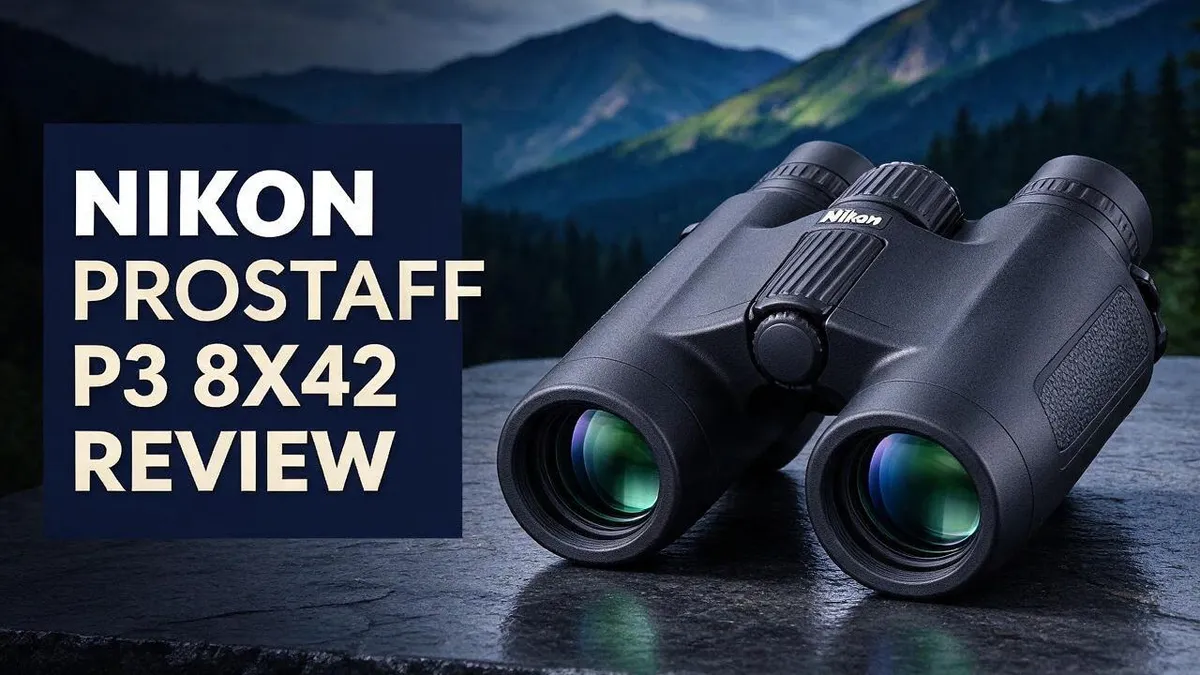
Nikon Prostaff P3 8×42 Review: In-Depth Breakdown
Want binoculars that work well right out of the box? The Nikon Prostaff P3 8×42 aims to deliver exactly that.
This pair gives you bright, clear views thanks to its 42mm lenses. They gather plenty of light for dawn and dusk outings.
The body is lightweight and rubber armored. It feels sturdy and secure in your hands. The focus wheel moves fast and adjusts with ease.
Nikon also made these binoculars waterproof, fogproof, and drop resistant. Glasses wearers get 20.2 mm of eye relief, plus comfy eyecups.
In this review, we look at the specs, the strengths, and the weak spots. Then you can decide if the P3 deserves a place in your bag.
In a Nutshell
-
Wide, easy views: The 377 ft field of view at 1,000 yards helps you find and follow moving subjects with little effort.
-
Good for eyeglass wearers: The 20.2 mm eye relief and twist up eyecups let you see the full image comfortably, with or without glasses.
-
Close and far: The 9.8 ft close focus works well for butterflies, birds in a nearby bush, and other small details nearby.
-
Smooth handling: The focus wheel moves fast and adjusts easily, so you can sharpen the view in seconds.
-
Clear in damp air: The nitrogen filled body keeps the inside free of moisture, so lenses stay clear in changing weather.
-
The trade off: These binoculars use silver prism coatings and no phase coating. One comparison also says they lack full multicoating. Rivals like the Nikon Prostaff P7 or Vortex Razor HD may offer sharper contrast for demanding users.
Optical Quality and Image Brightness


Last update on 2026-10-13 / Affiliate links / Images from Amazon Product Advertising API Some of the links on this website are affiliate links, which means that at no additional cost to you, I earn a commission if you click through and make a purchase. I only recommend products and services that I believe will add value to my readers. Thank you for your support!
Brightness matters most when the light fades. The Nikon Prostaff P3 8×42 offers a 5.3 mm exit pupil. That size lets more light reach your eyes at dusk.
Your eye pupil often opens wider in dim settings. A matching exit pupil helps the image stay bright without strain. You can watch deer or waterfowl during the last hour of daylight with less effort.
Color is another part of optical quality. When you scan a wooded area, colors matter. Clear optics help greens and browns look natural. That contrast makes camouflaged animals easier to pick out.
Edge sharpness also matters. A clear image near the outer edges keeps birds in view as you pan across a branch line. Sharp edges make scanning feel natural.
Glare control plays a role on bright days. Sunlight reflecting off water or snow can wash out details. Good light transmission cuts that haze, so your view stays crisp from morning until evening.
Shadows deserve attention too. Dense brush can hide fine detail in dark corners. A bright, even view helps you separate shadow from actual movement, which saves time on every hike.
Silver coatings do affect contrast a bit. You may notice slightly less punch in high contrast scenes compared with phase coated models. For most casual outings, the brightness still feels satisfying.
Steady hands reduce blur, so the bright image looks sharper. Rest your elbows on a fence or tree trunk when light runs low.
Test the optics in person before you decide. Look at a tree line, a sign, and a shaded area. If details look bright and clean, these binoculars will likely serve you well.
Field of View, Focus and Eye Relief
Think of field of view as the window you look through. A wider window helps you keep a moving target in sight. Sweeping across a meadow feels smooth, not jumpy.
Panning becomes easier when the view stays open at 8x. You can follow a hawk across the sky without losing your place. Your eyes spend less energy hunting for the subject again.
Focus works best in two simple steps. First, find the subject roughly with your eyes. Then turn the wheel slowly until fine details snap into place.
Practice on a fence post or sign first. This trains your hand and eye to work as a team. Small, repeated turns feel natural after a few outings.
Eye placement matters as much as the binoculars. Hold the unit steady and move your eye until the full circle appears. A small shift can dim the image or crop the edges.
Skip the glasses? Fold the eyecups down so your eye sits closer to the lens. This simple move gives a wider view with less effort.
Scan in slow arcs from left to right. Pause for a few seconds at each stop. This method catches movement faster than rushing from one spot to another.
Use a tripod or lean on a tree when you watch distant birds. Steady support keeps the image calm. Calm images make focus easier to hold.
Check the focus at both near and far distances. A quick test on a nearby leaf and a distant roof shows how the wheel responds. This habit helps you judge the close focus range.
Field of view, focus, and eye placement work as a team. Practice each step at home before your next trip. Your comfort grows with every outing.
Good habits make the binoculars feel like an extension of your hands.
Build, Weight and Grip
The Nikon Prostaff P3 8×42 feels light from the moment you pick it up. Many hunters and hikers want a pair they can carry all day. This model answers that need well.
The body wraps in a rubber armor coating. This coating cushions the frame. It also gives your fingers a firm place to rest. The texture feels pleasant against bare skin.
Dropping binoculars on rocks is a common fear. The solid build handles bumps with ease. You can toss it into a pack without much worry.
Grip deserves a closer look. The rubber surface stays secure even when your hands feel damp. Sweat or light rain will not make the body slip as easily.
The center hinge feels firm. It holds the barrels in place without wobbling. A loose hinge can throw off your view. This hinge stays steady during regular use.
Hand size affects comfort. Smaller hands fit around the barrels with little strain. Larger hands may rest the thumb on the center area for better balance.
Long watching sessions show the real comfort level. The lightweight frame reduces neck and shoulder fatigue. Pair it with a neck strap for even better control. Many users forget this detail, but weight distribution matters too.
Tip: Hold the binoculars with both hands. Tuck your elbows near your ribs. This stance keeps the view steady and the body relaxed.
Overall, the build suits outdoor use. The grip feels secure. The weight stays easy to carry. Shoppers who value a comfortable everyday pair will appreciate this.
Top 3 Alternatives
Looking for a different pair of binoculars? These three options all offer solid performance for everyday outdoor use. Each one suits a slightly different need.
Vortex Crossfire HD

Last update on 2026-10-05 / Affiliate links / Images from Amazon Product Advertising API Some of the links on this website are affiliate links, which means that at no additional cost to you, I earn a commission if you click through and make a purchase. I only recommend products and services that I believe will add value to my readers. Thank you for your support!
The Vortex Crossfire HD is a great choice for beginners and experienced users alike. Its fully coated lenses deliver bright, clear images in dim light at dawn or dusk.
The rubber armor gives a secure grip when your hands are wet or cold. Many owners also praise the sharp focus across the whole view.
Celestron Nature DX

Last update on 2026-08-27 / Affiliate links / Images from Amazon Product Advertising API Some of the links on this website are affiliate links, which means that at no additional cost to you, I earn a commission if you click through and make a purchase. I only recommend products and services that I believe will add value to my readers. Thank you for your support!
The Celestron Nature DX suits birdwatchers and nature lovers who want natural colors. Its ED glass lenses reduce color fringing around bright edges.
Birds and leaves look rich and true to life. The body feels light, so you can carry it all day on a long trail. It also works well for wildlife trips and scenic hikes.
Bushnell Engage

Last update on 2026-11-24 / Affiliate links / Images from Amazon Product Advertising API Some of the links on this website are affiliate links, which means that at no additional cost to you, I earn a commission if you click through and make a purchase. I only recommend products and services that I believe will add value to my readers. Thank you for your support!
The Bushnell Engage is a good fit for casual outdoor fans and families. It offers a wide field of view, so you can scan large areas quickly.
The compact design slips easily into a daypack or jacket pocket. Eye relief is comfortable for people who wear glasses. This model handles sports games, hiking trips, and stargazing nights with ease.
Weather Resistance and Durability
Weather can change fast when you spend time outdoors. Your gear needs to handle rain, dust, and cold without fuss.
The Nikon Prostaff P3 8×42 is waterproof. Light rain or a splash from a creek will not harm the internal parts, so you can keep scanning during a steady drizzle.
Nitrogen fills the inside of the barrels. This helps the glass stay dry when a cold morning turns into a warm afternoon. Sudden temperature swings often cause fogging, so this matters on early starts.
Dust and grit cause a different kind of wear. Fine sand can work its way into moving parts over time. After a dusty hike, wipe the outer surfaces with a soft dry cloth and let them air out. Never blow hard into the lenses, because breath can leave residue.
Salt air near the coast brings another risk. Salt spray can settle on the body and the lens surfaces. Wipe away residue with a damp cloth, then dry the binoculars fully.
Cold weather brings its own challenges. Thick gloves make small controls harder to reach. Take a moment to practice the focus wheel at home so you feel ready in the field.
Good habits also extend the life of your binoculars. Keep them in a padded case away from hot car dashboards. Heat and direct sunlight can stress the seals and the finish over many seasons.
Think of durability as a mix of design and care. The sealed build gives you a strong start, and simple habits do the rest. Treat your binoculars well, and they will serve you for years.
Coatings and Prism Technology Explained
Coatings and prism technology shape how bright and sharp your view looks. Light travels through many glass surfaces inside binoculars. Each surface can reflect some light away from your eyes.
Coatings are thin layers applied to lens and prism surfaces. They cut reflections and help more light reach your eye. Good coatings give you a clearer picture in the field.
The Nikon Prostaff P3 8×42 uses silver prism coatings instead of phase coatings. Silver reflects light well, but it may not keep colors as even as phase coatings do. You may notice this difference when you compare it with premium models.
Light also needs a path through the prisms. Roof prisms fold that path to keep the body compact. Phase coatings on roof prisms keep light waves in step. This helps fine details look crisp.
Reviews also note that this model is not fully multicoated. Some glass surfaces may carry only a single layer. Light loss can add up across all those surfaces. Still, the bright 42mm lenses make up for part of that loss.
Here is a simple check. Look at the lens surfaces in good light. A purple or blue tint often signals strong multicoating. A dull or weak glow may suggest fewer layers.
Prism technology also affects color balance. Your eye may see slightly warmer or cooler tones depending on the coating. Test the optics on a green forest and a gray sky. Watch how each scene looks before you decide.
Coatings matter most in low light at dawn or dusk. Bright images help you spot wildlife in shade. Good light transmission keeps details visible when the sun drops. Choose the view that feels natural to you.
Best Uses: Birding, Hunting and Outdoor Viewing
The Nikon Prostaff P3 8×42 fits many outdoor plans. Birders, hunters, and wildlife watchers each use it in their own way.
Birding in forests and fields. The 8x power shows fine feather detail without making the image shake. A wide view also helps you follow a warbler as it hops between branches.
Close looks at small creatures. The close focus of 9.8 feet lets you study butterflies, dragonflies, and flowers without stepping back.
Hunting in early light. The 42mm lenses gather plenty of light. You can scan a tree line before sunrise or stay out until dusk.
Glassing open country. Hunters often sit still and scan wide meadows or ridges. The wide field of view covers more ground with each sweep. Less time moving the binoculars means more time spotting movement.
Tracking movement at the edge of a meadow. Animals often step in and out of cover near the edge of a field. A quick scan helps you catch the moment they appear.
Viewing wildlife from a distance. Animals near lakes, rivers, and rocky slopes often stay far away. This model keeps them in clear view across open water.
Watching shorebirds and waders. Shorelines offer open views of birds that feed in shallow water. The 5.3 mm exit pupil keeps the image comfortable when the light softens at sunset.
Hiking with a purpose. Trail walkers can stop often to check a bird or animal. The 42mm lenses keep the view bright even under tree cover.
Planning your trips. These binoculars shine in daylight and twilight. Very dim light after dark still limits the view, so plan outings around the hours when light is strong.
Sharing the view. Kids, friends, and guides often take turns with one pair on group outings. Everyone can enjoy the same scene without needing a second pair.
Pros and Cons
Pros
– Wide field of view of 377 feet at 1,000 yards helps you track moving birds.
– Eye relief cups let glasses wearers see the full image.
– Fast focus wheel makes quick adjustments easy.
– Close focus of 9.8 feet suits small subjects up close.
– Light body makes long walks and hikes easier.
Cons
– Silver prism coatings may look less crisp than phase coated rivals in harsh sunlight.
– The 8x power offers less reach than higher magnification models for distant targets.
– Many close competitors make it harder to pick the right model.
Who Should Buy It
Some people will enjoy this model more than others. It suits new binocular owners who want a simple pair. The controls stay easy to learn, so you can start viewing right away.
Casual nature walkers also gain a lot here. A morning stroll through a city park can reveal woodpeckers, ducks, and songbirds. This pair handles those quick sightings with ease. Kids and adults both enjoy spotting these birds.
Sports fans make another good match. Many people use binoculars at ballgames, race tracks, or outdoor concerts. The view stays easy to hold in the stands.
Families with kids often want gear that works for everyone. Adults can share one pair, and older children can learn to focus it on their own. Nature trips become a shared activity.
Travelers who want one pair for everything may also like it. It works on boat rides, mountain overlooks, and scenic road trips. Fewer bags means more room for the fun stuff.
Who might want something else? People who need more zoom for far off targets should look at higher power models. Astronomy fans will need different tools as well.
Beginners often feel nervous about buying optics. This model gives a friendly start without a steep learning curve.
Gift buyers can also feel confident here. A pair like this suits teens, parents, and grandparents alike. Many people appreciate a gift they can use every week.
Before you decide, think about where you will use them most. Choose this pair if you plan regular outings close to home. Your daily habits should guide the final choice.
Overall, this pair suits people who want reliable everyday views. It keeps outdoor fun simple for most users.
Final Verdict
The Nikon Prostaff P3 8×42 is a dependable pair of binoculars for people who want clear views with little fuss. It holds its own in a crowded 8×42 class.
Build quality stands out first. The body is nitrogen filled, so it resists fog when the weather shifts fast. It is also waterproof and drop resistant.
The rubber armor gives your hands a secure grip. Wet fingers and cold mornings do not make it slip. That adds confidence on muddy trails.
The optics deliver bright, clear images in most conditions. The 42mm lenses pull in plenty of light. Colors look natural, and long sessions feel comfortable.
The coatings are the main trade off. The silver prism coatings are not phase coated. One comparison also says the lenses are not fully multicoated. Picky viewers may spot this in harsh light.
Rivals can fill that gap. The Nikon Prostaff P7 and the Nikon Monarch HG offer a finer optical finish. The Vortex Razor HD aims even higher for demanding users.
The Bushnell Engage and the Celestron Ultima also compete in this size. Compare a few before you commit, and you will feel sure about your choice.
Nikon built its name on optics, and this model shows that care. You get honest performance without extra gadgets or complicated settings. Most users will pick it up and feel at home in minutes.
Our verdict: the Prostaff P3 8×42 is a solid, tough, easy to use choice. It rewards you with dependable views season after season.
Pick it if you want a sturdy partner that handles rain, bumps, and daily use. Look at premium models if you need the sharpest glass available.
Frequently Asked Questions
What does the exit pupil mean for dim light?
The exit pupil is the bright circle of light you see when you look through the eyepieces. The Prostaff P3 8×42 has a 5.3 mm exit pupil. A larger circle like this helps your eyes take in more light at dawn and dusk.
Why does the nitrogen filling matter?
The tubes hold nitrogen gas instead of plain air. This keeps moisture out, so the inside lenses stay clear. You can move from cold air to warm air without seeing a foggy haze on the glass. This feature matters most on wet, humid mornings when moisture builds up fast.
How should I clean the lenses?
Start with a soft lens brush to remove dust and grit. Then wipe the glass with a clean microfiber cloth. Skip paper towels, because they can scratch the coatings over time. Gentle care keeps your views sharp for years.
Can I use these in cold weather?
Yes, the nitrogen fill and sealed body handle cold conditions well. Still, let them warm up slowly when you come indoors. This step stops condensation from forming on the lenses. Store them in a dry case overnight too, so your next outing starts clear.

Hello, I’m Emily Price, the founder of Birds Affection. As a passionate bird enthusiast and spiritual seeker, I’ve always been fascinated by the symbolic meanings and mystical connections between birds and our lives. On this website, I share my knowledge and insights on the spiritual significance of various bird species, exploring their roles as messengers, guides, and teachers. Through my writing, I aim to inspire and educate others on the profound wisdom and beauty that birds bring to our world. Join me on this journey as we delve into the enchanting realm of bird symbolism and discover the hidden meanings behind these magnificent creatures.