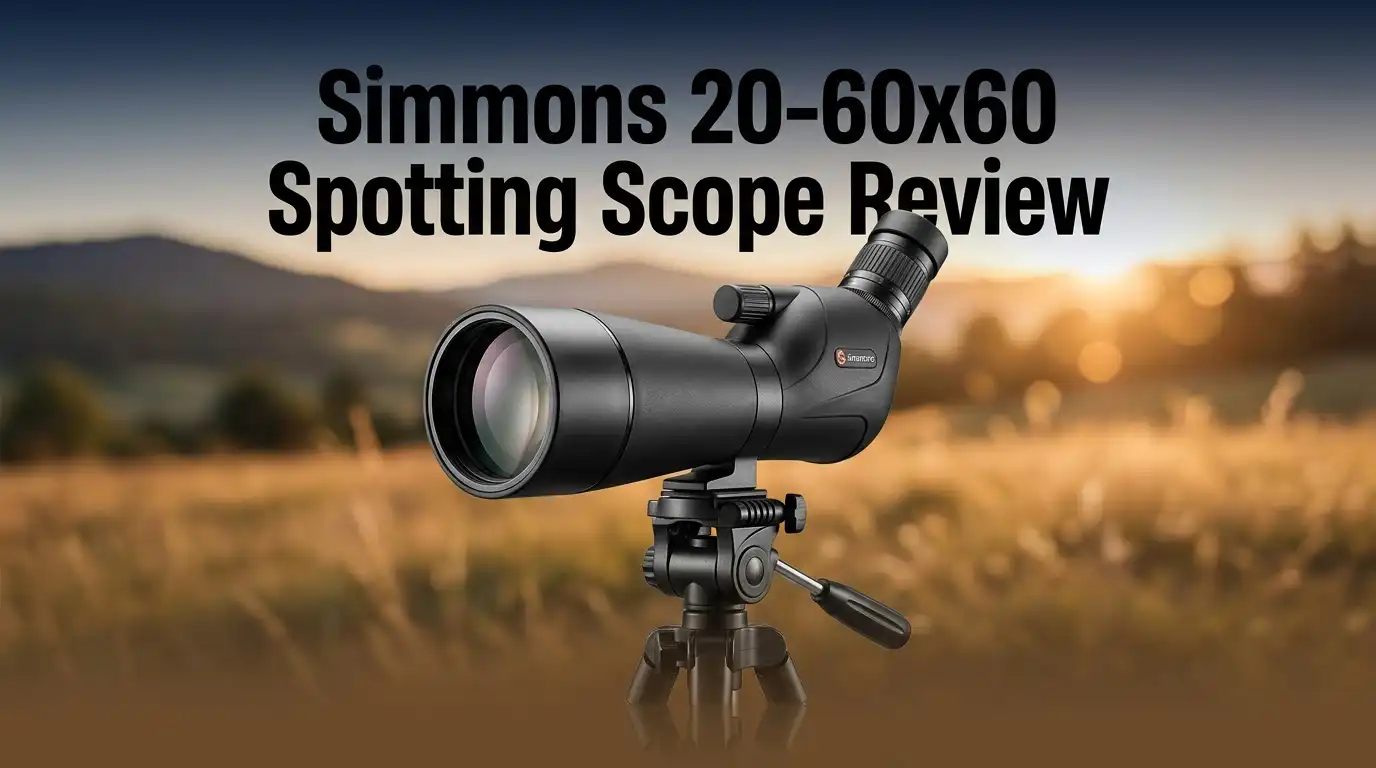
Simmons 20-60×60 Spotting Scope Review 2026: Worth Buying?
Long range viewing gear used to cost a small fortune. Today you can grab a 60mm zoom spotter for less than the price of a decent pair of boots. The Simmons 20-60×60 sits right in that budget zone, and shooters keep asking the same thing: does cheap glass still show bullet holes at 200 yards?
I spent several range days, two early morning bird sessions, and one very windy afternoon with this scope. I checked it against published specs, compared notes with other owners, and pushed the zoom ring until the image fell apart.
This review covers what the Simmons does well, what it fumbles, and who should skip it entirely. No marketing fluff, just honest observations from the eyepiece.
In A Nutshell:
- Price beats performance here. The Simmons 20-60×60 usually sells under $150 with a tripod and two cases included. That bundle alone explains most of its popularity. You get a complete kit, not just a tube.
- Usable magnification tops out near 30x. The zoom ring says 60x. Your eye disagrees. Past roughly 30x the image dims, softens, and loses contrast fast. Treat the upper range as emergency power, not daily power.
- The 60mm objective limits light gathering. Exit pupil drops to 1mm at full zoom. That is tiny. Dawn and dusk viewing suffers badly compared to 80mm scopes in the same price bracket.
- Build quality feels better than expected. Rubber armor, nitrogen purging, and a solid focus knob give the body a reassuring feel. It survives rain, fog, and a truck bed without complaint.
- The included tripod is the weakest link. It is a small tabletop unit. It wobbles under wind and under any magnification above 25x. Budget another $40 for a real field tripod.
- Best for casual range use and daytime glassing. Paper punchers at 100 yards, backyard birders, and campers will be happy. Serious hunters and competition shooters should spend more.
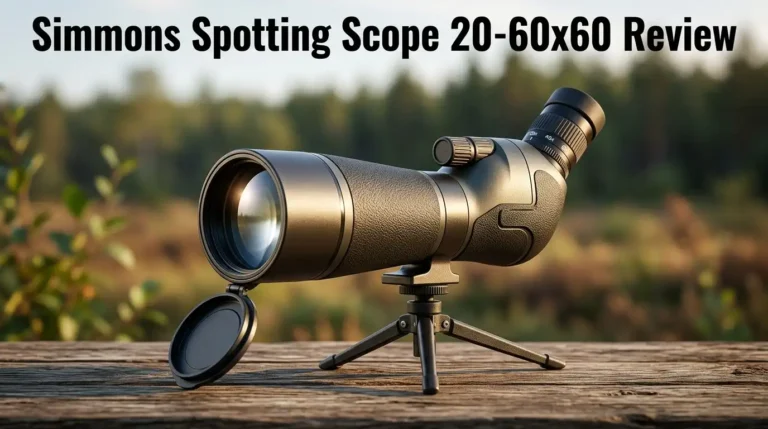
Simmons 20-60×60 Spotting Scope Overview

Last update on 2026-09-20 / Affiliate links / Images from Amazon Product Advertising API Some of the links on this website are affiliate links, which means that at no additional cost to you, I earn a commission if you click through and make a purchase. I only recommend products and services that I believe will add value to my readers. Thank you for your support!
The Simmons Venture 20-60×60 is an entry level straight body spotting scope. Simmons has built budget optics since 1983, and this model follows the same formula: functional glass, generous accessories, and an aggressive price tag.
The scope uses a 60mm objective lens with fully multi coated optics and BK7 prisms. The eyepiece sits in line with the tube, which helps you find targets quickly. A retractable sunshade slides out from the front to cut glare.
Field of view measures 100 feet at 1000 yards on the low setting and drops to 50 feet at full zoom. Eye relief runs from 15.2mm down to 12.7mm. The body weighs about 32 ounces and stretches 13.8 inches long.
Simmons ships the scope with a tabletop tripod, a hard plastic case, and a soft carry case. That package matters. Most rivals at this price give you one flimsy bag and nothing else. You are buying a complete starter kit, not a bare optic.
Unboxing Experience And First Impressions
The box arrives heavier than you expect. Mine weighed just over seven pounds shipped. Inside, a black hard shell case takes up most of the space, with the soft case folded beside it.
Pop the latches and the scope sits in molded foam. The rubber armor feels grippy and slightly tacky, the kind that holds fast in wet hands. Lens caps are tethered rubber, which is a nice touch at this price. Nothing rattled loose in transit.
First thing I noticed: the zoom collar turns smoothly, almost too smoothly. It rotates with one finger. The focus knob has more resistance and lands where you want it without overshooting. Both controls feel better than the price suggests.
The tabletop tripod, though, deflates the mood instantly. It is light, short, and made mostly of plastic with thin metal legs. The window mount clamp feels flimsy. The scope impressed me in the first minute. The tripod disappointed me in the second.
Key Specifications Explained
Numbers tell you more than marketing copy, so let me translate the important ones.
The 60mm objective is the front lens. Bigger glass pulls in more light. At 60mm you are on the small side for a spotting scope, since 80mm models dominate this category.
Exit pupil measures 3mm at 20x and shrinks to 1mm at 60x. Your pupil opens to about 5mm in dim light. A 1mm exit pupil means a dark, squinty image. This single number explains most of the scope’s high power weakness.
Eye relief of 15.2mm at low power works fine for eyeglass wearers. At 60x it tightens to 12.7mm, so glasses users lose edges of the view.
BK7 prisms cost less than BAK4 prisms. They can produce slightly squared off exit pupils and softer edge detail. The difference shows in side by side comparisons.
Close focus sits around 30 feet. Do not buy this for butterfly watching in the garden.
Optical Performance In Real Use
Here is the honest verdict from behind the glass. At 20x to 25x the Simmons delivers a bright, pleasing, and surprisingly sharp image. Colors look natural. Contrast holds up in midday sun. At those settings I had no complaints.
Push to 30x and the picture stays acceptable. You notice a slight softening at the edges and a small drop in brightness, but details remain readable.
Past 35x the image degrades quickly. Brightness falls off, chromatic aberration appears as purple fringing on high contrast edges, and fine detail smears. At the full 60x setting the view resembles looking through a dirty window in a dim room.
Atmospheric heat shimmer makes this worse. On a hot range at 200 yards, 60x turns the target into wobbling soup. That happens with expensive scopes too, but good glass recovers faster.
Realistic expectation: this is a very good 25x scope wearing a 60x label. Accept that and you will enjoy it.
Top 3 Alternative for Simmons 20-60×60 Spotting Scope

Last update on 2026-07-01 / Affiliate links / Images from Amazon Product Advertising API Some of the links on this website are affiliate links, which means that at no additional cost to you, I earn a commission if you click through and make a purchase. I only recommend products and services that I believe will add value to my readers. Thank you for your support!
Emarth 20-60×60 Angled Spotting Scope

Last update on 2026-09-13 / Affiliate links / Images from Amazon Product Advertising API Some of the links on this website are affiliate links, which means that at no additional cost to you, I earn a commission if you click through and make a purchase. I only recommend products and services that I believe will add value to my readers. Thank you for your support!
Gosky Updated 20-60×80 Spotting Scope


Last update on 2026-07-01 / Affiliate links / Images from Amazon Product Advertising API Some of the links on this website are affiliate links, which means that at no additional cost to you, I earn a commission if you click through and make a purchase. I only recommend products and services that I believe will add value to my readers. Thank you for your support!
Celestron Ultima 20-60×80 Angled Spotting Scope
Build Quality, Tripod And Cases
The scope body earns genuine praise. Matte black rubber armor wraps the tube and absorbs knocks. Nitrogen purging and O ring seals keep moisture and internal fog out. I left mine in drizzle for twenty minutes with no clouding inside.
The sunshade extends with a firm pull and stays put. The fold down eyecup works for both glasses wearers and bare eye viewing. Nothing on the body feels like it will break in the first season.
The tripod is a different story. Its short legs mean you must place the scope on a bench, tailgate, or shooting table. There is no standing use. At 30x, a light breeze introduces visible shake. Touching the focus knob sends the image dancing.
Both cases do their jobs. The hard case protects the kit during travel. The soft case makes field carry easier, though the strap is thin.
Buy a proper aluminum tripod with a fluid head. It transforms this scope more than any other upgrade.
Target Shooting Performance
Range shooters make up most of the buyers here, so this section matters most.
At 100 yards the Simmons spots .223 holes in white paper at 25x on a bright day. Holes in black bullseyes need more effort and better light. I could confirm hits but not always call exact scoring rings.
At 200 yards, .30 caliber holes appear as faint gray dots at 30x, and only in good conditions. Smaller calibers vanish. Pushing to 50x to compensate makes things worse, since the image dims exactly when you need more detail.
At 300 yards, forget bullet holes. You can see splash on steel and confirm impacts on reactive targets, and that is the realistic ceiling.
Shoot at high contrast targets and this scope performs noticeably better. Orange stick on dots or splatter targets help enormously.
For a 100 yard rimfire or centerfire bench session, it does the job. For load development at distance, it will frustrate you.
Bird Watching And Wildlife Use
Birders have different needs than shooters. They want brightness, a wide field, and a fast focus at dawn.
The Simmons handles daytime feeder watching and open field glassing well. At 20x you get a wide 100 foot view at 1000 yards, which makes tracking movement easy. Plumage colors look reasonably accurate in sunlight.
Two problems appear quickly. First, the 30 foot close focus rules out nearby subjects. Birds at your window feeder stay blurry. Second, the straight body forces awkward neck angles when looking upward at treetops. Most dedicated birders prefer an angled eyepiece for that reason.
Low light performance also disappoints. Golden hour is prime bird time, and a 60mm objective with BK7 prisms simply does not gather enough light. The image turns gray and flat.
Casual daytime birders will find it useful. Serious birders should choose an 80mm angled scope instead.
What This Scope Does Not Do Well
Every honest review needs this section, so here is the plain truth.
It does not deliver usable 60x magnification. The top half of the zoom range exists mainly on the label. Anyone buying this for maximum power will feel cheated.
It does not perform at dawn or dusk. The small exit pupil kills low light viewing. Compare it against an 80mm scope at first light and the gap is embarrassing.
It does not come with a usable field tripod. The tabletop unit only works on a solid, sheltered surface.
It does not focus close. Thirty feet is far for anyone wanting detailed views of nearby subjects.
It does not resolve small bullet holes past 150 yards. That limitation frustrates precision shooters more than any other.
It does not come with a lifetime no fault warranty like some rival brands offer.
None of these flaws are unusual at this price. They only become problems when expectations run too high.
Pros And Cons
Pros
- Excellent value bundle that includes the scope, tabletop tripod, hard case, and soft case in one box
- Sharp, bright image between 20x and 30x that satisfies most casual users
- Genuinely waterproof and fogproof thanks to nitrogen purging and sealed construction
- Tough rubber armor that handles bumps, rain, and rough transport without damage
- Smooth focus and zoom controls that feel more refined than the price suggests
- Light at 32 ounces, making it easy to carry in a range bag or daypack
- Straight body design helps you acquire targets quickly at the bench
Cons
- Magnification above 35x becomes soft and dim, so the 60x claim misleads buyers
- Poor low light performance caused by the small 60mm objective and 1mm exit pupil
- Included tripod wobbles and cannot be used standing in the field
- BK7 prisms deliver less edge sharpness than BAK4 glass found in some rivals
- Close focus of 30 feet limits nearby viewing
- Visible purple fringing on high contrast edges at higher power
- Warranty support lags behind brands like Vortex and Celestron
Who Should Buy It
Last update on 2026-09-23 / Affiliate links / Images from Amazon Product Advertising API Some of the links on this website are affiliate links, which means that at no additional cost to you, I earn a commission if you click through and make a purchase. I only recommend products and services that I believe will add value to my readers. Thank you for your support!
This scope suits a specific buyer, and matching that profile keeps you happy.
Buy it if you shoot paper at 100 yards and want to stop walking downrange after every group. At 25x it confirms hits, saves time, and pays for itself in convenience.
Buy it if you need a first spotting scope and do not yet know whether you will use one often. Spending $130 to learn your preferences beats spending $600 on a guess.
Buy it if you want a compact daytime glassing tool for camping, boating, or watching distant scenery.
Skip it if you shoot small calibers past 200 yards. Skip it if you hunt at dawn and dusk. Skip it if you plan serious birding, since an angled 80mm scope serves far better for similar money.
The Simmons rewards modest expectations and punishes ambitious ones. Know which camp you fall into before ordering.
Price, Value And Final Verdict
In 2026 the Simmons 20-60×60 typically sells between $110 and $160 depending on retailer and bundle. At that price the competition includes the Emarth 20-60×60, several Gosky models, and stretch options like the Celestron Ultima 80.
Value depends on how you weigh accessories. The Simmons includes two cases, which few rivals match. The optical quality sits roughly level with other 60mm budget scopes. The glass will not beat an 80mm scope costing $60 more.
My verdict: this is a solid 3.5 out of 5 spotting scope for casual daytime use. It does the basics well and hides its weaknesses as long as you stay near 25x.
If your budget can stretch another $60 to $100, an 80mm scope will serve you far longer. If your budget is fixed and you need something working this weekend, the Simmons gets the job done without regret.
Frequently Asked Questions
Can the Simmons 20-60×60 see bullet holes at 200 yards?
Sometimes. Holes from .30 caliber and larger in white paper appear at 30x in bright, still conditions. Small calibers like .22 and .223 are usually invisible at that distance. Use high contrast splatter targets to improve your odds.
Is the Simmons 20-60×60 waterproof?
Yes. The scope uses O ring seals and nitrogen purging, so it resists rain and internal fogging. I would not submerge it, but normal wet weather causes no problems.
Does it come with a tripod?
Yes. A small tabletop tripod with a window mount is included. It works on a bench or vehicle window but wobbles in wind and cannot be used standing.
What is the best magnification setting to use?
Between 20x and 30x. Image brightness and sharpness stay strong in that range. Higher settings look dim and soft on most days.
Is the Simmons better than the Emarth 20-60×60?
They perform similarly optically. The Simmons offers better cases and waterproofing. The Emarth offers an angled eyepiece that many birders prefer. Choose based on body style.
How long does the Simmons 20-60×60 last?
With reasonable care it lasts many years. The sealed body and rubber armor resist typical field wear. Store it in the hard case and keep lens caps on between sessions.

Hello, I’m Emily Price, the founder of Birds Affection. As a passionate bird enthusiast and spiritual seeker, I’ve always been fascinated by the symbolic meanings and mystical connections between birds and our lives. On this website, I share my knowledge and insights on the spiritual significance of various bird species, exploring their roles as messengers, guides, and teachers. Through my writing, I aim to inspire and educate others on the profound wisdom and beauty that birds bring to our world. Join me on this journey as we delve into the enchanting realm of bird symbolism and discover the hidden meanings behind these magnificent creatures.