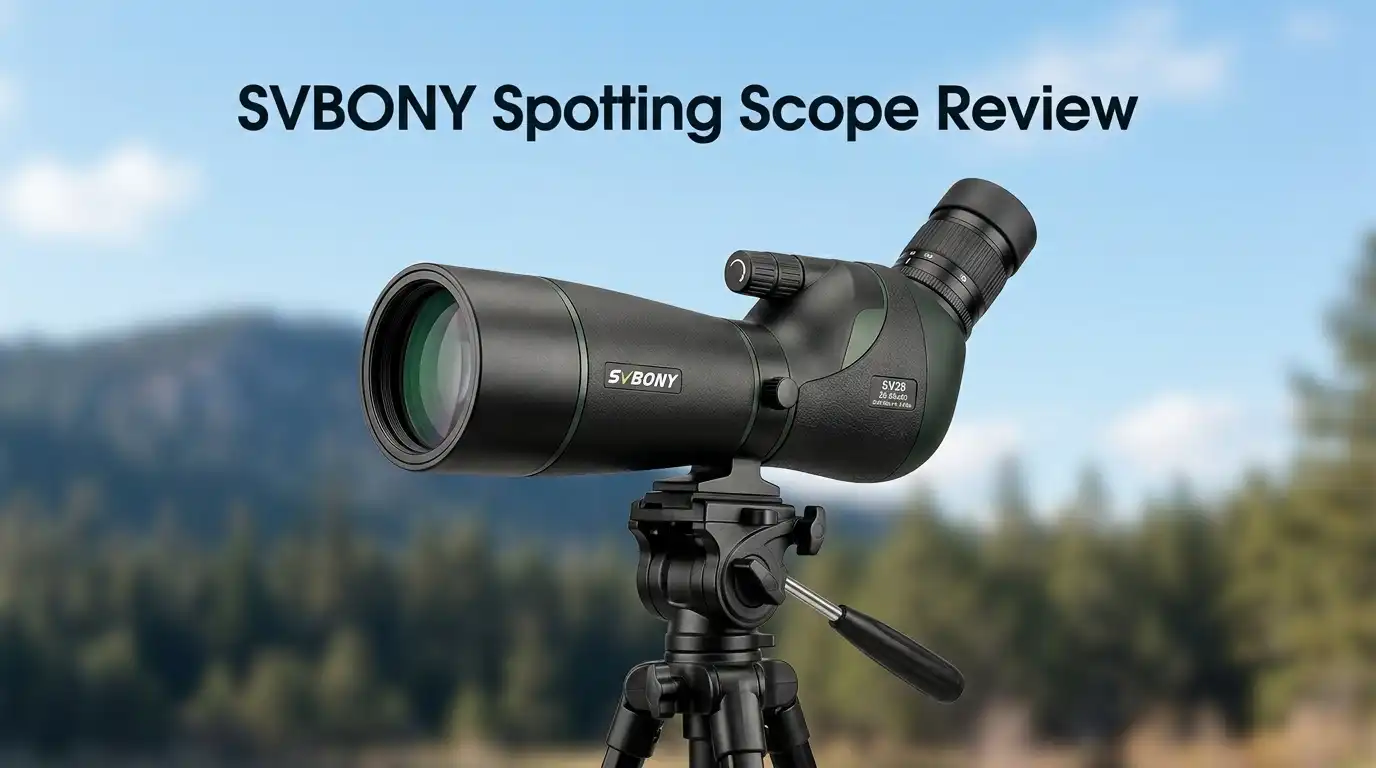
SVBONY Spotting Scope Review 2026: Worth Buying?
SVBONY sits in a strange spot. The brand sells 80mm ED spotting scopes for the price of a decent pair of binoculars. That pricing makes people suspicious, and it should. Cheap optics usually mean soft images, sloppy focusers, and fogged lenses after one rainy morning.
I have spent time with SVBONY glass in backyards, at ranges, and on cold mornings by a lake. The results surprised me in some areas and disappointed me in others.
This review covers the SV406P and the SV28, the two models most buyers compare in 2026. You will get real performance notes, honest weak points, and clear guidance on who should skip these scopes entirely.
In a Nutshell:
- The SV406P is the value pick. Its 80mm ED objective controls color fringing better than almost anything near its price. Images stay sharp from 20x through roughly 45x, which covers most real world birding and range work.
- The SV28 is a beginner scope, not a serious one. It performs fine inside 100 yards. Push it past that distance and image quality drops quickly. Treat the top of its zoom range as a rough framing tool, not a viewing setting.
- Included tripods are the weakest part of every bundle. The aluminum tripods shipped with these kits wobble badly above 40x. Budget an extra $60 to $120 for a stable tripod or your scope will underperform.
- Build quality punches above the price. Rubber armor feels solid, waterproof ratings hold up in light rain, and the focus wheels turn smoothly on most units.
- Quality control varies unit to unit. Some buyers report loose eyepieces or slight collimation issues. Buy from a seller with easy returns and inspect your scope within the first week.
- These scopes will not match Swarovski, Kowa, or Vortex Razor glass. They close maybe 70 percent of the gap at 15 percent of the cost, which is the actual selling point.
SVBONY SV406P 20x to 60x 80mm ED Spotting Scope

Last update on 2026-09-20 / Affiliate links / Images from Amazon Product Advertising API Some of the links on this website are affiliate links, which means that at no additional cost to you, I earn a commission if you click through and make a purchase. I only recommend products and services that I believe will add value to my readers. Thank you for your support!
The SV406P is the model that built SVBONY’s reputation among birders. It pairs an 80mm extra low dispersion objective with a 20x to 60x zoom eyepiece, and it accepts standard 1.25 inch astronomy eyepieces. That last detail matters more than the spec sheet suggests.
The ED glass does real work here. Chromatic aberration stays controlled on high contrast targets like dark branches against bright sky. You will see a faint purple edge at maximum zoom, but nothing distracting at normal viewing power.
Field of view measures roughly 108 feet at 20x and 60 feet at 60x, both at 1000 yards. Eye relief is comfortable enough for glasses wearers at lower magnifications, though it tightens noticeably as you zoom in.
The dual focus system is the standout feature. A coarse wheel gets you close, then a fine wheel locks in sharpness. At 60x, that fine adjustment becomes essential rather than optional.
Weight sits around 4 pounds with the eyepiece attached. This is a car to blind scope, not a backpacking scope.
Unboxing Experience: What Arrives in the Box
The SV406P ships in a plain cardboard box with dense foam inserts. Nothing feels premium about the packaging, and that is fine. The foam does its job.
Inside you find the scope body, the zoom eyepiece packed separately in a small bag, a padded nylon carry case, front and rear lens caps, a cleaning cloth, and a short manual. The carry case is genuinely useful, with a zipper that runs the length of the scope and cutouts that let you use the scope while it stays partly covered.
First impression on picking it up: the rubber armor grips well and the whole body feels dense. The rotating tripod collar turns with firm resistance and locks tight. That collar lets you shift from an angled eyepiece position to a side position without moving the tripod head.
One small annoyance appears immediately. The eyepiece thread needs a firm twist to seat properly, and the manual does not mention this clearly. Several buyers assume their scope is defective when the eyepiece simply is not fully tightened.
SVBONY SV28 25x to 75x 70mm Spotting Scope

Last update on 2026-07-01 / Affiliate links / Images from Amazon Product Advertising API Some of the links on this website are affiliate links, which means that at no additional cost to you, I earn a commission if you click through and make a purchase. I only recommend products and services that I believe will add value to my readers. Thank you for your support!
The SV28 targets a completely different buyer. It costs a fraction of the SV406P and uses standard multicoated glass rather than ED elements. The objective measures 70mm and the zoom runs from 25x to 75x.
Do not buy this scope for the 75x number. That top magnification exists on the box, not in usable practice. Image brightness falls off sharply past 45x and detail turns mushy. Most owners settle around 25x to 35x for anything they actually want to study.
Inside 100 yards, the SV28 performs well. Backyard birds at a feeder look bright and reasonably sharp. Paper targets at 100 yards show bullet holes clearly in good light. That is the honest scope of its ability.
Build quality is decent for the money. The body carries rubber armor, the focus wheel turns smoothly, and the IP rated sealing handles dew and light rain. The included tabletop tripod, however, is nearly useless above 30x.
Top 3 Alternative for SVBONY Spotting Scope


Last update on 2026-07-01 / Affiliate links / Images from Amazon Product Advertising API Some of the links on this website are affiliate links, which means that at no additional cost to you, I earn a commission if you click through and make a purchase. I only recommend products and services that I believe will add value to my readers. Thank you for your support!
Celestron Ultima 20 to 60x80mm Angled Spotting Scope

Last update on 2026-09-13 / Affiliate links / Images from Amazon Product Advertising API Some of the links on this website are affiliate links, which means that at no additional cost to you, I earn a commission if you click through and make a purchase. I only recommend products and services that I believe will add value to my readers. Thank you for your support!
Gosky Updated 20 to 60×80 Spotting Scope with Tripod

Last update on 2026-09-13 / Affiliate links / Images from Amazon Product Advertising API Some of the links on this website are affiliate links, which means that at no additional cost to you, I earn a commission if you click through and make a purchase. I only recommend products and services that I believe will add value to my readers. Thank you for your support!
Vortex Optics Diamondback HD 20 to 60×85 Spotting Scope
Optical Quality: Sharpness, Color, and Brightness
Optical performance separates these two models more than any other factor. The SV406P holds sharp center detail through roughly 45x, then softens gradually. The SV28 starts softening around 35x.
Edge sharpness is where budget scopes reveal themselves. Both SVBONY models show visible softening in the outer 20 percent of the field. Your eye naturally centers on the subject, so this bothers some users and passes unnoticed by others.
Color rendering leans slightly cool on the SV406P. Grays and browns look accurate, which helps with bird identification. The SV28 produces a warmer, slightly yellow cast that flatters landscapes but muddies subtle plumage differences.
Low light is the clearest weakness. At dawn and dusk, the 80mm ED objective gathers enough light for usable viewing until about 20 minutes after sunset. The 70mm SV28 gives up considerably earlier. Premium scopes stretch that window by 15 to 25 minutes, and serious birders pay heavily for exactly that advantage.
Contrast on both scopes drops when you point near a bright sky.
Build Quality, Weather Sealing, and Field Durability
SVBONY rates the SV406P at IPX5 or IPX7 depending on the production run, and the SV28 at IP65. Both ratings cover rain and splashes. Neither invites submersion.
Nitrogen purging prevents internal fogging on the SV406P, and this works as advertised in my experience. Moving a cold scope into a warm car produces exterior fogging only, which wipes away in seconds.
The rubber armor resists scuffs well. After months of use, my SV406P shows light marks on the objective end and nothing else. The tripod foot uses a standard quarter inch thread and includes a second mounting hole for better balance.
Here is the durability caveat. The zoom eyepiece collar on some units develops a gritty feel over time. This is not universal, but it appears often enough in owner reports to mention. SVBONY customer service generally responds to warranty claims, though shipping a scope back can take weeks.
Metal parts feel solid. Plastic parts, including the eyepiece caps, feel cheap and get lost easily.
Focus System and Zoom Feel
The SV406P’s dual focus arrangement is the single best reason to choose it over rivals at similar prices. The coarse wheel covers the full focus range in about one and a half turns. The fine wheel then moves in tiny increments.
At high magnification, fine focus stops being a luxury. Depth of field shrinks to almost nothing at 60x, and a single focus wheel makes precise adjustment frustrating. This system solves that problem well.
Resistance feels even across the range on most units. Some scopes arrive with a slightly stiff coarse wheel that loosens after a few weeks of use.
The zoom collar is less impressive. It requires a firm grip and tends to shift your aim slightly as you turn it. On a lightweight tripod, this means recomposing after every zoom change.
The SV28 uses a single focus wheel positioned on top of the body. It works acceptably at low power and becomes fiddly above 40x, where you hunt back and forth for the sharpest point.
Digiscoping: Phone and Camera Results
Both scopes accept phone adapters, and the SV406P also handles a T ring for mirrorless and DSLR bodies. This flexibility explains much of the brand’s popularity among hobbyist photographers.
Phone digiscoping produces usable social media images and little more. Expect vignetting at lower magnifications, visible softness at the frame edges, and heavy dependence on bright light. Aligning the phone camera with the eyepiece takes patience during your first several attempts.
The included or optional SVBONY adapters clamp securely but adjust slowly. Screw based alignment means you cannot quickly grab a shot of a bird that lands for three seconds.
Camera digiscoping through the 1.25 inch port gives better results. Removing the zoom eyepiece and attaching a camera directly turns the SV406P into roughly a 500mm lens at f/6.3. Images come out sharp in the center with noticeable falloff at the corners.
Shutter vibration becomes a real problem on lightweight tripods. Use a remote trigger or a timer delay.
Birdwatching Performance in Real Conditions
For backyard and park birding, the SV406P delivers genuinely satisfying views. A cardinal at 60 yards fills the field at 30x with clear feather detail and accurate color.
Shorebird work at distance exposes the limits. Identifying a distant sandpiper at 300 yards requires pushing past 45x, where atmospheric heat shimmer and optical softness combine against you. Premium scopes cut through this better, though even they struggle with heat waves.
Tracking moving birds works reasonably well at 20x thanks to the wide field. Above 40x, finding and following a bird becomes genuinely difficult without practice.
The angled eyepiece design helps more than beginners expect. It reduces neck strain during long sessions and lets multiple people of different heights share the scope without adjusting the tripod.
Eye relief tightens as magnification rises. Glasses wearers may need to remove their glasses above 40x, which frustrates people with strong prescriptions. The twist up eyecup adjusts smoothly and holds its position.
Target Shooting and Range Use
Range shooters have different priorities than birders. You need to see bullet holes in paper, and you need to see them quickly between strings.
At 100 yards, both scopes resolve .22 caliber holes clearly in good light. The SV28 handles this task competently and costs far less. At 200 yards, the SV406P pulls ahead noticeably, showing .223 holes on white paper without much effort.
At 300 yards, you need favorable light and steady air. Holes in white targets show as faint dots at 45x. Black targets make this much harder at any distance.
Mirage remains the real enemy. On hot days, heat shimmer above the ground degrades any scope’s image far more than glass quality does. Shooting early in the morning helps more than upgrading optics.
The angled eyepiece works awkwardly at a shooting bench. Many range users prefer a straight body design, which SVBONY offers in other models within the same lineup.
Astronomy Use: Moon, Planets, and Star Clusters
Spotting scopes make surprisingly capable casual astronomy instruments, and the SV406P’s 1.25 inch eyepiece port makes it far more flexible than most.
Lunar views are excellent. Craters along the terminator show clear shadow detail at 40x to 60x. The ED glass keeps the lunar limb free of obvious color fringing, which cheaper scopes cannot manage.
Jupiter shows its four main moons and two cloud belts. Saturn’s rings separate from the planet body around 50x. These are recognizable views, not detailed ones.
Bright open clusters like the Pleiades look genuinely beautiful with a wide eyepiece. The Orion Nebula shows its gray glow and the Trapezium stars resolve cleanly.
Deep sky performance stops there. An 80mm aperture simply cannot gather enough light for faint galaxies, and the alt azimuth tripod motion makes tracking tedious.
The SV28 handles moon viewing acceptably and struggles with everything else.
What SVBONY Spotting Scopes Do Not Do Well
Honest reviews list failures, so here are the real ones.
The included tripods are inadequate. This is the most common complaint and the most justified one. The bundled aluminum legs vibrate for several seconds after any touch, ruining high magnification viewing. Replace the tripod immediately.
Quality control is inconsistent. Most units arrive fine. A meaningful minority show decentered optics, stiff focusers, or dust specks inside the tube. Check your scope carefully during the return window.
High magnification claims oversell reality. The SV28’s 75x setting is marketing, not a usable feature. SVBONY is hardly alone in this practice, but it misleads first time buyers.
Low light performance lags behind premium glass by a wide margin. Dawn and dusk are prime wildlife hours, and this is exactly when the gap shows most.
Customer support responds slowly by North American standards. Warranty claims often involve international shipping and multi week waits.
The manuals are thin and poorly translated.
Pros and Cons of SVBONY Spotting Scopes
Pros
- Exceptional price to performance ratio. The SV406P delivers ED glass quality that cost three times more just a few years ago.
- Standard 1.25 inch eyepiece compatibility on the SV406P opens up a huge upgrade path with astronomy eyepieces.
- Dual focus system makes precise focusing at high magnification genuinely pleasant rather than frustrating.
- Solid weather sealing and nitrogen purging handle rain, dew, and temperature swings without internal fogging.
- Rotating tripod collar allows flexible viewing angles without repositioning your tripod head.
- Complete kits include a carry case, caps, and cleaning cloth, so nothing essential is missing except a good tripod.
Cons
- Included tripods are too flimsy for use above 40x and need immediate replacement.
- Edge softness affects the outer portion of the field on both models.
- Top magnification settings are largely unusable, especially on the SV28.
- Unit to unit quality varies, with occasional focuser and alignment issues.
- Low light performance falls short of premium scopes during the best wildlife viewing hours.
- Customer service is slow and warranty returns can take weeks.
- Eye relief tightens uncomfortably at high zoom for glasses wearers.
SVBONY vs Celestron, Gosky, and Vortex
The Celestron Ultima 80 costs somewhat more than the SV406P and delivers a slightly clearer, better corrected image with a smaller and lighter body. Celestron’s customer service is meaningfully better in North America. The Ultima lacks ED glass, so color fringing shows more on high contrast targets.
Gosky occupies the same budget space as the SV28. Its 20x to 60x 80mm model offers a larger objective for similar money, but optical consistency varies at least as much as SVBONY’s. Gosky bundles tend to include more accessories and weaker glass.
The Vortex Diamondback HD sits in a different class entirely at several times the price. It gives cleaner edges, better low light performance, and an unlimited unconditional warranty that replaces your scope no questions asked.
That warranty alone justifies the gap for serious users. For casual users, SVBONY captures most of the practical performance for a small fraction of the cost.
Who Should Buy an SVBONY Spotting Scope in 2026?
Buy the SV406P if you are a serious hobbyist on a real budget. It suits backyard birders, range shooters working inside 300 yards, and casual astronomers who want lunar and planetary views without buying a telescope.
Buy the SV28 only if your viewing stays inside 100 yards. It works for feeder watching, backyard use, and short range target work. Anyone planning distance viewing will outgrow it within a season.
Skip SVBONY entirely if you are a professional guide, a competitive long range shooter, or a birder who chases rarities at extreme distance. Your work demands better glass and faster warranty support, and the price difference will pay for itself in frustration avoided.
Also skip these scopes if you cannot budget for a proper tripod. A $250 scope on a $40 tripod performs worse than a $150 scope on a solid one.
For everyone else, SVBONY offers the best value available in 2026.
Frequently Asked Questions
Is SVBONY a reliable brand?
SVBONY is a Chinese optics manufacturer that has built a solid reputation in budget astronomy and birding gear over the past decade. Reliability is generally good, though quality control varies more than with premium brands. Most units perform as advertised. Buy from a seller with a straightforward return policy so you can exchange a problem unit quickly.
Which SVBONY spotting scope is best for birdwatching?
The SV406P is the strongest choice for birding. Its 80mm ED objective controls color fringing well, the dual focus system handles precise adjustment, and the 1.25 inch eyepiece port lets you upgrade optics later. Birders working mostly at feeders or short distances can save money with the SV28.
Do I really need a better tripod?
Yes. This is the single most impactful upgrade you can make. The included tripods vibrate noticeably at any magnification above 40x, which cancels out the scope’s optical quality. A tripod rated for at least 10 pounds with a fluid pan head transforms the viewing experience.
Can I use an SVBONY spotting scope for astronomy?
The SV406P works well for moon viewing, bright planets, and open star clusters. Saturn’s rings and Jupiter’s cloud bands are visible. Deep sky objects beyond the brightest nebulae remain out of reach because an 80mm aperture gathers limited light.
How far can these scopes see clearly?
The SV406P gives clear, detailed views out to roughly 300 yards under good conditions. The SV28 performs well inside 100 yards. Atmospheric conditions, heat shimmer, and available light affect real world range more than the scope specifications do.
Are SVBONY scopes waterproof?
Both models carry water resistance ratings that handle rain, snow, and dew. The SV406P includes nitrogen purging to prevent internal fogging during temperature changes. Neither scope is designed for submersion, so avoid dropping one in a stream.

Hello, I’m Emily Price, the founder of Birds Affection. As a passionate bird enthusiast and spiritual seeker, I’ve always been fascinated by the symbolic meanings and mystical connections between birds and our lives. On this website, I share my knowledge and insights on the spiritual significance of various bird species, exploring their roles as messengers, guides, and teachers. Through my writing, I aim to inspire and educate others on the profound wisdom and beauty that birds bring to our world. Join me on this journey as we delve into the enchanting realm of bird symbolism and discover the hidden meanings behind these magnificent creatures.