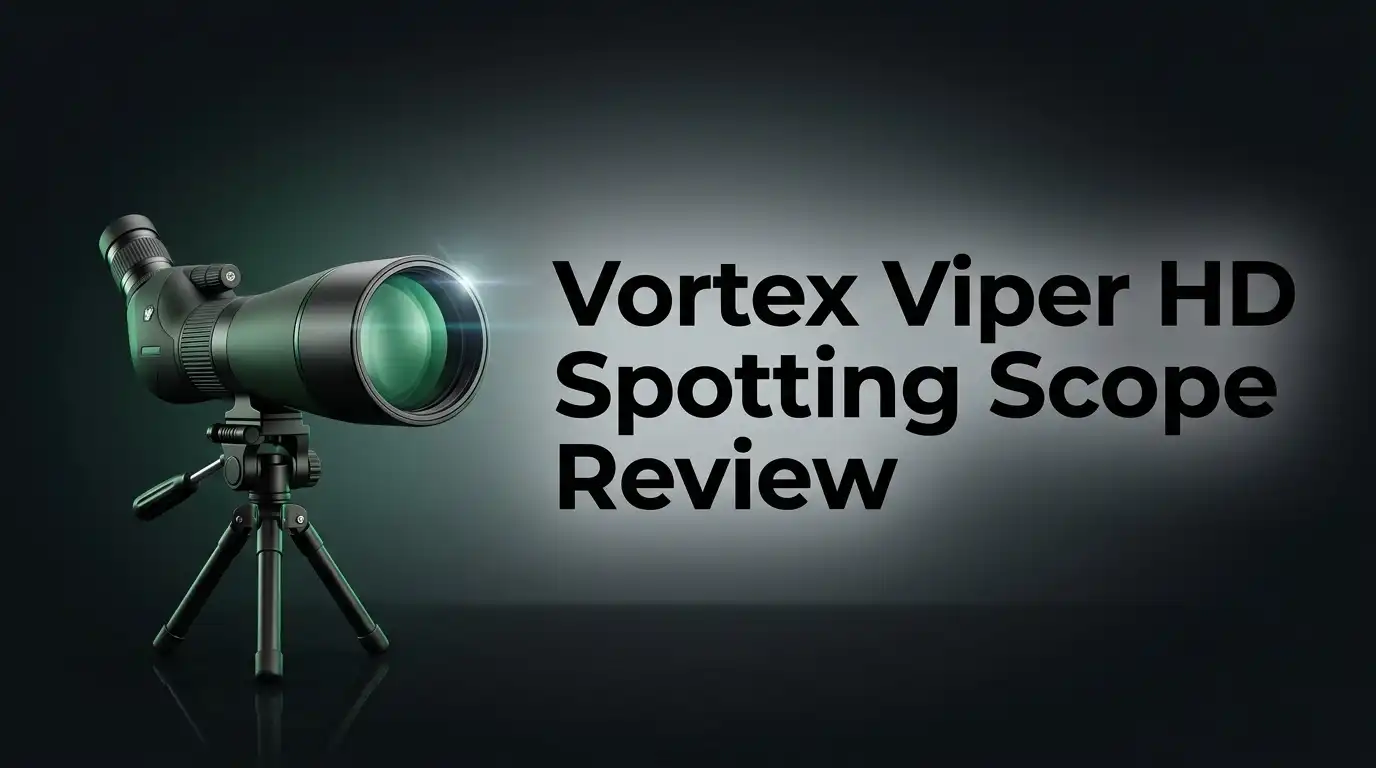
Vortex Viper HD Spotting Scope Review 2026: Still Worth It?
Buying a spotting scope feels like a gamble. You spend real money, you mount it on a tripod, and you hope the image looks better than the cheap glass you already own.
The Vortex Viper HD sits right in that uncomfortable middle zone between budget spotters and four figure European optics. It promises premium performance at a price that does not require a second mortgage.
This review covers what the Viper HD does beautifully, and just as importantly, where it falls short. No marketing fluff. Just field notes, measured specs, and honest opinions from someone who has hauled it uphill.
In a Nutshell:
- Optical quality punches above the price. The HD glass with XR Plus coatings produces sharp, color accurate images with very little purple fringing. At mid magnification the view looks genuinely premium.
- Build quality is excellent. Argon purged, O ring sealed, rubber armored, and Arca Swiss compatible right out of the box. No extra plate needed for most tripod heads.
- It is heavier than you expect. The 65mm model weighs 59 ounces. That is 3.7 pounds before you add a tripod. Backcountry hunters feel every ounce.
- The top of the zoom range gets soft. Image quality holds well up to about 35x on the 65mm and about 45x on the 85mm, then brightness and detail drop off.
- The VIP warranty is unlimited and unconditional. Vortex repairs or replaces it no matter what happened, no receipt required, and that policy has a strong track record.
- Best value picks are clear. Choose the 65mm for packing and birding. Choose the 85mm for range work and long distance glassing from a truck or fixed position.
What Is the Vortex Viper HD Spotting Scope?

Last update on 2026-09-20 / Affiliate links / Images from Amazon Product Advertising API Some of the links on this website are affiliate links, which means that at no additional cost to you, I earn a commission if you click through and make a purchase. I only recommend products and services that I believe will add value to my readers. Thank you for your support!
The Viper HD is Vortex’s mid tier spotting scope line. It sits above the Diamondback HD and below the flagship Razor HD. Vortex redesigned the whole Viper series, and the current version looks and feels nothing like the older models.
Two main configurations exist. The compact version offers 15x to 45x magnification with a 65mm objective lens. The larger version offers 20x to 60x magnification with an 85mm objective lens. Both come in angled and straight body styles, so you pick four possible combinations.
The core technology stays the same across the line. You get an HD optical system with extra low dispersion glass, XR Plus anti reflective coatings, dielectric prism coatings, and ArmorTek exterior lens protection. Every model uses a helical focus collar rather than a traditional focus knob.
The MSRP on the 65mm sits around $1,049 as of 2026, though street prices often land lower. That places it squarely in the serious hobbyist and working hunter category.
Unboxing Experience and First Impressions
The box arrives modest and unfussy. Vortex does not waste money on fancy presentation, which I appreciate because that money went into the glass instead.
Inside you find the scope wrapped in its neoprene cover, already fitted. That cover surprised me. It stays on while you use the scope, protects the body from scuffs and dings, and includes flaps that open for the eyepiece and objective. You also get an ocular lens cover, an objective lens cover, and a lens cloth.
Lifting the scope out is the moment that sells you. The weight feels reassuring rather than cheap. The rubber armor has a grippy texture that does not feel rubbery or sticky. The focus collar turns with a smooth, damped resistance that reminds me of scopes costing twice as much.
One small disappointment: no hard case is included at this price point. The padded storage case sells separately. For a scope near a thousand dollars, that stings a little.
Build Quality and Body Design
Vortex built this thing to get knocked around. The chassis is aluminum, wrapped in rubber armor, and the profile is deliberately smooth. There are no protruding knobs to snag on pack straps or truck doors.
The argon gas purge matters more than people realize. Nitrogen purged scopes work fine, but argon molecules are larger and leak out more slowly. That means better fog resistance over years of temperature swings, not just months.
The eyecup twists up and down with defined stops. I wear glasses, and the fully retracted position gives me a usable full field view. Eye relief runs from 17.8mm to 19.6mm, which is generous for a spotting scope.
My favorite design choice is the built in Arca Swiss compatible foot. You clamp it directly onto most quality tripod heads without buying an extra plate. That single feature saves you forty dollars and one more thing to lose.
The rotating tripod ring moves smoothly and locks firmly, so switching between horizontal and angled viewing takes two seconds.
Optical Performance in Daylight
This is where the Viper HD earns its reputation. In good light, the image looks bright, neutral in color, and sharp across most of the field.
Chromatic aberration control impressed me most. On high contrast subjects like a dark hawk against a white sky, I see only faint color fringing at the edges of the frame. The center stays clean. Cheaper spotters smear purple and green halos everywhere in that situation.
Edge sharpness holds up well until roughly the outer fifteen percent of the field. Beyond that, detail softens slightly. Honestly, most users never notice because you center your subject anyway.
Resolution at mid magnification is the sweet spot. On the 65mm model, 25x to 32x delivers a crisp, contrasty image that I can study for long periods without eye strain. I read rifle bullet holes in paper at 300 yards on a calm day.
Color fidelity leans neutral with a very slight warm bias. Animals look natural, not artificially punched up like some coated optics.
Top 3 Alternative for Vortex Viper HD Spotting Scope
If the Viper HD misses your budget or your needs, these three deserve a serious look.

Last update on 2026-09-13 / Affiliate links / Images from Amazon Product Advertising API Some of the links on this website are affiliate links, which means that at no additional cost to you, I earn a commission if you click through and make a purchase. I only recommend products and services that I believe will add value to my readers. Thank you for your support!
Vortex Diamondback HD 20x to 60×85 Angled Spotting Scope

Last update on 2026-09-17 / Affiliate links / Images from Amazon Product Advertising API Some of the links on this website are affiliate links, which means that at no additional cost to you, I earn a commission if you click through and make a purchase. I only recommend products and services that I believe will add value to my readers. Thank you for your support!
Athlon Optics Ares G2 20x to 60×85 UHD Spotting Scope


Last update on 2026-09-17 / Affiliate links / Images from Amazon Product Advertising API Some of the links on this website are affiliate links, which means that at no additional cost to you, I earn a commission if you click through and make a purchase. I only recommend products and services that I believe will add value to my readers. Thank you for your support!
Celestron Regal M2 80ED Spotting Scope
Low Light Performance at Dawn and Dusk
Legal shooting light and peak wildlife activity happen at the edges of the day. That is when a spotting scope proves its worth or exposes its limits.
The Viper HD performs well here, with an honest caveat. The 85mm model clearly outperforms the 65mm in dim conditions because it gathers more light. At dawn, the 85mm at 30x stays usable a solid ten to fifteen minutes longer than the 65mm at similar magnification.
Exit pupil math explains it. On the 65mm at 45x, your exit pupil shrinks to about 1.4mm. Your eye cannot use that efficiently in low light, so the image darkens noticeably. Dialing back to 20x or 25x restores brightness immediately.
Compared to a Razor HD, the Viper gives up maybe ten percent of low light detail. Compared to a Diamondback HD, it gains a clear step. The Viper sits exactly where its price suggests it should sit, which is a compliment.
The Helical Focus System Explained
Vortex swapped the traditional focus knob for a wide helical collar that wraps around the body. Opinions on this split hard.
Here is how it works. You rotate the textured collar, and the entire inner lens tube shifts forward or back. One control handles both fast adjustments and fine adjustments, so you never hunt for a second knob.
I like it a lot. The collar is huge, easy to find with gloves on, and takes about one and a half turns to run through the full focus range. The resistance feels smooth and consistent in cold weather, which is more than I can say for some geared focus systems.
The tradeoff is close focus distance. The 65mm model focuses no closer than 23 feet. The older Viper managed 16 feet. Butterfly watchers and anyone scoping a nearby feeder will find that frustrating.
For hunting and range work, close focus never matters. For backyard birding, it might.
The 85mm Model: Bigger Glass, Bigger Commitment

Last update on 2026-09-13 / Affiliate links / Images from Amazon Product Advertising API Some of the links on this website are affiliate links, which means that at no additional cost to you, I earn a commission if you click through and make a purchase. I only recommend products and services that I believe will add value to my readers. Thank you for your support!
The 20x to 60×85 version is a different animal. It stretches 17.5 inches long and weighs 76.6 ounces, which works out to nearly 4.8 pounds.
That extra aperture buys you real performance. Field of view runs 101 feet to 50 feet at 1000 yards. Eye relief matches the smaller model at 17.8mm to 19.6mm. Close focus sits at 36 feet, noticeably longer than the 65mm.
Where the 85mm shines is sustained high magnification. At 45x it stays bright and detailed in conditions where the 65mm starts struggling. Scoring targets at 800 yards or judging antler mass across a canyon becomes much easier.
The honest cost is portability. You need a genuinely sturdy tripod for this scope, not a lightweight travel model. Mine lives in the truck and comes out for range days and glassing from fixed positions.
If you hike more than two miles to your glassing spot, buy the 65mm instead.
Field Performance for Hunters
Western hunting is the use case Vortex clearly designed this for, and it shows.
Judging animals at distance requires resolving small details like antler tine length, ear tip spread, and body proportions. The Viper HD handles this reliably out to about 1000 yards in decent conditions on the 65mm model, and farther with the 85mm.
Mirage remains your real enemy, not the optics. On hot afternoons, heat shimmer destroys detail at any magnification. I learned to drop to 20x and wait for cooler air rather than blame the scope.
The snag free body genuinely helps. I strap it to the outside of my pack without the focus knob catching on brush. That sounds minor until you push through thick timber.
Setup speed is good. The Arca Swiss foot clamps on in about three seconds, so I am glassing before the animal moves. Angled bodies work better for sharing with a partner, straight bodies work better with window mounts.
Birding and Wildlife Observation
Birders will find a lot to like and one thing to dislike.
The good news covers image quality and color accuracy. Warbler plumage detail, subtle gray tones on gulls, and the fine barring on raptors all come through clearly. The neutral color rendering helps with identification because you see true colors rather than boosted ones.
The multi position eyecup handles eyeglass wearers well. The wide field at low magnification, 137 feet at 1000 yards on the 65mm, makes finding birds in trees reasonably easy.
The 23 foot close focus is the real limitation. Many dedicated birding scopes focus at 15 feet or closer. If you scope a pond edge from a blind twenty feet away, you are out of luck.
Also worth noting: the Viper HD does not accept interchangeable eyepieces. You are locked into the zoom that comes with it, which some birders find restrictive compared to scopes offering wide angle fixed eyepieces.
Target Shooting and Range Use
At the range, the Viper HD does its job without drama.
On the 65mm at 40x, I resolve .30 caliber bullet holes in white paper out to roughly 300 yards in good light. The 85mm at 50x stretches that closer to 400 yards on a cooperative day.
Reading mirage for wind calls works well because the scope has enough resolution to show the shimmer pattern clearly. Dial the magnification down and the mirage becomes easier to interpret.
Vortex also sells reticle eyepieces separately for the 85mm Viper HD, which helps spotters call corrections in MOA or MRAD. That accessory turns a hunting spotter into a legitimate precision rifle tool.
The helical focus deserves credit here too. Between strings of fire you refocus with one hand while keeping your eye at the eyepiece.
The scope will not replace a dedicated target scope with a fixed high power eyepiece, but for most shooters it removes the need for one.
Digiscoping With a Phone
Phone photography through the Viper HD works, with realistic expectations.
The eyepiece diameter measures 2.230 inches, and several adapter brands list compatible sizes for both the 65mm and 85mm models. Alignment matters enormously. A sloppy adapter produces vignetting and blur no matter how good the glass is.
Results at low to mid magnification look genuinely good. I have captured identifiable images of elk at 900 yards that were clear enough for scouting records. Color reproduction comes through accurately.
Push past 40x and phone sensors struggle. The narrow exit pupil starves the camera of light, so shutter speeds drop and any tripod vibration ruins the shot.
Two practical tips: use a heavy tripod and trigger the shutter with a timer or remote. Touching the phone ruins more digiscoping shots than any optical flaw.
This scope is not a photography instrument first. It is an observation tool that tolerates a camera reasonably well.
Weight, Packability and Tripod Requirements
Let us talk honestly about weight, because this is the Viper HD’s most criticized trait.
The 65mm weighs 59 ounces and measures 14 inches long. Competing 65mm scopes from other brands come in lighter, sometimes by a full pound. The extra mass comes from the aluminum chassis and the helical focus assembly.
Does it matter? For truck based hunting, range use, and casual birding, no. For a ten mile backcountry push where every ounce counts, yes. Add a tripod and head and you carry five to seven pounds total.
Tripod choice is not optional. A flimsy tripod turns excellent glass into a shaky mess. I recommend a carbon fiber tripod rated for at least ten pounds, paired with a smooth pan head or a ball head with a panning base.
The stability upside of a heavier scope is real. In wind, the Viper HD sits steadier than featherweight competitors.
What the Viper HD Does Not Do Well
Every honest review needs this section. Here is where the scope disappoints.
Top end magnification is soft. On the 65mm, image quality degrades noticeably above 35x. On the 85mm, above 45x. You have a zoom range you will rarely use fully, which feels like a spec sheet number more than a practical one.
Close focus is poor. 23 feet on the 65mm and 36 feet on the 85mm rules out close range nature study.
No interchangeable eyepieces. Premium competitors let you swap in wide angle or fixed power eyepieces. The Viper does not.
No hard case included. At this price, that omission feels stingy.
Weight. Already covered, but it bears repeating for backcountry users.
Not a Razor. Side by side with the Razor HD, the difference in edge sharpness and low light punch is visible. If your budget stretches, the Razor is better glass.
Pros and Cons of the Vortex Viper HD
Pros
- Outstanding optical value. HD glass and XR Plus coatings deliver clarity that competes with scopes several hundred dollars more expensive.
- Excellent chromatic aberration control. Very little color fringing on high contrast subjects, which keeps images clean and natural.
- Unlimited unconditional VIP warranty. Vortex repairs or replaces regardless of fault, with no receipt and no registration required.
- Arca Swiss foot built in. Direct mounting saves money and removes a failure point.
- Smooth helical focus. One large collar handles coarse and fine focus, works well with gloves, and stays snag free.
- Genuinely weatherproof. Argon purged and O ring sealed construction shrugs off rain, snow, and temperature swings.
- Included neoprene cover. Protects the body during use, not just in storage.
Cons
- Heavy for its class. 59 ounces on the 65mm and 76.6 ounces on the 85mm.
- Soft image at maximum magnification. The top third of the zoom range sees limited real use.
- Long close focus distance. A drawback for backyard birders and insect watchers.
- Fixed eyepiece only. No option to swap in specialty eyepieces.
- Hard case sold separately. An extra cost at a premium price point.
Price and Value in 2026
MSRP on the 65mm model runs around $1,049, and the 85mm typically runs higher. Street prices fluctuate, and retailers discount regularly, so patient shoppers save meaningfully.
Is that fair money? Compare the field. Below the Viper sits the Diamondback HD, which is a good scope but visibly behind in low light and edge sharpness. Above it sits the Razor HD, which is better in every optical measure but costs considerably more.
The Viper HD occupies the value sweet spot. You get roughly eighty five percent of Razor performance for a large price reduction.
The warranty deserves weight in the value calculation. An unlimited unconditional lifetime warranty with a genuine service reputation is not marketing filler. Drop the scope off a cliff and Vortex fixes it.
For a hunter or birder who plans to use one scope for twenty years, that coverage effectively lowers the long term cost of ownership.
Who Should Buy the Vortex Viper HD?
This scope fits specific people very well and other people poorly.
Buy it if you hunt the West and need reliable animal judging at distance, you shoot at a range regularly and want to score your own targets, you bird at moderate to long distances, or you want one durable scope that will last decades.
Buy the 65mm if you carry the scope any real distance or value a compact setup. Buy the 85mm if you glass from vehicles or fixed positions and want maximum low light capability.
Skip it if you count ounces on serious backcountry hunts, you need close focus for garden and pond observation, or you want interchangeable eyepieces.
Also skip it if your budget can genuinely reach the Razor HD. The step up is real, and buying once beats buying twice.
For everyone in between, the Viper HD remains one of the smartest optics purchases available in 2026.
Frequently Asked Questions
Is the Vortex Viper HD worth the money in 2026?
Yes, for most users. The optical performance closely approaches scopes costing significantly more, and the lifetime warranty protects your investment permanently. Newer competitors have narrowed the gap, but the Viper HD still holds a strong position on price to performance.
Should I choose the angled or straight body?
Choose angled if multiple people of different heights share the scope, if you glass uphill frequently, or if you want a lower tripod setup. Choose straight if you use a car window mount, need fast target acquisition, or glass mostly downhill from elevated positions.
How far can you see with the Vortex Viper HD?
The 65mm model judges game reliably to about 1000 yards and reads bullet holes to roughly 300 yards. The 85mm extends both figures noticeably. Atmospheric conditions and mirage limit real world performance far more than the optics do.
What tripod do I need for the Viper HD?
Use a tripod rated for at least ten pounds with a smooth pan head. Carbon fiber saves weight for field use. Avoid lightweight camera tripods because vibration will ruin your view at high magnification.
Does the Vortex Viper HD come with a case?
It includes a fitted neoprene cover that stays on during use, plus lens caps and a cloth. A padded hard storage case is sold separately.
How does the Viper HD compare to the Razor HD?
The Razor HD offers better edge sharpness, superior low light performance, and wider apparent field. The Viper HD delivers most of that performance for considerably less money. The Razor is the better scope, and the Viper is the better value.
Can I use the Viper HD for astronomy?
You can view the moon, bright planets, and star clusters with decent results. Dedicated astronomy telescopes gather far more light and reach much higher magnification. Treat astronomy as a bonus feature rather than a reason to buy.

Hello, I’m Emily Price, the founder of Birds Affection. As a passionate bird enthusiast and spiritual seeker, I’ve always been fascinated by the symbolic meanings and mystical connections between birds and our lives. On this website, I share my knowledge and insights on the spiritual significance of various bird species, exploring their roles as messengers, guides, and teachers. Through my writing, I aim to inspire and educate others on the profound wisdom and beauty that birds bring to our world. Join me on this journey as we delve into the enchanting realm of bird symbolism and discover the hidden meanings behind these magnificent creatures.