Bresser Bird Feeder Camera Review 2026: Worth It?
Bird watching has changed a lot in the past few years. Smart feeders now stream live video to your phone and name the species for you. So where does the Bresser Bird Feeder Camera fit into all of this?
It takes a very different approach. No app. No WiFi. No monthly fee. Just a feeder, a small camera, and a memory card that quietly collects photos while you go about your day.
This review covers the good parts, the weak parts, and the parts nobody mentions in the product listing. By the end, you will know whether this simple camera feeder deserves a spot on your tree or whether your money belongs elsewhere.
In a Nutshell:
- The Bresser Bird Feeder Camera is an offline device. It records photos and short videos to a microSD card. You remove the camera module and plug it into a computer to view your shots. There is no phone app and no live stream.
- Image quality sits at 1.5 megapixels. That was fine years ago. In 2026, it looks soft and grainy next to 2K and 4K smart feeders. Expect fun snapshots, not frame worthy prints.
- Battery life reaches roughly 30 days per charge. The internal lithium battery holds up well in mild weather. Cold temperatures shorten that number noticeably.
- Close focus is the real strength. The camera shoots birds from about 2 inches away. You see feather texture, eye rings, and beak detail that a long lens rarely captures.
- No subscription exists, and that matters. Many rivals charge monthly for cloud storage and species identification. Bresser charges nothing after purchase.
- Buy it for the hobby charm, not the specs. If you want species alerts, night vision, and HD video on your phone, a modern smart feeder serves you better.
What Is the Bresser Bird Feeder Camera?

Last update on 2026-10-07 / Affiliate links / Images from Amazon Product Advertising API Some of the links on this website are affiliate links, which means that at no additional cost to you, I earn a commission if you click through and make a purchase. I only recommend products and services that I believe will add value to my readers. Thank you for your support!
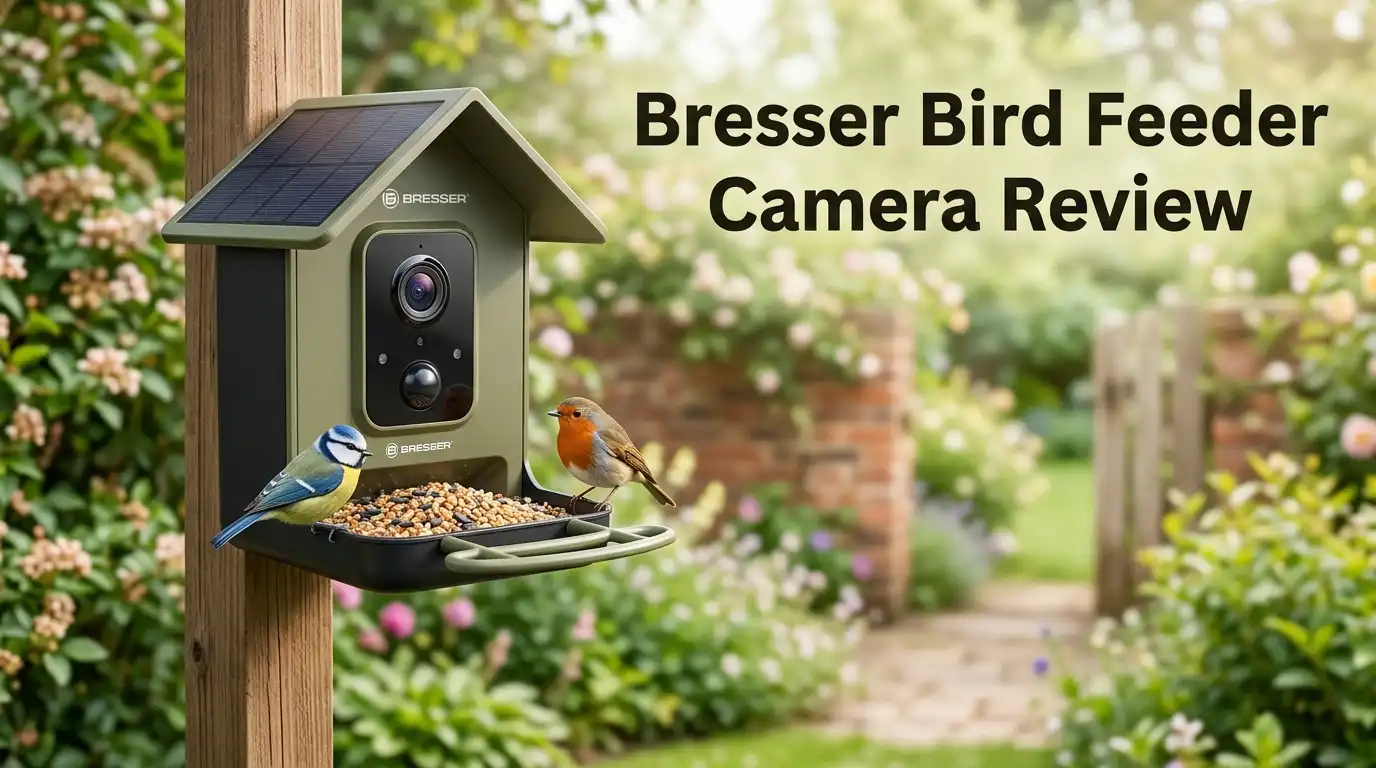
The Bresser Bird Feeder Camera is a seed feeder with a small camera built into the roof section. Bresser is a German optics brand known for telescopes, binoculars, and trail cameras. This product carries model number 40 40001 in most listings.
The concept is simple. You fill the hopper with seed or nectar. A bird lands. A motion sensor notices the movement. About one second later, the shutter fires. The image saves to a microSD card inside the camera module.
The camera module detaches from the feeder body. You carry it indoors, connect it to a Mac or PC with a USB cable, and browse your photos. The module resists water, so light rain does not end your session.
This is a closed loop device. Nothing leaves the card until you move it yourself.
Unboxing the Bresser Bird Feeder Camera
The box arrived in plain cardboard with a product photo on the front. Nothing fancy. Inside, the feeder body sat in a molded tray with the camera module packed separately in a foam cutout.
The contents list is short. You get the feeder housing, the removable camera module, a USB cable, a hanging cord, and a thin folded manual. No microSD card is included. No batteries either, since the battery lives inside the module and charges through USB.
First impressions were mixed. The plastic feels light in the hand, almost toy like. The camera module, however, has a reassuring solidity and a snug seal. Assembly took me under five minutes without reading much.
My honest reaction was quiet surprise at how small the whole package is. It looks modest on a shelf and even smaller hanging from a branch.
Design and Build Quality
The feeder uses a green and clear plastic shell. Seed sits behind a transparent panel so you can judge the level at a glance. A perch bar runs along the front, positioned directly in the camera’s field of view.
That perch placement is the smartest design choice here. Birds have one comfortable spot to stand, and that spot happens to be the focus zone. You get usable framing without any adjustment.
The weak point is material thickness. The plastic flexes under finger pressure. Squirrels chew it. One of my panels picked up scratch marks within two weeks.
The camera module seals well with a rubber gasket around the battery and card compartment. Water never reached my electronics, even during a heavy afternoon storm. Just close the latch fully every single time. A half closed latch invites moisture and ruins the day.
Top 3 Alternative for Bresser Bird Feeder Camera

Last update on 2026-07-01 / Affiliate links / Images from Amazon Product Advertising API Some of the links on this website are affiliate links, which means that at no additional cost to you, I earn a commission if you click through and make a purchase. I only recommend products and services that I believe will add value to my readers. Thank you for your support!
NETVUE Birdfy Smart Bird Feeder with AI Camera


Last update on 2026-07-01 / Affiliate links / Images from Amazon Product Advertising API Some of the links on this website are affiliate links, which means that at no additional cost to you, I earn a commission if you click through and make a purchase. I only recommend products and services that I believe will add value to my readers. Thank you for your support!
HARYMOR Smart Bird Feeder with Camera

Last update on 2026-08-27 / Affiliate links / Images from Amazon Product Advertising API Some of the links on this website are affiliate links, which means that at no additional cost to you, I earn a commission if you click through and make a purchase. I only recommend products and services that I believe will add value to my readers. Thank you for your support!
Bird Buddy Pro Solar Smart Bird Feeder with Camera
Setting Up the Bresser Bird Feeder Camera
Setup is refreshingly quick because there is no network to join. Buy a microSD card first. A 16GB or 32GB card works well and costs very little.
Slide the card into the module. Plug the USB cable into a charger and let the battery fill completely. Bresser suggests a full first charge, and I agree. My initial partial charge gave me weak results for two days.
Choose photo mode or video mode using the small switch inside the compartment. Video clips run short, which saves card space and battery.
Mount the feeder using the included cord or fix it to a flat surface. Height matters more than people expect. I settled on about five feet, within easy reach for refilling and high enough to discourage cats.
Total time from box to branch was fifteen minutes.
Image Quality in Real Use
Let us be direct. A 1.5 megapixel sensor produces small, soft images. Photos measure roughly 1600 pixels wide. You cannot crop much before detail falls apart.
In bright morning light, results are genuinely pleasant. Colors look natural. A goldfinch fills the frame with visible feather separation. The extreme close focus distance does heavy lifting here, because filling the frame hides resolution limits.
Overcast days are a different story. Images turn muddy and noisy. Fast moving birds blur because the shutter speed drops. I threw away more shots than I kept on grey mornings.
There is no night vision and no infrared illumination on this feeder model. Once light fades, the camera stops producing anything useful.
Set expectations around charming backyard snapshots. Treat anything sharper as a happy accident.
Motion Sensor and Trigger Speed
The sensor uses passive infrared detection with a short range of roughly one meter. That narrow range is deliberate. Swaying branches and distant movement do not waste your battery or your card space.
Trigger delay sits near one second. In bird photography, one second is a long time. A chickadee can arrive, grab a seed, and leave inside that window.
My hit rate ran around sixty percent. Larger, calmer visitors like doves, cardinals, and jays triggered reliably and stayed put. Small restless species often left an empty perch photo behind.
Patience fixes part of this problem. Across a full week, enough birds lingered long enough to produce a solid collection.
If you need instant capture of darting hummingbirds, this sensor will frustrate you. Slower feeder regulars suit it far better.
Battery Life and Charging
Bresser claims up to 30 days per charge. My experience landed close to that figure during mild spring weather with moderate bird traffic.
Two factors drain it faster. Cold weather cuts lithium battery performance significantly, and heavy visitor traffic means more triggers and more writes to the card. In a cold week, I got roughly eighteen days.
Charging happens through the USB cable. A full charge took about four hours from a standard phone adapter. There is no battery level indicator, which is the most annoying omission on the whole device. You simply guess.
My workaround was a calendar reminder every three weeks. Charge the module while you refill the seed hopper and you never miss a moment.
No solar panel option exists. That feels dated in 2026, when solar is standard on competing feeders.
Weather Resistance in Daily Use
The feeder is water resistant rather than fully waterproof. There is no published IP rating, which tells you something on its own.
In practice, it survived rain showers without complaint. The camera module stayed dry. Seed inside the hopper stayed mostly dry too, though humid stretches caused slight clumping near the bottom.
Direct driving rain is the real risk. Mount the feeder under eaves, a branch canopy, or a porch overhang if your area gets stormy. That single placement decision extends the product’s life considerably.
Cold does not damage the unit, but it reduces battery runtime and makes the plastic more brittle. I would bring it indoors during a deep freeze.
Sun exposure gradually fades the green plastic. Mine lost a little color after a month in full afternoon light.
Feeding Capacity and Bird Behavior
The seed hopper is small. I refilled every two to three days with steady traffic. If you host a busy backyard, daily refills become routine.
Small capacity has one upside. Seed stays fresh and never sits long enough to mold or attract pests at the bottom.
Birds accepted the feeder faster than I expected. House finches arrived on day two. Chickadees followed, then nuthatches and a pair of cardinals. The camera makes no noise and shows no light, so nothing spooked my visitors.
Squirrels are the real problem here. There is no baffle and no weight sensitivity. One determined squirrel emptied the hopper in a single afternoon and left tooth marks on the perch.
Sunflower hearts and nyjer worked best for me. Mixed cheap seed caused more mess than visits.
What the Bresser Bird Feeder Camera Does Not Do Well
Honesty time. This device has clear gaps, and you should know them before buying.
It cannot identify species. There is no AI, no database, no name tag on your photos. You do the identifying yourself, which some hobbyists enjoy and others find tedious.
It offers no live viewing. You will never watch a bird in real time from your sofa. Every image waits on the card until you fetch it.
It sends no notifications. No alert tells you a rare warbler just stopped by.
Low light performance is poor. Dawn, dusk, and cloudy days produce weak files.
The manual is also thin and lightly translated, leaving a few settings unexplained. Expect some trial and error during your first week.
Pros and Cons of the Bresser Bird Feeder Camera
Pros
- No subscription fees ever. Your photos belong to you on your own card, with no cloud account and no monthly charge.
- Excellent close focus at about 2 inches, which produces intimate portraits that long lenses struggle to match.
- Removable camera module makes charging, card swaps, and file transfer simple and quick.
- Long battery runtime up to 30 days means very little maintenance between charges.
- Completely silent and light free operation, so birds settle in without hesitation.
- No WiFi needed, which makes it usable in gardens, cabins, and remote spots with no signal.
- Simple enough for children and older users who want zero app setup.
Cons
- Only 1.5 megapixel resolution, which looks dated next to 2K and 4K rivals.
- No live stream, no app, and no alerts, so every viewing requires physical effort.
- No species identification, unlike nearly every modern smart feeder.
- Roughly one second trigger delay causes missed shots of quick birds.
- No night vision capability at all.
- Small seed hopper needing frequent refills.
- Thin plastic build vulnerable to squirrel damage.
- No battery indicator and no solar option.
Who Should Buy This Feeder
This camera feeder suits a specific type of person. If you enjoy the slow pleasure of discovering what visited while you were away, you will like it. Opening the card feels like developing film.
Gardeners without reliable WiFi gain the most. Remote allotments, cabins, and rural yards shut out every app based feeder. Bresser works anywhere.
Privacy minded buyers also benefit. Nothing uploads. No account exists. No company stores your backyard footage.
Children find it genuinely exciting, and the identification work becomes a learning activity rather than a chore.
Skip it if you want social media ready video, instant alerts, or automatic species names. Those features simply are not present, and no firmware update will add them. Buy a modern smart feeder instead and enjoy the convenience.
Price and Value in 2026
Pricing varies widely because this model is older and stock moves through different sellers. You will often find it well below the cost of app connected feeders.
Value depends entirely on your expectations. Compared to a 2K smart feeder with AI identification, the specification sheet looks poor. Compared to the total cost of ownership across three years with a monthly cloud plan, Bresser starts looking sensible.
Factor in the extras. Add a microSD card and good quality seed. Consider a squirrel baffle if your yard has active climbers.
My verdict on value is cautiously positive at a low price and clearly negative at full retail. Watch for discounts. At a bargain price, the charm outweighs the flaws comfortably.
Bresser Versus Modern Smart Feeders
The gap is wide and worth stating plainly. Feeders from NETVUE Birdfy, HARYMOR, and Bird Buddy deliver 2K or higher video, live streaming, night vision, solar charging, and species recognition covering thousands of birds.
They also bring complications. You need stable 2.4GHz WiFi. You manage an app. Some features sit behind paid plans. Batteries and cameras can fail, and support quality varies.
Bresser trades every smart feature for simplicity and independence. Nothing can break in the cloud because there is no cloud.
Think of it as a disposable film camera next to a smartphone. The smartphone wins on every measurable point. The film camera still delivers a feeling the phone cannot.
Choose based on which experience you actually want in your garden.
Tips to Get Better Results
Small adjustments made a real difference for me. Place the feeder facing north or east so morning light falls on the perch rather than into the lens.
Avoid pointing the camera at bright sky. Backlit birds turn into silhouettes instantly on a small sensor.
Use a dark, plain background such as a hedge or fence. Busy backgrounds confuse the tiny sensor and flatten your subject.
Choose large seeds like sunflower hearts. Birds linger longer while handling them, which beats the slow trigger.
Clean the lens every refill. Dust, pollen, and seed debris build up fast and soften every shot.
Finally, format the card monthly on your computer. Mine produced corrupted files twice before I adopted that habit, and the problem never returned afterward.
Final Verdict
The Bresser Bird Feeder Camera is a modest product with genuine charm and real limitations. Its 1.5 megapixel sensor, one second lag, and complete lack of connectivity place it far behind 2026 smart feeders on paper.
Yet it does something those feeders rarely manage. It gives you tiny, intimate portraits of wild birds from inches away, with no fees, no accounts, and no setup headaches.
I would recommend it to patient hobbyists, offline gardens, privacy conscious buyers, and curious kids. I would steer everyone else toward a connected feeder with AI identification.
Rating: 6.5 out of 10. Good idea, honest execution, dated hardware. Buy it on discount, keep your expectations grounded, and it will reward you with a slow drip of small backyard surprises.
Frequently Asked Questions
Does the Bresser Bird Feeder Camera need WiFi?
No. The camera works completely offline. It saves photos and videos to a microSD card inside the module. You remove the module and connect it to a computer using the included USB cable to view files. This makes it usable in gardens, cabins, and rural locations with no internet signal at all.
Does it come with a memory card?
No. The microSD card is sold separately, which is a common complaint. A 16GB or 32GB card is plenty for weeks of photos. Format the card on your computer before first use, then reformat monthly to prevent corrupted files.
Can it identify bird species automatically?
No. There is no AI recognition and no companion app. You identify birds yourself using a field guide or a free bird identification app on your phone. Many hobbyists enjoy this part. Buyers who want automatic species names should choose a modern smart feeder instead.
How long does the battery last?
Bresser rates the internal lithium battery at up to 30 days per charge. My testing matched that in mild weather. Cold temperatures and heavy bird traffic reduce it, sometimes to around eighteen days. There is no battery indicator, so set a recurring reminder to recharge.
Does it work at night?
No. This feeder model has no infrared illumination and no night vision mode. Once daylight fades, images become unusable. Nocturnal visitors will not be captured.
Is it squirrel resistant?
Not really. The plastic is thin, and there is no baffle or weight sensing mechanism. Squirrels can empty the hopper and chew the housing. Add a separate pole baffle or hang the feeder away from jumping points to reduce damage.
How close does the camera focus?
The camera focuses on birds as close as about 2 inches. This very short focus distance is the product’s standout feature and the main reason photos still look appealing despite the low resolution sensor.

Hello, I’m Emily Price, the founder of Birds Affection. As a passionate bird enthusiast and spiritual seeker, I’ve always been fascinated by the symbolic meanings and mystical connections between birds and our lives. On this website, I share my knowledge and insights on the spiritual significance of various bird species, exploring their roles as messengers, guides, and teachers. Through my writing, I aim to inspire and educate others on the profound wisdom and beauty that birds bring to our world. Join me on this journey as we delve into the enchanting realm of bird symbolism and discover the hidden meanings behind these magnificent creatures.