Barska 25-75×75 Spotting Scope Review 2026: Still Worth It?
Long distance viewing gear can drain your wallet fast. Premium spotting scopes often cost more than a used car payment. So people keep searching for an affordable scope that still shows a distant deer, a perched hawk, or a bullet hole at 200 yards.
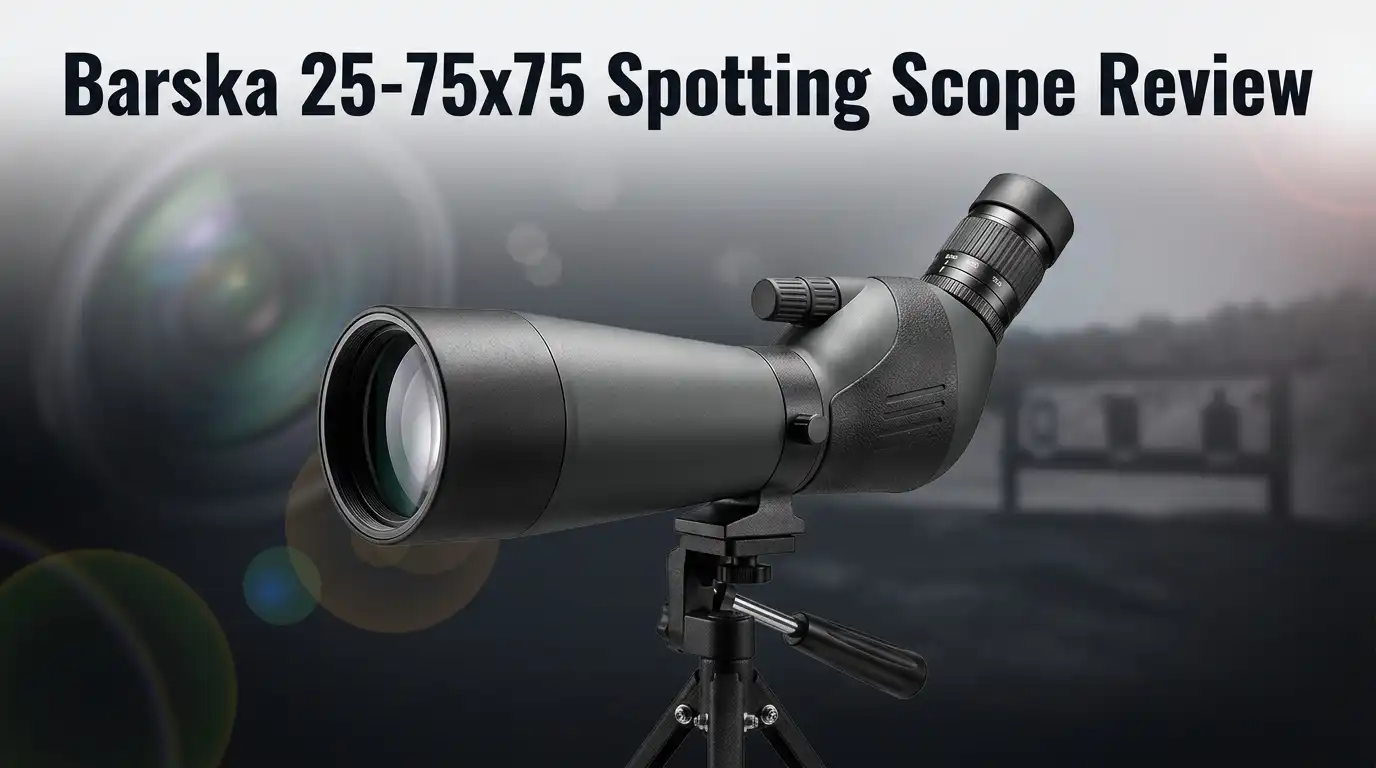
The Barska 25-75×75 Colorado sits right in that budget zone. It promises big magnification, a 75mm objective lens, and a tripod, all for a price that rarely crosses the three digit mark.
But budget optics always hide tradeoffs. Some are easy to live with. Others ruin the experience the moment you zoom past 40x. This review breaks down real performance, honest weaknesses, and who actually benefits from this scope in 2026. Read on before you spend a dollar.
In a Nutshell:
- Magnification range is generous, but only usable to a point. The scope zooms from 25x to 75x. Image quality stays acceptable through roughly 40x to 45x. Past that, brightness drops and details soften noticeably.
- The 75mm objective gathers decent light for the price. Morning and evening viewing works better than smaller 60mm budget scopes, though it still cannot match multi coated premium glass.
- Build quality feels solid in the hand. The rubber armored body resists bumps, and Barska lists it as waterproof and fogproof. The included tripod, however, is the weakest part of the package.
- Best suited for casual users. Backyard birding, range work at 100 yards, and campground wildlife watching all fit well. Serious birders and long range competitive shooters will outgrow it quickly.
- Value depends on expectations. At its typical street price, it delivers more reach than binoculars. It does not deliver the sharpness of scopes costing three times as much.
Barska 25-75×75 Colorado Spotting Scope Overview


Last update on 2026-09-25 / Affiliate links / Images from Amazon Product Advertising API Some of the links on this website are affiliate links, which means that at no additional cost to you, I earn a commission if you click through and make a purchase. I only recommend products and services that I believe will add value to my readers. Thank you for your support!
The Barska Colorado line targets entry level buyers. This model uses a straight body design, which means you look through the eyepiece in line with the barrel. Straight scopes suit ground level viewing and quick target acquisition from a seated position.
Inside sits a BK7 porro prism paired with fully coated optics. That is important language. Fully coated is not the same as fully multi coated. Fully coated means a single antireflective layer on the outer glass surfaces. Multi coated scopes apply several layers and transmit more light.
Barska includes a flip down lens cover, a grooved zoom dial, a soft carrying case, and a compact tripod. The package aims at buyers who want one purchase and no extra shopping trips. For many first time owners, that convenience matters more than lab grade optical charts.
Unboxing Experience: What Actually Arrives
The box is plain cardboard with product photos on the front. Nothing fancy. Open it and you find the scope wrapped inside a soft nylon case with a shoulder strap and a zip closure.
The scope itself feels heavier than expected. The rubber armor has a slightly tacky texture that grips well, even with damp hands. Pulling it out for the first time genuinely feels reassuring. The zoom ring turns with firm resistance, not loose wobble.
Then you reach the tripod. It is a small aluminum table top model with plastic locks. The weight difference between the scope and the tripod is immediately obvious. That contrast tells you the story of this product before you ever look through the glass. The flip down objective cover stays attached, which is a nice touch since loose caps get lost within a week.
Key Specifications at a Glance
The numbers matter, so here they are in plain terms. Magnification runs from 25x to 75x. The objective lens measures 75mm. The prism type is BK7 porro. Optics are fully coated. Close focus sits around 32.8 feet, or 10 meters.
Exit pupil shrinks as you zoom. At 25x you get roughly 3mm of exit pupil. At 75x that drops to about 1mm. This single fact explains most of the scope’s behavior. A 1mm exit pupil produces a dim, narrow view that your eye struggles to hold steady.
Body length runs close to 17 inches with the sunshade retracted. Weight lands near 3 pounds without the tripod. The body is listed as waterproof, fogproof, and shockproof. Barska backs it with a limited lifetime warranty, which adds peace of mind at this price.
Optical Performance in Real Daylight
Set the scope on a stable surface at 25x on a bright day. The view looks pleasantly sharp across the center, with a reasonably wide field. Colors appear neutral, maybe slightly warm. Edge sharpness falls off in the outer twenty percent of the view.
Push to 40x and the image holds together. You can still count fence posts, read large signage, and identify a robin from a cardinal at a hundred yards. This range is the sweet spot, and honestly it is where most owners should live.
Move past 50x and chromatic aberration becomes visible. Bright edges pick up purple or yellow fringing. Contrast flattens. At full 75x the image becomes dim and mushy on anything but a high contrast target. The top of the zoom range exists more as a marketing number than a practical setting.
Top 3 Alternative for Barska 25-75×75 Spotting Scope

Last update on 2026-09-25 / Affiliate links / Images from Amazon Product Advertising API Some of the links on this website are affiliate links, which means that at no additional cost to you, I earn a commission if you click through and make a purchase. I only recommend products and services that I believe will add value to my readers. Thank you for your support!
Barska Blackhawk 25-75×100 Angled Spotting Scope

Last update on 2026-07-01 / Affiliate links / Images from Amazon Product Advertising API Some of the links on this website are affiliate links, which means that at no additional cost to you, I earn a commission if you click through and make a purchase. I only recommend products and services that I believe will add value to my readers. Thank you for your support!
Celestron Ultima 20-60×80 Angled Spotting Scope

Last update on 2026-09-25 / Affiliate links / Images from Amazon Product Advertising API Some of the links on this website are affiliate links, which means that at no additional cost to you, I earn a commission if you click through and make a purchase. I only recommend products and services that I believe will add value to my readers. Thank you for your support!
SVBONY SV28 Spotting Scope with Tripod Bundle
How the Zoom Dial Feels in Use
The grooved zoom ring sits near the eyepiece. It turns smoothly with a thumb and forefinger. Resistance is even, with no sticky spots on the sample tested. That is better than many scopes in this bracket.
One real annoyance appears though. The scope is not parfocal. Change magnification and the image loses focus. You must refocus after every zoom adjustment. Several owners mention this same issue in their reviews, often describing it as an inability to focus at high power.
The fix is simple but slow. Find your subject at 25x, refine the focus, zoom up gradually, and refocus at each step. Do it quickly and you will think the scope is broken. Do it patiently and the image snaps in. New users should practice this on a stationary target before taking the scope into the field.
Build Quality and Weather Protection
The rubber armor covers the entire barrel. It absorbs knocks and quiets handling noise, which hunters appreciate. Drop it from waist height onto grass and nothing rattles loose.
Barska lists the scope as waterproof and fogproof. In practice, it survives rain showers and humid mornings without internal condensation. Treat it as weather resistant rather than submersible. Nobody should test it in a creek.
The retractable sunshade slides out to block glare and shield the front lens from light drizzle. It moves with friction, not a locking mechanism, so it can creep back in slowly. The tripod mounting collar rotates, letting you shift the eyepiece position. The lock knob holds firmly once tightened. Overall the chassis punches above the price, which makes the optical compromises easier to forgive.
The Included Tripod Is the Weak Link
Time for honesty. The bundled tripod is small, light, and made largely of plastic joints. It works on a picnic table. It struggles everywhere else.
At 25x the setup stays reasonably steady. At 50x, a light breeze makes the image dance. At 75x, your own pulse transmits through the legs. You will spend more time watching vibration than watching wildlife.
The fix costs money but transforms the product. A mid weight photo tripod with a fluid pan head, priced around the same as the scope itself, removes almost all shake. Many buyers report that upgrading the tripod improved their experience more than any other change. Budget for this from the start, and your opinion of the Barska will be far more positive.
Focusing, Eye Relief, and Eyeglass Users
The focus wheel sits on top of the barrel near the middle. It turns with moderate resistance and travels through the full range in roughly one and a half rotations. That is a reasonable balance between speed and precision.
Eye relief is short. People who wear eyeglasses will find the full field difficult to see. The rubber eyecup folds down, which helps somewhat, but spectacle wearers often report a visible black ring around the edge of the view.
Close focus sits near 33 feet. That rules out close range butterfly or insect observation, a task where higher end birding scopes shine. For distant subjects it poses no issue at all. Contact lens users get the better experience here, plain and simple.
Field Use for Birdwatching
Birders sit in a demanding group. They want color accuracy, bright images at dawn, and quick focus on moving subjects. The Barska meets some of those needs.
At 25x to 35x, identifying waterfowl across a pond works fine. Plumage patterns show clearly on ducks, herons, and raptors. Songbird identification in shaded woods is much harder, because the modest light transmission limits detail in dim conditions.
The straight body design suits scanning across open water and fields from a seated chair. Users who observe from elevated positions, looking downward, may prefer an angled scope instead.
Verdict for birders: this works as an introduction to the hobby. If bird identification becomes a serious pursuit, you will want a multi coated ED glass scope within a year or two.
Field Use at the Shooting Range
This is where the Barska performs best relative to price. High contrast paper targets suit modest optics. Black holes against white paper are easy to resolve.
At 100 yards, spotting .22 caliber holes works reliably around 30x to 40x. At 200 yards, .30 caliber holes remain visible in good light, though you may need to wait for heat shimmer to settle. Mirage limits every scope at this price, not just this one.
Beyond 300 yards, calling small caliber shots becomes guesswork. You will see impact splash in dirt, but not precise hole placement on paper. Range users who shoot at 100 yards get real value here. Long range precision shooters should look at scopes with ED glass and better coatings.
Digiscoping With a Smartphone
Barska does not include a phone adapter with this model. You will need to buy one separately, and universal clamp adapters fit the eyepiece diameter without trouble.
Phone photos through the scope look acceptable at low magnification. Expect soft edges, visible vignetting, and color fringing on bright subjects. Social media sharing works fine. Printed photos will disappoint.
The bigger problem is stability. Attaching a phone adds weight and creates leverage on the small included tripod. Every tap on the screen shakes the image. A sturdier tripod plus a shutter timer solves most of this.
Treat digiscoping as a fun bonus, not a reason to buy. If photography ranks high on your list, a scope with better coatings and a dedicated adapter mount serves you far better.
What This Scope Does Not Do Well
Authentic reviews name the flaws. Here are the honest ones.
Magnification above 50x is largely unusable. The image dims, softens, and loses contrast. Treat the top third of the zoom range as a bonus, not a feature.
Low light performance disappoints. BK7 prisms and single layer coatings simply cannot compete with BAK4 glass and multi coating. Dawn and dusk sessions end earlier than you would like.
Refocusing after every zoom change slows you down. Fast moving subjects get away.
The tripod cannot support the scope’s own potential. Eyeglass wearers lose part of the field. Close focus at 33 feet limits nearby observation. None of these are dealbreakers at the price, but pretending they do not exist would be dishonest.
Pros and Cons
Pros
- Large 75mm objective gathers more light than typical 60mm budget scopes in the same price bracket
- Rubber armored body feels durable and handles rough treatment well
- Waterproof and fogproof construction survives real outdoor weather
- Complete package includes tripod, soft case, and flip down lens cover
- Smooth zoom ring with good tactile feedback
- Barska limited lifetime warranty adds long term confidence
- Excellent value for range shooting at 100 yards
Cons
- Image quality collapses above 50x magnification
- Fully coated optics transmit less light than multi coated alternatives
- BK7 prism produces visible edge softness and color fringing
- Included tripod is too light and flexible for high magnification use
- Scope requires refocusing after every zoom adjustment
- Short eye relief frustrates eyeglass wearers
- Close focus distance of 33 feet limits nearby viewing
- No phone adapter included
Who Should Buy the Barska 25-75×75
This scope fits specific people very well. Casual nature watchers who want more reach than binoculars will enjoy it. Setting it on a deck rail to watch a distant hillside is genuinely satisfying.
Recreational target shooters at 100 yards get strong value. Paper targets are high contrast subjects, and the scope handles them competently at moderate power.
Parents buying a first optic for a curious kid will appreciate the tough body and the low replacement cost. Nobody panics when a twelve year old drops a budget scope.
Skip it if you are a dedicated birder chasing warblers in dim forest, a long range precision shooter, or a wildlife photographer. Those pursuits demand ED glass and multi coated optics. Buying cheap twice costs more than buying properly once.
Price and Value in 2026
Spotting scope pricing shifted over recent years. Direct to consumer brands pushed multi coated BAK4 scopes into the same price territory the Barska once owned alone.
That competition changes the math. The Barska still competes on build quality and brand warranty support, two areas where newer online brands sometimes fall short. Barska has operated since the mid 1990s and honors its warranty claims.
Value here depends on how you shop. At a deep discount, this scope is an easy recommendation for casual use. At full retail, alternatives with better coatings deserve a serious look.
One practical tip: compare the total cost. A cheaper scope plus a required tripod purchase may cost more than a bundled option. Always price the complete setup, not just the tube.
Final Verdict: Should You Buy It?
Last update on 2026-09-25 / Affiliate links / Images from Amazon Product Advertising API Some of the links on this website are affiliate links, which means that at no additional cost to you, I earn a commission if you click through and make a purchase. I only recommend products and services that I believe will add value to my readers. Thank you for your support!
The Barska 25-75×75 Colorado is an honest budget scope with one oversold number on the box. The 75x figure attracts buyers and then disappoints them. Ignore it, live at 25x to 40x, and the scope becomes genuinely enjoyable.
The body quality impresses at this price. The 75mm objective delivers usable brightness. The warranty removes long term risk. Those three things carry the product.
The tripod holds it back, and the single layer coatings limit low light use. Both are fixable or forgivable depending on your budget and expectations.
Recommendation: buy it if you want affordable long distance viewing for casual outdoor use or short range target work. Pair it with a better tripod. Skip it if serious birding or precision shooting is your goal, and save toward a multi coated ED scope instead.
Frequently Asked Questions
Is the Barska 25-75×75 good for bird watching?
It works for beginners watching larger birds at moderate distance. Waterfowl, raptors, and shorebirds show clearly at 25x to 35x in good light. Small songbirds in shaded woods are much harder to identify because the fully coated optics limit light transmission. Dedicated birders should consider a multi coated scope with BAK4 prisms.
Can you actually use the full 75x magnification?
Rarely. Usable image quality ends around 45x to 50x in most conditions. At 75x the exit pupil shrinks to roughly 1mm, producing a dim and soft view. Atmospheric heat shimmer makes it worse on warm days. Treat the top end as an occasional bonus for high contrast targets in perfect light.
Does the included tripod work well enough?
Not for high magnification. The bundled table top tripod handles 25x acceptably on a stable surface. Above 40x, vibration becomes a constant distraction. Most owners who upgrade to a mid weight tripod with a fluid head report a dramatic improvement. Plan for this purchase if you want the best results.
Is this scope waterproof?
Barska lists the scope as waterproof and fogproof with a sealed, nitrogen purged body. It handles rain, snow, and humid conditions without internal fogging. Do not submerge it. Treat the rating as protection against weather, not a guarantee of underwater survival. Dry the exterior and lens surfaces after wet outings.
How far can you see with this spotting scope?
Distance depends on target size and light. Paper targets at 100 yards show .22 caliber holes clearly. At 200 yards, larger caliber holes remain visible in good conditions. For wildlife, you can identify a deer at a mile and read large signage several hundred yards away. Atmospheric conditions limit performance more than the optics on many days.
Is it good for eyeglass wearers?
Not particularly. Eye relief is short, so spectacle wearers often see a dark ring around the field edge. The rubber eyecup folds down and helps a little. Contact lens users get the full field without difficulty. If you must wear glasses while viewing, check the eye relief specification on alternative scopes before buying.
What is the difference between straight and angled spotting scopes?
A straight scope lines the eyepiece up with the barrel. It suits seated viewing across flat ground and makes target acquisition faster. An angled scope positions the eyepiece at 45 degrees, which helps when viewing upward, sharing with people of different heights, or observing from a standing position. This Barska model uses a straight body design.

Hello, I’m Emily Price, the founder of Birds Affection. As a passionate bird enthusiast and spiritual seeker, I’ve always been fascinated by the symbolic meanings and mystical connections between birds and our lives. On this website, I share my knowledge and insights on the spiritual significance of various bird species, exploring their roles as messengers, guides, and teachers. Through my writing, I aim to inspire and educate others on the profound wisdom and beauty that birds bring to our world. Join me on this journey as we delve into the enchanting realm of bird symbolism and discover the hidden meanings behind these magnificent creatures.